
 by
by To hear the podcast click here
David Capes
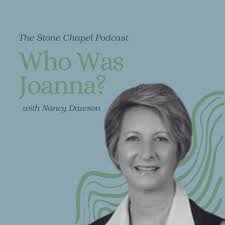
Hi everybody, and welcome to The Stone Chapel Podcast. My name is David Capes. Joining me today is Dr Nancy Dawson, who has been with us before, several times to talk about remarkable women in the Bible, and she’s working on this amazing book called All the Women of the Bible. We’re going to be talking today about one of those women, and her name is Joanna. Dr Nancy Dawson, welcome back to The Stone Chapel Podcast.
Nancy Dawson
Thank you, Dr. Capes!
David Capes
You’ve been here before to talk about the women who are mentioned in the genealogy of Jesus in the Gospel of Matthew. And you’ve also been here before to talk about your book, All the Genealogies of the Bible. You’re working on another one called All the Women of the Bible. Tell us about that project.
Nancy Dawson
There was a theme there. It’s a very exciting project. Broadman and Holman have asked me to write that book. Of course, it covers Old Testament and New Testament women. There’s around 350 women. So it’s a comprehensive, and a little bit daunting task, But very exciting and insightful to see the roles that women have. And why are they there? Why are they mentioned? How do their stories dovetail with what else is going on in the narratives and their overall importance. When you look at a fleshed out view of the women, you see how important they are. They do counter cultural things. I see that they foreshadow many of the characteristics of Christ and also divine characteristics. Through their actions, sometimes words, but definitely through their actions, they do these remarkable things. They are noteworthy.
David Capes
All right, so when should we be able to go to Amazon or go to our local bookstore and pick that up?
Nancy Dawson
It’ll probably be a couple of years. I’m in the middle of the research right now, which I enjoy so much, but getting that down into words and edited takes time.
David Capes
You like the research better or the writing better?
Nancy Dawson
I definitely like the research better. That’s my background but I’ve always been interested in teaching the Bible and writing about men and women.
David Capes
Well, you’re a great teacher. I’ve seen you teach here. I’ve had you come to the course I teach for Truett seminary on the gospels and the book of Acts. You’ve done a great job in those classes. You’re a good teacher as well as a good researcher, and a great writer.
All right, Joanna, let’s talk about Joanna. Joanna is a person that a lot of people may not know very much about. She’s mentioned in passing in some ways, but she’s mentioned in some very important times and places. Let me read one of these texts from the Gospel of Luke. And it’s Luke, chapter eight, verse one.
Soon afterward, he (Jesus) went on through the cities and villages, proclaiming and bringing the Good News of the Kingdom of God. And the 12 were with him, and also some women who had been healed of evil spirits and infirmities. Mary called Magdalene, from whom seven demons had gone out, and Joanna, the wife of Chuza, Herod’s household manager. And Susanna and many others who provided for them out of their means.
Nancy Dawson
Remarkable. Number one, you probably haven’t ever heard a sermon about her, but she’s this Galilean aristocratic woman who is healed by Jesus of evil spirits, along with Mary Magdalene and Susanna. And remarkably, she becomes a disciple or follower of Jesus. The text says that she’s the wife of a Herodian official. And of course, they’re talking about Herod Antipas, who was the successor of Herod, the Great, his father. And this is a real poignant place in the text that tells you about her background and what information she might have about that royal court. And then, she becomes this faithful follower throughout Jesus’s ministry, and she’s going to be a witness, along with other women, to the crucifixion and the empty tomb.
David Capes
She’s gone from Galilee at that point, the Galilean ministry, down to Judea, so she’s traveled with them. Is that correct?
Nancy Dawson
Yes. Her name means “God has given graciously”. She’s named after her father, which might be common these days. Her father’s name was John or Yohanan, and this was a common practice in the Second Temple period. There was research done by a wonderful scholar named Tal IIan, who worked on Jewish women in the Greco Roman world and about 3- 4% of the women are called Joanna. It’s a very common name. Around 46% of the women are called Mary. So, this is why you always see terms of disambiguation for the Mary figures, like Mary of Magdala or Mary mother of Jesus.
And some scholars have speculated that she should be equated with the Junia figure of Romans 16. I don’t adhere to that, but some scholars have said this is a possibility, but they’re usually very tentative, in making that association. She’s married to Herod Antipas’ steward named Chuza. He was an appointee of Herod and had a lot of court responsibilities, overseeing his estates, possibly acting like a steward or a guardian over the ones that would be up and coming for inheritance under Herod Antipas.
David Capes
And they lived in Tiberias you said.
Nancy Dawson
They lived in Tiberias, which was on the western shore of the Sea of Galilee. That town was basically built by Herod Antipas around AD 18-20 but noteworthy is it was built over a cemetery, and so this is not something that goes down well.
David Capes
That’s not really kosher! Tiberias is a thriving city today. If you go to Israel, you’ll see it on that western shore.
Nancy Dawson
It’s part of Galilee. It’s one of the major cities. Jesus grew up in this small Nazareth hometown in the Sepphoris area and so that’s the general area. But what we see with Joanna is that she’s definitely from this elite, aristocratic background. She’s Jewish, and whether her husband was a believer or not, is not clear.
David Capes
You mean a believer in Jesus?
Nancy Dawson
In Jesus. She seems to be a type of informant, both to the Herodian court and also to Jesus and his followers of what’s going on. More than once she said Herod Antipas has heard about Jesus, and he’s curious, and he wants to see him. But he wants to see him so that he’ll perform a miracle for them.
David Capes
He wants to see a show, doesn’t he?
Nancy Dawson
Yes, that’s exactly right. But you can see that there’s this definitely negative overlay. She’s from a wealthy background, so has the luxury of the socially elite. Also, this is a highly Romanized place. The Jews do not like the taxation. They do not appreciate any of the political domination, the economic exploitation. Heron Antipas actually had to pay people to come and live in Tiberias.
David Capes
Like Alaska today, you have to pay people to go live up there. There’s a couple of things I found fascinating from this. She’s mentioned specifically, as well as Susanna, as providing for Jesus and his ministry out of their own means. Let’s discuss that part of it.
Nancy Dawson
These women are following Jesus and that’s strange and counter-cultural for the day. You don’t hear about women being in the entourage of John the Baptist. This is something you hear about only with Jesus. So, this is very striking for that time. Jesus invites women and approves of them being a part of a mixed entourage. So that’s very noteworthy.
What you see is that she is supporting Jesus out of her own personal finances. There was a great book written in 2002 by Richard Bauckham called Gospel Women, and he researched where women would have the ability to have discretionary funds that they could use, possibly separate from their husband. Because Chuza may not have been supportive of this. She has at least some disposable funds at her discretion.
And there’s seven sources. One is that you could have inheritance from your father. Usually, this is like the prodigal son. The father is dead, and then you receive it. But there’s also property that can be acquired by a deed of a gift from your father or mother or your husband. That she could use also. There was at the time of marriage, ketubah money, the marriage contract money. That was what her husband would pay to her in case they were ever divorced or something would happen to him.
David Capes
A prenuptial agreement in a way,
Nancy Dawson
Exactly, yes. She could have tapped into that. The dowry that was paid by her husband to her father, sometimes that is given to the daughter.
David Capes
This could be considerable money that you’re talking about.
Nancy Dawson
Yes, or possibly property. Something like Barnabas, who sold his property to support the ministry. And it could be something like this that she availed, this source of funds and monies to give. And this is so consistent with her name which means “God has given graciously”. Then you see that she, in turn, gives graciously. This is a striking aspect of ministry.
David Capes
There’s a lot of talk these days among scholars about benefactors and patrons and those kinds of things. Benefaction is a particular kind of giving, but what I hear you saying is this is not really “benefaction.”
Nancy Dawson
Not according to that traditional female patron benefactor role where a wealthy person is giving money or provisions for a community in return for status or honor. Instead, she actually joins this itinerant band of followers of Jesus. She is not regarded in any special way. We know from the story of the widow with two mites, she gave everything that she had, and so that was what was praised. Not how much you give, but that you give willingly and graciously. And this is what she does.
David Capes
It’s striking to me that she leaves behind a rather a luxurious life for this itinerant life, sleeping in tents and walking lots of distance and probably doing lots of washing clothes at the river, those kinds of things.
Nancy Dawson
Yes. We don’t really know. The text is silent on what these women actually do. But Luke is so poignant in mentioning this; that it’s women who support the ministry. It doesn’t mean that men did not support the ministry, but Luke is making a statement on what is generally true. And so, you see the mention of her in a Luke 8:3 and then we’re going to see that Luke mentions her again in Luke 24. There’s an inclusio, a literary inclusio about Joanna that I find is again, remarkable.
David Capes
Let me read that text. We’re looking at Luke 24:9.
Now at daybreak on the first day of the week Jesus had been discovered as raised from the dead. Then they, (that is these women) who observed this returned from the tomb and announced all these things to the eleven and all the others. The women were Mary Magdalene, Joanna and Mary, the mother of James, and others who accompanied them, also told this to the apostles. But their story, (that is, the women’s story,) seemed like nonsense, so they did not believe them.
What do you learn from that?
Nancy Dawson
The testimony of women was considered unreliable. I think it was J.D. Atkins on one of the Exegetically Speakingpodcasts that said the old lexicons say that sounded like hum-bug. It’s like just an old wives tale. We’re not going to believe that. It’s just a silly tale that women are saying. But what you see is in all the Gospel accounts, it is women who are present at the crucifixion, at his burial, at the empty tomb and at the resurrection. Now John 19:25 also mentions one of the disciples that was at the crucifixion, and that was John the Beloved Disciple, but you don’t hear any mention about men. And again, this is noteworthy. These women have a staying power, a presence, even in these difficult moments. They’re not running away.
They’re not afraid. They’re there at the crucifixion and they’re at a distance, it says. But then at the burial, they’re taking spices to the tomb of Joseph of Arimathea; and they prepared the body, but because it was a Sabbath, it wasn’t completed. It was done in haste.
David Capes
They had to, by the rules the Sabbath, stop what they were doing with the idea that the when the Sabbath is over, the first day of the week has arrived, which was a day of work, then they would go back finish the job.
Nancy Dawson
And so, this is what the women do. They complete this proper burial ritual. They prepare spices and take them in. They complete that process. But when they arrive at the empty tomb, two angels are there, and they say to the women,
“Why are you looking for the living among the dead? He is not here, but he has risen.”
And the next phrase that’s used is,
“Remember how he spoke to you when he was still in Galilee, and He would be crucified and rise on the third day”.
And then they remembered his words.
David Capes
In other words, the women were there when Jesus was saying all this.
Nancy Dawson
Yes. You see that they don’t even have to touch Jesus or eat with Jesus, or remember the scriptures. They remember his words. And this is what we’re all called to do, is recall the scriptures, recall what Jesus has said. And so, they become these incredible eyewitnesses and servants. Joanna left a life of ease. She reminds me a little bit of Old Testament Abigail, who was married to Nabal, the fool. And she leaves that life of luxury and becomes a wife and follower of the Son of David, and so, there’s these interesting parallels.
David Capes
Yes, there are interesting parallels. What’s one thing you take away from Joanna as you think about your own life here in the 21st Century?
Nancy Dawson
What I see is that we always need to be flexible. We need to consider and be ready to leave that life, that maybe we have had, and be willing to follow a new path. And that Jesus can use you with whatever you bring. For Joanna it was possessions, but it was also a kind of fidelity, and this is what we’re called as Christians to do. And Luke probably uses Joanna as a source for information. The material that’s unique to Luke is called the L material in text criticism. She is giving these personal insights. This is what we all bring. It’s a personal insight. God can use you and remake you. And transform you.
David Capes
I like the idea that Luke is naming his sources, throughout the gospel. He does it, I think, with Mary as well, and in an earlier passage. This is a great, great help, honestly. Maybe somebody will feel now they need to do a sermon on Joanna and encourage women and others who are there, who have the ability to give a gracious gift and be a gracious blessing. Dr Nancy Dawson, thanks for being with us today on this podcast.
Nancy Dawson
Thank you so much.
Description
Dr. Nancy Dawson is back on The Stone Chapel Podcast to talk with Dr. Capes about a woman in the New Testament who followed Jesus. Few could name her or tell us anything about her. Her name is Joanna. She came from elite circles to follow the Nazarene in a less than luxurious life. Luke tells us (Luke 8:1-3) that she supported Jesus’ work financially and was a close follower of him.
 A Word in Edgewise
Leave a comment