Page 13 of 17

The Wife of Jesus

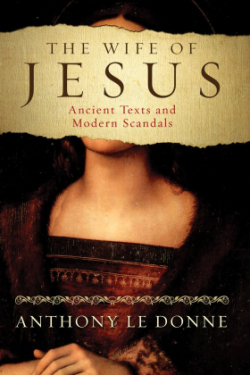
Anthony Le Donne is a young scholar who has tackled some tough subjects.  In this particular book he addresses the question recently on a lot of minds: Was Jesus married?  The book is entitled: The Wife of Jesus: Ancient Texts and Modern Scandals.  It is published by Oneworld Publications in London.  The first copyright is 2013 so I’m a bit late telling you about it.wife-of-jesus
Although the question whether Jesus was married has been around a long time, Dan Brown’s The Da Vinci Code certainly kindled everyone’s imagination.  If you’re prone to sensational readings of history and wish to see conspiracies under every rock, then Brown is your guy.  More recently ,the announcement and publication of the badly named Gospel of Jesus’ Wife made it a matter of scholarly concern.  I’ll have more to say about that later, but what Le Donne has done is to take a controversial subject and make sense out of it historically and socially.  Perceptively, he notes that the modern response to the question—whether excitement or repulsion—has more to say about us than it does the historical Jesus.  In many ways the question of whether Jesus was married and how we respond to it provide a mirror of ourselves and our times.  In the final chapter he writes: “This book, in large part, has been about ancient and modern attempts to project sexual identities onto Jesus” (p. 147).

Le Donne examines a wide variety of texts from the ancient world,  accounts about the asceticism of John the Immerser in the NT Gospels to non-canonical accounts which some people take to describe an intimate relationship between Jesus and Mary Magdalene in the Gospel of Philip.  Le Donne reads widely in Greek and Jewish sources contemporaneous with Jesus and in the first half of the Christian century.  He seems to be able to argue for it—yes, it is likely Jesus was married as was typical of most Jewish men­—and against it­—no, there is no solid historical evidence he was married.  As a historian, Le Donne knows the difficulty of arguing from the general to the particular.  What is true of most people is not necessarily true of a particular person.   Though most Jewish men married between the ages of 20 and 30, not everyone did.  There was already an impulse toward asceticism and self- denial in Jesus’ day.  John the Immerser and the desert covenanters of Qumran appear to offer contemporaneous examples.

Le Donne offers a helpful construct for what was typical of Jewish males in the first century.  The term he uses is “civic masculinity”; it represents the gender role most Jewish men would play in their day.  It would include things like marriage and having children, working a trade and taking responsibility for one’s economic well-being, passing the faith along, seeking to own and work the land, etc.  Jesus, according to Le Donne, may have been raised to accept this role, but he may have subverted it in his public ministry.  Jesus , he says, “invested in the two-sided coin of economic disobligation and celibacy.”  Such a lifestyle was probably considered “crazy” by ancient standards and “anti-family” by modern.

Mark Goodacre, NT Professor at Duke University, says it well: Le Donne’s book is “a crystal-clear, compelling yet historically robust account of what we can and can’t know about the wife of Jesus.”

Reading Backwards: Toward a Figural Christology

Recently I had the privilege of serving on a panel discussion at the Lanier Theological Library.  The topic of the seminar was “Reading Backwards: the Old Testament in the New.”

Other panelists included

Richard Hays, Dean of Duke Divinity School/ Professor of New Testament

Lynn Cohick, Professor of New Testament at Wheaton College

Carey Newman, Director of Baylor University Press

Mark Lanier served as the moderator of the panel.

Here is a link to the video:

http://www.laniertheologicallibrary.org/seminar-videos-2/

The audio on the file is hard to listen to at points.  Still it is worth the effort!

Jesus in the Canonical and Gnostic Gospels

Recently, I had an opportunity to be on a panel discussion with Simon Gathercole, Peter Davids, and David Chapman.  The topic is “Jesus in the Canonical and Gnostic Gospels.”  The seminar took place in the beautiful chapel at the Lanier Theological Library.  Mark Lanier, the founder of the library, served as moderator or should I say cross-examiner.

Here is a link to the video: Jesus in the Canonical and Gnostic Gospels

If this does not work, please paste the following URL in your web-browser:

Seminar Videos

Xmas: Is It Really Taking Christ out of Christmas?

I remember my fourth grade teacher, Mrs. Potts, opening a vein when anyone wrote “Xmas” instead of “Christmas.”  She felt there was a war on Christmas  and that people who abbreviated the name of the holiday were trying to take Christ out of Christmas.  I suppose that is true for some people, but when you look into the real story of “Xmas” you realize that something else is at work.

The story begins with the Ten Commandments.  One of those commandments says, “Do not take the name of the LORD in vain.”  The name by the way is not “LORD,” that was a respectful translation or substitute for the name.  In Hebrew THE NAME is four letters, yodh-he-vav-he. The technical term for the name is the tetragrammaton (literally, “the four letters”).  Scholars today think the name may have been pronounced—when it was pronounced—Yahweh or Yahveh.  But we aren’t sure.  This was the covenant name of God, the name revealed to Moses and Israel at Mt. Sinai. nomina_sacra

Under the influence of the commandment about the misuse of God’s name, the faithful spoke it less and less.  By the time of Jesus speaking the name was considered blasphemous in almost every circumstance. The rabbis made their mark by building a hedge about the law. If you never spoke God’s name, you could never be guilty of taking the name in vain. It was a way of safeguarding the name.  Even when reading Scripture in the synagogue, a substitute word was used.  In Aramaic-speaking synagogues the readers said “Adonai.”  In Greek-speaking synagogues they said “kyrios.”  Both mean something like “Lord” or “Master.”

The Dead Sea Scrolls provide good evidence for how the name of God was written in the centuries and decades leading up to the New Testament era.  In many of the biblical scrolls the name of God is written in paleo-Hebrew script.  That would be like shifting to a Gothic font when writing the name of God.  In other scrolls the name is not written at all; it is represented by four, thick dots written in the center of the line. In yet other scrolls where the name of God should be there is a blank in the line just large enough for the tetragrammaton.  Scholars theorize that the blank was left by a junior scribe and would have been filled in later by a senior scribe who had permission to write the name. Where there is a blank in the line, we think the senior scholar never got around to writing the divine name in the blank. These were some of the ways the faithful showed respect for the name of God.

Early Christians developed their own way of signaling respect for the names and titles associated with God the Father, God the Son, and God the Holy Spirit.  Copying the New Testament books in Greek, they abbreviated the names (usually first letter and last letter) and placed a line above those letters. You can see this in the picture.  Scholars refer to these as nomina sacra (Latin for “sacred names”).  Copyists continued to write sacred names this way for centuries.  It remains a common practice still among artists who create the icons used in the eastern churches.  Many names and titles were written this way including “God,” “Father,” “Jesus,” “Son of God,” “Son of Man,” “Christ,” “Lord,” “Holy Spirit.” For our purposes note the nomina sacra for “Christ;” it was written XC. Now remember these are letters from the Greek alphabet not our Latinized version. It is not “X” (eks) the 24th letter of our English alphabet but the Greek letter “Chi,” the first letter of the title “Christ.”

Earliest versions of writing Christmas as “Xmas” in English go back to the Anglo-Saxon Chronicle (about 1100).  This predates the rise of secularism by over 600 years.  The Oxford English Dictionary cites the use of “X-“ for “Christ” as early as 1485.  In one manuscript (1551) Christmas is written as “X’temmas.”  English writers from Lord Byron (1811) to Samuel Coleridge (1801) to Lewis Carroll (1864) used the spelling we are familiar with today, “Xmas.”

The origin of “Xmas” does not lie in secularists who are trying to take Christ out of Christmas, but in ancient scribal practices adopted to safeguard the divine name and signal respect for it.  The “X” in “Xmas” is not the English letter (eks) as in “X marks the spot,” but it is the initial Greek letter “Chi” (X), the first letter of the title “Christ.”  No doubt some people today use the abbreviated form to disregard the Christian focus of the holy-day, but the background tells a different story, a story of faithful men and women showing the deep respect they have for Jesus at this time of year.

Merry Christmas or should I say “Merry Xmas”!


How God Became Jesus

How God Became Jesus

I’m heading to San Diego to attend the Annual Society of Biblical Literature meeting.  I’m meeting with former and future publishers, scholars, and a variety of former students.  One of my duties while there is to preside over a session of a program unit called The Extent of Theological Diversity in Earliest Christianity.  The session will offer a panel review of Bart Ehrman’s new book, How Jesus Became God: The Exaltation of a Jewish Preacher from Galilee.  The title and subtitle tells you the essential story; Ehrman suggests that Jesus was understood first as Jewish itinerant teacher from Galilee; only later did his disciples claim he is divine.  How much time goes by he does not say, but apparently he thinks in some circles it happened early even though it took centuries for the language to be worked out in church councils.  Accordingly, Jesus didn’t regard  himself as divine in any sense, nor did his earliest disciples.  Jesus was, in fact, an apocalyptic prophet who announced the end of the current evil age.  He did believe and describe himself as the coming king of God’s future reign, the Messiah of God. Once the disciples came to believe that Jesus had conquered death and was exalted to God’s right hand, they came to hold to his divinity.  It is an important new book, some say his most significant book to date.How Jesus Became God

The book is published by HarperOne, an imprint of Harper Collins.  Interestingly, when Bart’s book was being prepared, someone got the idea to commission a group of other scholars to respond to the book. This happened  at Zondervan, which is now part of the Christian Publishing Group of . . . yep, Harper Collins.  Nice stroke.  Both ways, they win.  “Heads, I win. Tails, you lose.”  So editors at Zondervan appointed Michael F. Bird  of Ridley College in Melbourne, Australia to edit the book, and he assembled an impressive group of internationally recognized scholars to answer various aspects  of Bart’s book.  Their book is entitled How God Became Jesus The Real Origins of Belief in Jesus’ Divine Nature.  On the cover it also says it is “a response to Bart D. Ehrman.”  The scholars Bird assembled include: Craig Evans, Simon Gathercole, Charles Hill, Chris Tilling.  Each scholar takes on a different challenge.  For example, Craig Evans addresses the question of burial practices at the time of Jesus.  Ehrman claims Jesus was not buried; instead, in keeping with what happened with other crucified persons, Jesus’ corpse became food for scavengers. If there was no burial, there could be no empty tomb, so those traditions must have been invented by early Christians convinced Jesus  somehow conquered death.  Professor  Evans presents evidence that crucified people were occasionally buried and makes the further claim that Jesus must have been one of them.  This is the way it goes.  Point.  Counterpoint.How God Become Jesus

Both books make an important contribution to the study of early Christianity, in particular how early  Jesus’ followers came to regard him as divine.  In the history of the west and of the Christian church this may well be one of its most significant chapters.