
 by
by 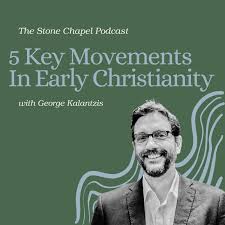
To hear the podcast click here.
George Kalantzis
Hi. I am George Kalantzis, and I teach theology at Wheaton College, where I also direct the Wheaton Center for Early Christian Studies.
David Capes
Dr George Kalantizis, welcome to The Stone Chapel Podcast. It’s a great pleasure to be with you. We are here at the Lanier Theological Library. You’re going to be teaching a class on early church history beginning tonight for our certificate program. I have to tell you, there’s been a lot of excitement around this class.
George Kalantzis
Thank you. It’s a great opportunity to try to do 500 years in five hours!
David Capes
That’s all we’ve given you for 500 years? I don’t know what that boils down to per decade or per century, but maybe just one hour per century. It’s going to be coming pretty fast. You’re working on some other projects as well. What are you working on now?
George Kalantzis
I’m finishing a book right now on seven questions that framed and shaped the Christological discussions in the first six centuries. Basically, how did the answer, any answer to Jesus’s question, “who do you say that I am”, frames and brings further questions that need further clarity. And in that process, how the church developed a grammar and a lexicon on how to understand and how to speak of the one we worship.
The other project is on the theology of refugees. It’s not a theology for refugees, but it’s a theology of refugees. I’ve been working with the International Association for Refugees for almost a dozen years now. Refugee work in southeast and the eastern part of Africa, hearing the voices of our brothers and sisters who have been displaced. Who have been forcibly displaced, seeking refuge. How do they see God? How do they hear God? Who does God reveal himself to be to them? It’s the same God we worship. Based on our location where we are as we speak of God and expect to hear God in particular ways. They hear God differently. Their emphasis, for example, is a lot more on the Old Testament. The emphasis is on the prophets and the messages of the prophet, the emphasis on the liberation from oppression.
David Capes
That’s what they know, that’s what they’re experiencing.
George Kalantzis
That’s their experience. God is a lot more, can I use the word tangible, to them than perhaps the God of the universe is to us.
David Capes
A lot of times, people think of God in a far-off way. As in, I’m going to God one day when I die. But they have to begin to see God working in their lives, working in history.
George Kalantzis
Yes, even in relationships.
David Capes
Yes, which is very scary, because they have been, as you said, forcibly displaced. They’re not there in Khartoum or some other place because they want to be. They’ve been forced there by some power, some political power.
George Kalantzis
Political, economic, health. They’re fleeing cholera. They’re fleeing famine. They’re fleeing civil war. They’re fleeing militias. Ten or twelve years ago I remember a question from Pastor Steven, a Presbyterian pastor of South Sudanese. When he spoke, he lifted his left arm, half of it was missing because he was cut off by a machete in an attack. And when we asked him, what do you expect from the next week that we’re going to be together.
He raised his hand and said, by the end of the week, I want to be able to forget. Forget that I had to dig with my hands a shallow grave to bury my wife as we were fleeing the conflict. He never stopped being a pastor. He never stopped being a man of God, and now he’s one of the leaders of the Christian movement in refugee camps. But that relationship is a very different relationship with God and certainty of God than perhaps I have in the suburbs of Chicago.
David Capes
Living in easy circumstances. I can’t wait to see that book. Eerdmans is publishing that. Today we’re going to turn our attention to the history of the Christian faith and discuss briefly, the first 500 year period of the early church. From the time roughly toward the end of the first century, into the fourth, and fifth centuries. What are you going to be talking about in that class?
George Kalantzis
All stories begin with Alexander the Great.
David Capes
You say that because you were born in Athens!
George Kalantzis
You don’t have a middle name of “the” for nothing! We’re going to work through five movements, some of the five key developments in the story of Christianity. And it’s not just simply church history; it’s history of Christianity. In other words, more broadly as a movement than just simply ecclesial. The first one is the break with Judaism. How do the two faith traditions, by the end of the first century, beginning into the middle of the second century, start moving away from one another?
David Capes
Yes, because they’ve been mostly one [people].
George Kalantzis
They have been. It sometimes surprises people when I remind them, Jesus was a Jew. So, we’re all the apostles.
David Capes
Yes, everybody that wrote the New Testament.
George Kalantzis
That’s right. But then we have varying discussions, especially in the second century, as Christianity moves beyond the Judea centered experience into the diaspora experience. That’s where we have interactions with Hellenistic or diaspora Jews and Hellenistic Christians or pagans converted to Christianity. To whom do the scriptures belong? And by that, they mean the Hebrew Bible. What happens with the law? Do we keep the law? Who are the true people of God? That has can be seen perhaps as a bit theoretical. But the lived experience of these people is not just simply theoretical. Because being a Jew, or of the genus of the Jew, as the Romans would recognize them, the religion of the Jews carried with it legal standing. Being a Christian did not carry that.
David Capes
It was a new thing, a new religion [as far as the Romans are concerned].
George Kalantzis
It was a superstition. We had no legal standing. So, do Christians claim the status of the Jew? Do the Jews claim the Christians as their team? How does that work? Fundamental break with Judaism that happens both in theology, but also in legal standing and in outlook.
The second is the movement of interacting with the world around them, because now we’re moving from a Jewish environment such as Palestinian, Judea, Samaria, Benjamine to a much broader environment that is Hellenistic, with its culture, with its philosophy. And we have a variety of Hellenistic Judaism, but also Philo in Alexandria, in Ephesus. But also we have middle Platonism. We have middle philosophical systems that are operative, about God, about ontology, about metaphysics, about morality. So how do Christians adopt, adapt, and interact with those philosophical systems? In the beginning was the logos.
David Capes
You’ve got a pretty important Greek term there.
George Kalantzis
That’s right. What do you want to do with that? We’re going to bring that all the way up to the second, end of the second century, beginning of the third with Tertullian of Carthage, the first great Latin theologian who gave us words and concepts like trinitas, trinity to describe what is “three in one” God. Sacraments, etc.
So how does Christian movement interact with, adopt and adapt aspects of Greco-Roman culture and philosophy. Because not only did they take them in, but they changed them again. In the beginning was the word. That’s not a Jewish concept; that’s a Greek concept. John continues in 1:14 and the Word became flesh. Well, his name was Jesus, right? We adopt and we adapt.
The third would be what is this thing? We call it the church, the ecclesia. Great. How do we organize ourselves? When do we worship? To whom do we pray? How do we pray? Do we baptize? How do we baptize? What is this like? How does it function? So, church organization within that context. And what we’re going to see is that sometimes we think that the earliest church starts with a set organizational system, including worship.
David Capes
Just like what I do every week. People think the same way as I do. They do exactly what we do every week.
George Kalantzis
And from there, it diversifies. In actuality, it’s exactly the opposite. There is so much diversity in the earliest generations, and slowly, slowly, it takes us a few 100 years to standardize, sometimes per region, other times per language, etc, our worship and structure. The Eastern Church and the Western Church don’t have the same structure and organization. The fourth one is going to be what do we actually believe? Who is this Jesus? And if we confess with our mother church and tribe that “Hear O Israel, the Lord, your God, the Lord is one”, but now you have two or three. How do you do that?
David Capes
Really looking at the idea of the Trinity that has developed, that it’s already around. It’s not that it just is birthed in that century. But there’s not really been a system that puts it all together.
George Kalantzis
We don’t have the grammar yet. Pliny, the younger, the famous governor of Bithynia in the second century, in 111 AD said “they pray to Christ as if to a God”. Already from the third generation [of Christians] in Bithynia, up in Pontus and Bithynia, Christians pray to Jesus as if to a God. In other words, praying to Jesus as God is the earliest that Christians do, from very early on. Okay, that’s great, but how do you not have two gods? So, you need to develop language to talk about it.
David Capes
To talk about it, about the oneness of God. At the same time, have a trinity.
George Kalantzis
So what is one? What is three? How do they relate? Does God the Father have a son, produce a son? That’s not a novel idea for the Greeks and the Romans. All their gods are born. They have mothers and fathers. So is that who he is? And if the father birthed the son, who’s the mother? Of course, here we have to talk about Mary. So that basic doctrinal definition, when we come and say, I want to be part of the community, and we say, great, this is what we believe. This is what we believe, and this is what you’re going to be baptized into. “I believe in one God, the Father, the Almighty maker of heaven and earth, of all things visible and invisible”. What does that mean? And if all things have been created by him, by the father, then what about Jesus, or the Holy Spirit. So basic definitions, that’s going to preoccupy the bulk of our time on the second day.
The same person who came over and said, I want to be part of this community, we say this is what we believe? But we don’t stop there. We also say, and this is how we live our life, which is the fifth part. Which is what are the patterns of spiritual and moral life that Christians had in the same letter, letter 96, Pliny to the Emperor Trajan.
Pliny says this is the total sum of their worship. Remember, this is a pagan speaking right, trying to get it right. But he’s a pagan. He has no idea who the Christians are. It’s the first time he meets Christians. He says they gather on a specific day, early in the morning, they pray antiphonally with one another, in other words, back and forth, back and forth from the Psalms, basically. Then they take an oath with one another, to not commit adultery, to not commit murder, do not commit theft, to return a deposit. Then they go away, and at the end of the day, they gather together again for a common, ordinary meal. Can you imagine if our Sunday services ended with an oath? You turn to your neighbor and you take an oath. Like, this week, this is how I’m going to live my life.
David Capes
I’m not going to murder.
George Kalantzis
I’m not going to commit adultery. We will be having a different kind of discussion.
David Capes
It’d be a different kind of service.
George Kalantzis
So how do these patterns develop? How many times a day do you pray as Christians? What days do you fast? Why do Christians fast on Wednesday and Friday? Good question. Because we’re not Jews who fast on Monday and Thursday. It’s community formative. Rituals are community formative.
David Capes
These are the things that we do that set us apart from other people.
George Kalantzis
A simple thing that Christians did from early on, was to cross themselves. You make the sign of the cross. We don’t do it, or at least Protestants don’t do it. But Christians did because they marked themselves in public. You cross yourself in view of others, right across yourself. Others see you.
David Capes
It’s not something you do in private.
George Kalantzis
That’s right. You don’t do it in private only. You do it in public and people see you. And that has consequence in the late third century.
So we’ll come all the way up to there and see the transformation. We’ll close with the transformation of the Roman world from a pagan world to a Christian world.
David Capes
Where Christianity does become legal at that point.
George Kalantzis
That’s right. It becomes tolerated. It becomes legal, and it becomes the only within the span of 120 years.
David Capes
Which, in historical terms, is very fast. Now, persecution seems to have been an important part of the history. You’re going to be addressing throughout.
George Kalantzis
That’s in the break with Judaism, the response to the Roman world. There are reasons for the persecution. Persecution is not “because I don’t like you”. They are accusations. Christians are accused of being seditious traitors because they don’t take an oath. They don’t pledge allegiance to the Roman state and to the Roman emperor, pure military state, like the Romans are. How do you respond to people who do not pledge allegiance to the Caesar.
David Capes
Or do they want to serve in a military? That became a problem as well.
George Kalantzis
That became a problem, especially when Christians are recognized or claimed to not be Jews. Because Jews were exempted from military service for religious reasons. But that was almost 200 years before. It has a long tradition in the Roman world. But you, your group, your people, say you’re not Jews, so you’re not covered by the exemptions of the Jews.
David Capes
History is just messy, the birth of the Christian church in Palestine in the first century, and then its growth in the next 500 years. It’s just really phenomenal to see the expansion of it but also the things that have to take place in order for it to become a religion that is tolerated and then eventually favored, in the Roman world.
George Kalantzis
Christianity, did not grow by leaps and bounds. For the first almost 250 years, Christianity was roughly around 2% [of the population of the Roman empire].
David Capes
Of the Roman of the Roman population.
George Kalantzis
Yes. And then it starts reaching into the sociologically important 10% and then by the end of the third century, it reaches roughly in the mid 20%.
David Capes
By then, they’re formidable.
George Kalantzis
They’re a formidable group politically. Because if a group that is 2% or less of the population, you don’t know anyone in that group. 2% of 100 people that you meet on the street.
David Capes
Maybe 2 in 100.
George Kalantzis
Maybe two, yes. And how do you recognize them? But at10% you think wait a minute. I know some of these people.
David Capes
Yes, I’ve met them. I think I work with one or two of them.
George Kalantzis
When they reach 25%, they live in your neighborhood. So now you pay attention. So how does that work? The other accusation was that they were atheists, and that is not just simply that Zeus in your heart. For the Romans, the relationship with the gods is sacred and pragmatic. It matters if the gods are turning against you as a person, as a city, as a province, as an empire. You’re done for.
David Capes
Calamity is coming.
George Kalantzis
Calamity is coming. Now flip the equation. When calamity comes. Why does it come? And everybody’s thoughts turn.
David Capes
We have 10% of the people who are Christians, and they’re really messing all of us up.
George Kalantzis
That’s right. So, their atheism puts all of us in danger.
David Capes
But the word atheos doesn’t mean what we mean by it.
George Kalantzis
It means that they don’t worship our gods. They don’t give honor to our gods. Romans don’t care if Jesus is in your heart, or Zeus is in your heart, or nobody’s in your heart. They just don’t care. What they care is that each one of us acts in public according to the rituals of Roman religion.
David Capes
And that ensures the safety of the city and all the people. I’m really fascinated by what we’re going to be doing tonight. I appreciate you coming all this way and sharing with us a little of what, what you know.
George Kalantzis
We’re basically doing 16 weeks in five hours.
David Capes
Okay, let’s see how quickly you can talk and we can listen to George Kalantzis, thanks for being with us today on The Stone Chapel Podcast.
George Kalantzis
My pleasure. Thank you.


Leave a Reply