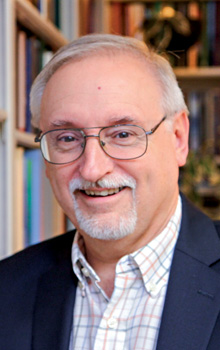
N. T. (“Tom”) Wright, Senior Research Fellow at Wycliffe Hall, Oxford University, joins David Capes on “The Stone Chapel Podcast” to talk about his June 2022 lecture: “The Romans Road: Through the Dark Valley.”
After recounting a bit of his early life, Wright describes what many evangelical Christians know as “The Romans Road.” It is a way of sharing key verses from Paul’s letter to the Romans to help people find salvation. But Wright thinks “salvation” for Paul means something different than what moderns mean by it, that is, going to heaven when we die.
To read Romans well and in context means that we continue to Romans 8. For Wright the story of salvation is a truly human story which includes going through the dark valley.
Amy Nichole Allan, adjunct Professor of Theology at Trinity Christian College, is working on her Wheaton Graduate School PhD dissertation, “Anthropomorphic and Anthropopathic Depictions of God in Hosea, Amos, Micah, and Zephaniah: Rhetoric, Interpretation, and Theology.” In this episode of Exegetically Speaking, Amy weighs carefully the last thing Job says in response to God’s long speech in chapters 38-41. Is Job 42:6 about self-loathing, or a retraction of Job’s words?
“Exegetically Speaking” is a weekly podcast of the friends and faculty of Wheaton College, IL and The Lanier Theological Library. Hosted by Dr. David Capes, it features language experts who discuss the importance of learning the biblical languages—Hebrew, Aramaic, and Greek—and show how reading the Bible in the original languages “pays off.” Each podcast lasts between seven and eleven minutes and covers a different topic for those who want to read the Bible for all it is worth.
Dr. John Walton, Professor of Old Testament at Wheaton Graduate School, author of many books and articles relating to the background, literature, and theology of the Old Testament, has contributed several episodes to this podcast. Currently, he is collaborating with his Wheaton colleague, Dr. Aubrey Buster, in writing a commentary on Daniel. In this conversation with David Capes, he gives some fresh and helpful attention to some of the language that God addresses to the rebellious actors of Genesis 3. Consequences of their acts bring, among other things, anxiety about conception and a desire for spousal support in the form of domestic stability and order.
“Exegetically Speaking” is a weekly podcast of the friends and faculty of Wheaton College, IL and The Lanier Theological Library. Hosted by Dr. David Capes, it features language experts who discuss the importance of learning the biblical languages—Hebrew, Aramaic, and Greek—and show how reading the Bible in the original languages “pays off.” Each podcast lasts between seven and eleven minutes and covers a different topic for those who want to read the Bible for all it is worth.
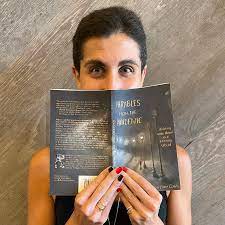
Dr. Christine Galib is a reader, a writer, an educator, and an entrepreneur. Perhaps more importantly, she is a seeker of Truth. In this podcast, she talks with David Capes about her new book, Parables from the Pandemic: Holding onto Hope in a Hurting World. She dedicated it to all who passed away and all who suffered loss as a result of the Covid pandemic. Dr. Galib has written twelves parables—one a poem, one a tweet!—that illustrate the harshness of this fallen world and yet speak Truth and offer hope. Inspired by Dante Alighieri, John Milton, Jesus, C. S. Lewis and other wise writers, Christine helps us understand that “sometimes, and perhaps most times, fiction teaches us more truths than fact does.” To know more about Christine Galib, go to her website: www.christinegalib.com.
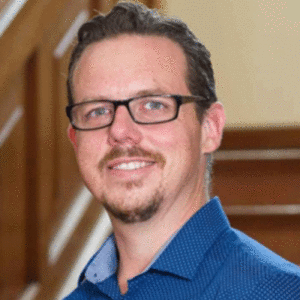
Nathan Lovell, senior lecturer in Old Testament and Hebrew at George Whitefield College in Cape Town, South Africa is an Australian who has lived in South Africa with his wife for the past ten years. He joins David Capes on “The Stone Chapel Podcast” to talk about his book, The Book of Kings and Exilic Identity: 1 and 2 Kings as a Work of Political Historiography (T. & T. Clark). Initially, our books 1 & 2 Kings were one book, and they share common themes and concerns. Written from exile this “book” looks back over 400 years of the history of Israel and Judah to ask a single question: what does it mean to be God’s people in exile? With no temple, no land, a broken covenant, and no king how ought they envision their lives as God’s people? In fact, many exiles questioned whether they were still God’s people, yet the book of Kings ends with a glimmer of hope. The Davidic king is released from his confinement and sits at the table of the Babylonian king. The Davidic line has not come to an end. God has not failed his exiled people.
The Stone Chapel is a podcast of the friends and staff of the Lanier Theological Library in Houston, Texas. It is hosted by Dr. David Capes, Senior Research Fellow at the library and former faculty member at Houston Baptist University and Wheaton College. The purpose of the podcast is to bring to our audience great conversations from the world’s leading experts in theology, biblical studies, archaeology, Church history, the Dead Sea Scrolls, ethics, ministry, and a host of other topics close to the mission of the library.
The Lanier Theological Library is a magnet for scholars, church leaders and influencers. For the last ten years, it has welcomed hundreds of academics and church leaders from across the globe for public lectures, study, panel discussions, consultations, and encouragement.
These podcasts as well as the Lanier library and the Stone Chapel are generously underwritten by Mark and Becky Lanier and the Lanier Theological Library Foundation. If you have questions or comments, please be in touch: Email david.capes@lanierlibrary.org





You must be logged in to post a comment.