
Page 3 of 3

English or Biblish?

I remember a conversation I had with a friend years ago.  He was lamenting the fact that modern Bible translations like the New King James Version and the New American Standard Version had dropped words like “Thee,” “Thou,” “Thine,” “art” (as in the Lord’s prayer: “Our Father, who art in heaven . . . “) and “hast.”  These words were typical of the 16th and 17th centuries but have long since fallen out of use with most English-speaking people. The only time people may have heard or used them was “in church.”  For my friend, the Bible was not the Bible if it didn’t sound . . . well “Biblish.”    kjv_bible
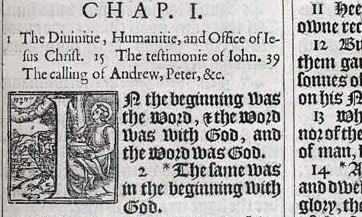
(I’m grateful to Mark Strauss and Gordon Fee for bringing this word to my attention in their excellent book, How to Choose a Translation for All Its Worth [Grand Rapids: Zondervan, 2007]).  Modern translations, he felt, had left behind the formal language of heaven (God’s language) preferring instead the mundane language of “this world.” The translation he loved sounded more “spiritual” to him than the newer ones, so he was against them, pure and simple.  Like many people, my friend had a deep emotional connection with the King James Version of the Bible based on all the years he spent in church and Sunday School.

As a seminary graduate and a recently minted PhD in New Testament, I tried to explain to him all the complexities of Bible translation. I talked about translation theory, the ins-and-outs of determining word meaning, the difference between functional and formal equivalence. I defended the need for newer translations.  But it didn’t matter.  His mind was made up.

The basic concern we had as a translation team on The Voice was to render Greek, Hebrew and Aramaic sentences (our source languages) into meaningful, natural English (our target language).  In other words, the goal of any English translation must be English not Biblish.  As Strauss and Fee note: “Biblish results when the translator simply replaces Hebrew or Greek words with English ones, without sufficient concern for natural or idiomatic English” (p. 21).   Translation is not about exchanging this Greek word for that English word or this Hebrew word for that English word.  Translation is not that easy. It involves knowing both the source and target languages well enough to be able to move back-and-forth between them.  It entails an understanding of culture—then and now—and recognizing how language is one of the key vehicles of culture.  Translation, I have come to understand, is not a science; it is an art.

I’m not sure what my friend would think about The Voice. I haven’t seen him in years.  I hope he would have mellowed a bit and would appreciate what we have tried to do.  In the last year I have met a number of people who prefer the KJV but now read regularly from The Voice.  But, if I’m honest, I’d be disappointed to learn that my friend had lost his deep, emotional connection with the KJV.  The KJV is a great, historic translation, even if it is no longer in our language.

A Few Days in Austin

Most of the collaboration on The Voice took place by means of technology: through email, Internet, SKYPE, and cell phones.  In some cases the work was personal, that is, people knew and worked closely with their reviewers and commentators. In other cases the work was anonymous.  It is standard practice, for example, in scholarly work for a person’s book or article to be reviewed anonymously, meaning both the writers and reviewers do not know the identity of the person offering the review.  This process ensures that a person’s feelings—positively or negatively—about another does not affect the quality of the review.  I understood the need for those checks and balances.The Voice of Hebrews cover

But there were a few remarkable occasions when writers and scholars actually sat down together, face-to-face, to work through a translation.

One of my favorite times working on The Voice project took place in Austin, TX.  Greg Garrett, a noted novelist, was working on the translation of the book of Hebrews, so I drove over to spend a few days with him. It was summer so he had arranged for us to work in empty classrooms at the Episcopal Theological Seminary of the Southwest, an institution where he was writer-in-residence.  The staff of the school graciously allowed me to stay in one of the dorm rooms—on The Voice discount of course.

Over the next few days Greg and I shared meals, swopped stories, and settled down over the Greek text of the letter to the Hebrews.  I watched carefully and listened closely as Greg, a gifted writer, worked through the challenging prose of the New Testament’s most sophisticated and difficult-to-translate books.  We plotted the argument and puzzled over the best way to communicate to our modern audience the way our anonymous Jewish author went about persuading his Jewish audience about the superiority of God’s new covenant.  I remember watching Greg count out the syllables, the rhythm, of the prose.  I learned from watching Greg that well crafted prose has a rhythm; meter is not restricted to poetry.  I had never thought of it before, but working with Greg convinced me it was true. 

Scholars are often strong left-brained people; this means they are good on the technicalities.  A translator might say, “this word is a Greek adverbial concessive participle and its referent is thus-and-so” or “this syllable is a pronominal suffix on the Hebrew root and its antecedent is x-y-z.”  Scholars can do that sort of thing all day long.  But gifted writers, poets, and artists are often strong right-brained people.  They are better equipped than technical scholars at capturing the beauty of a phrase or finding the right word to resolve the rhythm of a poem.  This is why I’m fond of saying about The Voice, “Finally, a Bible for both sides of your brain!”

I remember leaving Austin on the last day a bit sad. Greg and I had run out of time, and we had not been able to translate through all 13 chapters of this tough letter.  We would have to go back to our respective lives to complete it, in between other duties.  I was sad too that more of my Voice-related experience had been so isolated.  Translation is often a solitary experience—the nature of the discipline demands it be so—even if you are working in a “collaborative environment.”  As I started the car and headed for home, I was grateful for Greg’s talent and friendship.  When I look back, those were good days.


“Watered down”

One of the criticisms made of all contemporary, readable Bible translations is that they are “watered down” versions of God’s Word.  Interestingly, the people who make those charges never give examples of how the new translations dilute the Scripture.  Still that doesn’t stop them from making what amounts to a baseless accusation.watered down 

A different version of same argument was made around 500 years ago when the language of the church was Latin and the Scripture read in mass was The Vulgate.  “If people want to read the Bible,” they said, “let them learn Latin. Don’t put the Scripture in the language of the people.”  The Bible, they thought, was too important to be rendered in a tongue as banal as English.  You see, in those days English was considered a vulgar language, the language of the masses.  Important documents were written in Latin.  The language spoken in the English court was French (in those days France and England were getting along).  If a member of the aristocracy spoke to a peasant about spreading fertilizer in his field, he spoke English.  But if he spoke to an equal, he used a proper language like Latin or French.  No wonder people objected to having Scripture in so common a tongue.

A similar dynamic is at work today.  English may no longer be considered a vulgar language, but there are elites among us who think we need to keep Scripture in a form which makes it hard to reach.  Some apparently prefer the sound of “Biblish” to English and think others ought to prefer it too.  But when you study the Scriptures carefully, you realize the language of the New Testament was “common Greek.”  It wasn’t written in some highfalutin tongue spoken only by the pretentious.  It was the way people spoke in the market, at home . . . essentially, where people lived.  Apparently, God wanted the Bible to be in a language where the most people could get it, read it, understand it, and live it.     

I learned a long time ago that the smartest people around are those who can take complicated language and hard concepts and teach them so that others can understand.  But the true intelligentsia may not be those leading graduate seminars in the elite universities; they are likely to be found teaching 4th graders in public schools or middle-schoolers in Sunday School.  Just because translation committees have put the Bible on a shelf that people can reach does not mean it is watered down; it means that more and more people will be reading, paying attention, and living it.

This is why we did The Voice.

Idiomatically Speaking

Idiomatically speaking

by David B. Capes

I’m working on a book entitled The Story of the Voice.  Thomas Nelson will publish it in spring 2013. It will tell the story of how the Voice Bible came to be, talk about the people and the process, and discuss some of the translation decisions we made.  As I was researching for the book, I came across a paragraph in a book by Gordon Fee and Mark Strauss entitled How to Choose a Translation for All Its Worth (Zondervan 2007).  It is a terrific book, one I highly recommend if you interested in Scripture.

In a section on translating idioms I found a fun paragraph I want to share with you.idioms-full

First, let’s talk about idioms.  Every language has them, some more than others.  English has a lot.  Hebrew and Greek, the major biblical languages, have them as well.  They present one of the greatest challenges for translators.  So what is an idiom?  Here is the definition given by Fee and Strauss: “an expression whose meaning cannot be understood from the combined meanings of the individual words.”  If a person stays too late, he might say before he goes: “I need to hit the road.”  Now native English speakers will know exactly what that means: “I need to leave now.”  But a person who is taking each word literally might ask, “Why do you need to hit the road?  What has it done to you?”

I remember one of the first idioms I came across while studying Greek.  In Mark 1:32-34 the writer says—if we read it literally—that Jesus healed “those having badly.”  Now you might be able to figure out what that means but that would certainly not be the way we’d say it.  The Greek idiom “those having badly” means “those who were sick.”

Here is a paragraph which is a lot of fun (if you are a word-geek like me).  How many idioms do you see?

My career has seen better days.  I was skating on thin ice at work, scraping the bottom of the barrel, and ready to say uncle.  The boss and I did not see eye to eye, and he told me to shape up or ship out.  There was no silver bullet.  It was a safe bet that I was going to sink or swim.  Nobody could save my bacon.  My smart-aleck colleague was a stick-in-the-mud and a snake in the grass who would sell me down the river as soon as shake a stick at me.  I could smell a rat, so I steered clear of him. I had one slim chance.  It was a shot in the dark, but if I could keep a stiff upper lip, stick to my guns, and sail close to the wind, I would get a second chance.  The saving grace was that at the last minute I got a second wind and was saved by the bell.

Now don’t look too deeply for any great meaning in that paragraph.  It only illustrates how many idioms we use on a regular basis.  Those of us who translated The Voice had to be aware of the Greek and Hebrew idioms.  We had to figure out how in English to express their meaning to our modern audience.  Often you can figure out what an idiom in another language means, but you have to think about it.  It is often like a riddle.

So now it’s your turn.  Can you think of an idiom you have heard in English?  Do you have a favorite?  Have you ever used an idiom (in English) and had a non-native speaker look at you as if you had lost your mind?  By the way, how many idioms have I used in this blog?  If you have a lot of time on your hands, rewrite the paragraph above and say plainly what each of the idioms mean.  See if you can do it.  It is harder than you think.

Word for word and/or thought for thought translations

WordsI’m often asked whether The Voice is a word-for-word translation or a thought-for-thought translation.  That phraseology has become a standard way of delineating the more formal from the less formal translations.  I wrote about this more thoroughly in a  book called The Story of The Voice.  It was released in spring 2013 by Thomas Nelson.

The categories are themselves problematic. To state the question as an either-or implies that there is a strict dichotomy between a word and a thought.  It assumes there is little to nothing in common between them.  In fact that is not true in the slightest.  When you think about it, every word is a thought expressed. People can keep a thought to themselves; but when they speak, they have expressed something they have thought.  We’ve all laughed at someone who speaks before they think because what comes out is nonsense. For those who know only one language the point is hard to illustrate but consider what it means to translate one word into another.

Take the Spanish word más.  What does it mean?  Well, you get a Spanish-English dictionary (assuming your target language is English) and look up más.  What do you find? You find the English word “more.”  So más means “more.”  Well, not exactly. Más means what English-speaking people mean when they say “more.”  That is quite a different thing.  Spanish people don’t think “more” and say más.  They think más and say más. “More” might be equivalent to más in meaning, but a Spanish-speaking person doesn’t hear más and think ”more.”  Are you confused?

How about this?  Have you ever searched for the right word to express a thought?  As people get older sometimes they have trouble coming up with the right word.  It could be a word they know well, a word they’ve said thousands of times, but for some reason at that moment they can’t come up with it. You’ve heard people say “it was on the tip of my tongue.”  What was on the tip of their tongue?  The right word to express what they were thinking.  It is very frustrating for people to have thoughts they can’t express clearly.

We’ve all had the experience of thinking only to discover we are “talking to ourselves.” We try not to do that out loud too much or people might think we have lost it.  In fact in some languages the word for “think” means essentially to talk to yourself.  Leaving aside for a moment that some people are more visual thinkers than others, thoughts do arise from our conscious minds and are expressed in words.

My point is that there is no strict dichotomy between a word and a thought.  Every word is a thought expressed. Those who distinguish strictly between a word-for-word translation and a thought-for thought translation exaggerate the difference and are trying to privilege one over the other.  Generally, the word-for-word translations are considered superior to the thought-for-thought.  But every translation team has to wrestle with words, their meanings, and the thoughts behind them. Unlike Islam, the Christian tradition has never held that God’s Word is inspired only in a specific language. Though we urge ministry students to read the Scriptures in their original languages (Greek, Hebrew and Aramaic), we do not regard these texts as somehow more inspired than Luther’s German Bible or King James’ English Bible or any other translation.  God can and does speak through the words of the Scriptures whether they are in Mandarin, Dutch, Swahili or English.

So when people ask the question: “is The Voice a word-for-word translation or a thought-for-thought translation?” Say, “yes.”