In May 2023 Dan Wallace lectured at the Lanier Theological Library. His topic was “Formatting the Word of God.” Before the lecture, he sat down to talk with David Capes for “The Stone Chapel Podcasts.”
Who is Dan Wallace?
Dan Wallace is the CEO and executive director of the Center for the Study of New Testament Manuscripts (CSNTM) in Plano, Texas.
Formatting the Word of God
From the beginning, people who hand copied the New Testament manuscripts put into the manuscripts features which made the reading of Scripture easier. But these features led to certain interpretations.
The Bible has certain formatting to it. It has to. Every literary product has to. For example, how wide should the margins be for a text? How wide should the text be? Is it going to be on a three-foot papyrus roll? So, there’s some formatting.
Certain features, for example, make it easier to read in public. Other features of copying indicate respect for and devotion to Christ.
Dan’s lecture will be rich in imagery drawn from the thousands of photographs of these amazing manuscripts that this organization has taken over the last decades. (You can find a link to it below. It was a little over one hour long.)
Still thousands of manuscripts remain unphotographed. But his organization has discovered many other manuscripts not previously catalogued.
Even the form of the book itself—the codex not scrolls or rolls—has a certain interpretive significance.
The Center for the Study of New Testament Manuscripts
Because these manuscripts and inks are organic, over time they will decay, fade, and become unreadable. That’s one reason Dan started the Center for the Study of New Testament Manuscripts: to preserve these valuable artifacts.
But there is another reason. The goal of the center is to make high quality, digital images available to all people. If the staff meet their goal, then in the future anyone in the world with an internet connection will be able to view images of available manuscripts.
Formatting Today
Modern Bibles continue the interpretive features. Chapters, verses, columns, italicizing, page numbers, cross-referencing, and interpretive notes are employed by publishers and these guide readers to interpret the texts.
Capturing Christianity is an apologetics ministry directed by Cameron Bertuzzi, assisted ably by his wife Brittany. Cameron stopped by the Lanier Theological Library to talk with David Capes about his ministry on “The Stone Chapel Podcast.”
Who is Cameron Bertuzzi?
For years, Cameron made his living through photography and photo-editing. But when his brother came out as an atheist a few years ago, Cameron began a journey in apologetics that has led to this ministry. He wanted to know whether Christianity could be rationally defended. He wanted to explore some of objections raised by skeptics about its truth.
Like many people, Cameron had never thought deeply about his faith. He attended church and performed in the worship band, but he had never considered the rational basis of faith.
Capturing Christianity
Cameron and his wife work together in this ministry. Along his journey, Cameron began listening to apologists and soon found an intellectual hero in Dr. William Lane Craig. Today, Cameron works consistently with Dr. Craig. Dr. Craig lectured at the Lanier Library in 2021. For a link to his lecture click here.
The ministry started as a blog in 2017. Cameron worked on it in his free time for the first two years. Now he and Brittany work full time. He hosts dialogues, does interviews, and features what he calls “CC Exchanges.” At the heart of it all, they focus their conversations around “atheistic apologetics”.
The Capturing Christianity YouTube channel today has 178,000 subscribers. It has taken off. About 5000 people a month find his ministry.
CC Exchange
The next CC Exchange will be May 6, 2023 at the Lanier Theological Library. Cameron will host the exchange with Justin Schieber (atheist) and Eric Hernandez (Christian). Their topic is “Does God Exist?” To learn more about the event or to attend click here. The event is free and open to the public thanks to the generosity of the Lanier Foundation and the good people at Capturing Christianity.
If you can’t attend, it will be streamed live and recorded for the Capturing Christianity YouTube Channel.
For the website to Capturing Christianity click here.
For the Capturing Christianity YouTube Channel click here.
Sharon Dirckx is a freelance speaker and author who occasionally teaches courses for OCCA, The Oxford Centre for Christian Apologetics. She has been with us before on this podcast and has lectured at the Lanier Theological Library in Houston in November 2022. Links to those episodes and to her other books are below.
While her PhD from Cambridge is in brain imaging, Dr. Dirckx has turned her attention to our broken planet. She and her husband live in Oxford, UK.
A great deal of suffering is caused by natural disasters: tsunamis, earthquakes, floods, hurricanes, pandemics, and other catastrophes. How do we account for such disasters if there is a God who is all powerful? Is our planet broken or is this the best of all possible worlds as some regard it?
It is one thing to make a case for the origin and impact of moral evil or “man’s inhumanity to man.” But it’s quite another to talk about the planet itself as being our home and our nemesis.
Dirckx mixes her own style of apologetic argument with stories of people who suffered and survived to create a compelling book. This podcast captures a bit of her book and aims to help readers deal with those tragedies not caused by humans.
Click here to watch Sharon Dirckx’s lecture at the Lanier Theological library, on her second book, Am I Just My Brain.
Watch a short video here of Sharon discussing the topic, Can you be a credible scientist and believe in God.
For Sharon’s Podcast’s on her book, Am I Just My Brain, click here.
Recently, I sat down with Scott Stripling to talk about the publication of his team’s work on the discovery of the Curse Table from Mt. Ebal. It was an episode of “The Stone Chapel Podcast.” eHere’s a transcript of my conversation.
Scott Stripling
Hi, I’m Scott Stripling, Provost at the Bible Seminary and VP of Donor Relations
David Capes
Dr. Scott Stripling, Scott. Good to see you. Welcome back to the Lanier Theological Library.
Scott Stripling
Oh, David, it’s always a joy to come see you here, my friend. It’s a beautiful place and I think I might just move in.
David Capes
For those who don’t know Scott Stripling, tell us about yourslef. Who is Scott Stripling?
Scott Stripling
Well, I’m 60 years old. I’ve been married for 40 years. I have a PhD in ancient near eastern archaeology and a couple of master’s degrees. I’m a sports fanatic. I love my family and love the Lord. I’m addicted to reading the Bible and all the material culture and references that illuminate that background for us.
David Capes
Well, you’ve been digging up a number of really interesting places in Israel over the last few years. I’d love to at some point, to talk about that. But today, we’re going to talk specifically about an announcement that you made last year at a press conference here at the Lanier Theological Library, about a find that has gotten a lot of attention. What did you announce last year?
Scott Stripling
Yeah, it was March of last year [2022]. So just a little over 12 months ago we had a press conference here. Believe it or not, over 25 million people watched that press conference. There was a lot of interest and the reason is because it was a small folded lead tablet from Mt. Ebal. And it had what we believe is the oldest Hebrew script in a proto-alphabetic script. So the oldest Hebrew writing ever found in Israel and it included the name of Israel’s God.
David Capes
Where was it found?
Scott Stripling
Okay, let me give you some landmarks. Abram cut covenant with God at Elon Moreh, Moses told the Israelites when you come back into the land and you gain a foothold, you’re going to go to Mt. Gerizim, which is right next to Elon Moreh, and you’re going to renew covenant with me there, pronouncing blessings from Gerizim and curses from Ebal. Joshua built an altar on Mt. Ebal to the Lord: Joshua 8:30. Adam Zertal excavated that altar in the 1980s. We went back and sifted through [the rubble] using a new technology of wet sifting. And that’s where we found this jewel.
David Capes
So a dig was conducted in the 1980s. There was some refuse from that, because they were digging down and they just didn’t see this [artifact], right? They missed it.
Scott Stripling
No, in fact, archaeologists throw away about 75% of the evidence from the small finds. And that was the goal of my project to write a methodological paper and say, we can’t keep doing it the way we’ve been doing it. Because here’s what we’re missing. I had no idea that we were going to find this tablet of great significance.
David Capes
It seems like everybody wants to find something big and monumental. But in fact, a lot of things over time that were larger, become a bit smaller, with the wear and tear of nature and erosion. But this lead tablet is a fascinating discovery. It was folded, right?
Scott Stripling
Yeah, it’s about the size of a business card folded in half, if you can picture that. Made out of lead, which kind of reminds us of Job 19:24. “Oh, that my words were written on lead tablets with an iron pen.” Okay, so it’s a very ancient way of thinking. They’re just gonna write down these words and seal them up.
David Capes
And once the words were written down and sealed up, what kind of things are on the inside? What does it say? I know you [and your team] have been working on deciphering that. You’re trying to figure that out because you can’t open it up [the folded tablet].
Scott Stripling
No, we tried and it’s impossible. The lead is now brittle. We had to go to Prague, Czechoslovakia, and use tomographic scanning in a lab there. And using those scans, we were able to recover text on the inside, which then was reinforced by bulges on the outside. So in other words, what we were seeing with the naked eye on the inside of the tablet was confirmed by bulges on the outside of the tablet as well. The first word we got was the word “arrur”, which is the Hebrew word for curse. And at that point, I thought you’ve got to be kidding me.
David Capes
So you’re on the mount of cursing. And this [account] goes back to the book of Deuteronomy chapter 26:27. And certain curses are to be pronounced and certain blessings are to be pronounced in this covenant renewal. And this is a particularly important moment in the history of the people.
Scott Stripling
Well, that’s right. And they build an altar, Joshua 8:30. He says he built an altar to the Lord on Mount Ebal, which is not what we would expect. We would expect the altar to be on Mount Gerizim, the place of the blessing, but it’s on the place of the curse. And I think that’s so beautiful that it’s through the expiation, through the shedding of blood that there’s forgiveness of sin, Leviticus 17:11. And that’s where this tablet came from, was from the altar. So the picture is, here’s these curses first, by God, Yahweh, not by Satan, right? Yeah, you could deal with that. Now this is by Yahweh Himself. You’re cursed, and you will surely die. Now that curse is placed on the altar, and then the shedding of innocent blood covers it. And so the man who will come to the altar then is not held accountable for those curses. It’s the one who won’t own up to his action. So the symbolism is really beautiful.
David Capes
Interesting. So is there any way to date this? Is there any way to say with any kind of certainty that this is from the 14th century BC or 8th century AD?
Scott Stripling
Well, fortunately, our academic peer reviewed article has just been released by Heritage Science. And so if you’re having trouble sleeping at night, just download that and you can read all about it. Yes, there are three ways that we can date this. Number one is from the archaeological context. There were only two strata at Mount Ebal that Adam Zertal excavated, late Bronze Age II and Iron Age I. So there’s only two choices. So either way, it’s older than any previous inscription that had been found in Israel.
Any Hebrew inscription. Because we’ve got older Canaanite inscriptions. If it’s Late Bronze Age, which is what we argue in the article, then it’s several hundred years older. If it’s Iron Age, it’s still older. The existing ones say the Khirbet Qeiyafa ostracan.
David Capes
So for people who don’t know the Bronze Age from the Iron Age. The Bronze Age was first. And then the Iron Age comes later.
David Capes
Yes, with the transition around the year 1200 from one to the other.
David Capes
Okay. So you’re arguing [the tablet] is [from] Bronze Age? So 1200, or before.
Scott Stripling
Yes, 1400 to 1200. It’s in that range. Peter VanderVeen and I believe that it was closer to 1400, Gershon Galil, one of our co authors, feels like it’s closer to 1200. So what we’re saying is, LBII, Late Bronze Age II. And then there’s reasons why one might think it’s slightly older or not. But it’s not only that, we also have the source of the lead, because we were able to chemically test the lead at Hebrew University. And the lead derives from a mine in Greece at a place called Laurion.
David Capes
Well, that implies imports.
Scott Stripling
Yes and here’s the thing. We don’t all agree on very much in archaeology, but we all agree that around 1200, the imports stopped. Okay. So what does that tell us? If the lead came from a mine that we know was in use in Greece in the Late Bronze Age and imports to Israel stopped around 1200, ergo, it had to be earlier than 1200. So that’s the second way we have a date. And then thirdly, it’s the epigraphy. The style of writing is unique, and it’s a well known style of writing. It’s just been called proto-Canaanite normally, or proto-Sinaitic. Because they’re using the same alphabet, and Canaanites and Israelites have the same alphabet.
David Capes
It’s like Spanish and English. We use the same basic alphabet.
Scott Stripling
Yeah or maybe here’s another analogy. Let’s say I have a Muslim neighbor, and I’m a Christian. We’re still writing in English, right? You can’t tell one religion from another unless we have unique words. So if there was a prayer to Allah or something like that, within the script, then you might know my neighbor was a Muslim. And that’s what we have here. We have the name of God, Yahweh, or YHWH, the three letter spelling, twice. And there’s only one group of people in the ancient world worshipping this God, and those are the Israelites. So three ways: the epigraphy, archaeological context and the source of the lead.
David Capes
This may well be the earliest evidence for the name of God.
Scott Stripling
That’s right, in Israel. Now we have an older reference outside of, no I”m sorry, it’s not older. But we have a contemporary reference in Egypt of the Solep hieroglyph in the temple of Amenhotep III. He writes of the land of the nomads of Yahoo, or of Yahweh. So apparently there are nomads who worship Yahweh who have their own land by the year 1360.
David Capes
And of course, Abraham is a nomad. “A wandering Aramean was my father” as the text says. Well, this is probably changed your life in the last twelve months.
Scott Stripling
Yeah, thanks a lot. I have lost a lot of sleep over this.
David Capes
So 25 million times it’s been seen.
Scott Stripling
At least. Maybe as many as 50 million because once things go into secondary media and it gets on Tiktok, I don’t even know how to count things on Tik Tok, but it’s like millions there. And plus the original press conference that we were counting. So we estimate at least 25 million views.
David Capes
That’s incredible. Well, first of all, congratulations. Second is how do you follow it up?
Scott Stripling
Well, you know, now the academic debate begins, okay. And people can look at our research and agree or disagree, give alternate readings. But at least they’ve got good clean research in front of them that they can use as a basis for that. We now want to investigate the outside because we have writing on the outside as well. And so there will be a second academic article. And spoiler alert, it says pretty much on the outside what it says on the inside, but we do need to publish that also.
David Capes
Okay. So when you say it’s the same, is it a brief version of the same? Or is it the same length? Is it the same words?
Scott Stripling
That’s a nice try David, to get that informtion out of me but it’s not gonna work!
David Capes
No, okay.
Scott Stripling
But I will tell you this. On the inside, not only do you have Yahweh Yahu, but you also have El side by side. So the two names for the Hebrew God are side by side, which is very problematic for those who are advocating the Documentary Hypothesis. Because supposedly, those two are hundreds of years apart, right. And we have them side by side. So there’s going to be some theological argumentation, archaeological argumentation on a different levels at which we have to think about this.
David Capes
Where do you think the biggest pushback is going to be in relationship to this find and this interpretation?
Scott Stripling
I think from two areas. Number one is the one I just mentioned. So seminaries that have been teaching the Documentary Hypothesis as a basis for understanding, kind of a paradigm through which people understand the ancient world. This is problematic, and so not everybody’s gonna be quick to say, oh, golly, we were wrong all these years.
David Capes
Nobody wants to admit that after teaching, and writing books on it for 40 years. Nobody wants to do that.
Scott Stripling
And I can understand that. So I think we will get some pushback there. And then from the epigraphic community. It’s a very narrow, you know, people who have this unique skill set of being able to translate these ancient inscriptions. There’s always a variety, take the Khirbet Qeiyafa ostracan, when it came out. I mean, there’s 100 different research angles, well, maybe it doesn’t say this, or it could say that. So we expect that type of thing as well.
Scott Stripling
No that’s the thing, you’d have to say that it was a forgery. Either we did it or somebody else, you know, left this, this tablet there and it was a forgery or something like that. I laughed when someone suggested that like I’m smart enough to write in proto alphabetic script on lead from Laurion Greece on the planet.
David Capes
So is anybody quibbling over the date of the find at this point, anybody saying no, it really is later.
Scott Striping
No that’s the thing, you’d have to say that it was a forgery. Either we did it or somebody else, you know, left this tablet there and it was a forgery or something like that. I laughed when someone suggested that like I’m smart enough to write in proto-alphabetic script on lead from Laurion Greece on the planet.
David Capes
A lead that is so brittle that you can’t write on it!
Scott Stripling
I know! So where there’s two archeologist there are three opinions. And so there will be plenty of opinions. But we just felt like we wanted to be intellectually honest, do our very best research, presented in a highly reputable journal, so that everybody would have it as a historical record.
David Capes
So has anybody pointed out the fact, that this was not found in situ, this was found in a heap of rubble that was moved off to the side and not seen? That seems like to me to be something somebody would say. Well, we don’t know exactly what level it was.
Scott Stripling
Yeah, and that’s, a good point, I used to work on the Temple Mount. And for two years, I was a supervisor on the Temple Mount Sifting Project. And so we have multiple time periods from the earliest Paleolithic periods, all the way down to the Mamluk and even later Islamic periods. Well, that’s problematic. If you’re wet sifting that material. At Ebal, we only have two choices, Late Bronze Age II, or Iron Age I, even though it was found out of context.
David Capes
You’re already narrow. You’re already a bit narrow compared to what you just described, which could be 1000 years, right?
Scott Stripling
Right. If that were the case, then that criticism would have more validity. But even if it were Iron Age I, and the script no longer continues into Iron Age I, it would be like saying that Chaucer’s English is still being used in our time or something like that. So, you know, there’s already been a change of script. But even if that were the case, it’s still older than the Khirbet Qeiyafa ostracan by at least a couple of 100 years.
David Capes
Let’s talk about context. Why did people write these curses on lead texts like this, and then fold them up? What were they trying to do with?
Scott Stripling
Yeah, that’s a good question. I think it was a titular document, summarizing the curses of Deuteronomy 28 and 29. And there it’s really self inpregnatory. “Cursed are you by the God Yahweh.” In other words, that’s exactly what Deuteronomy 28 says. If you don’t keep my covenant, all these curses will come upon you. So I think it’s a self imprenatory type of a curse.
David Capes
So a person has, in a sense owned up to that. To being cursed?
Scott Stripling
Binding himself, saying these are the consequences. I accept those consequences if I don’t keep the terms of the covenant. Which you find the exact same thing in the Abrahamic covenant. So blessings and curses. That’s how Late Bronze Age covenants were cut. There were always blessings and curses. We know of hundreds of these tablets. They’re called defixios, that is the technical term. But I had never seen them from that earlier time period. I only knew them from later periods. So it’s not like we hadn’t seen it. As soon as I saw it, I knew what it was.
David Capes
So you knew as a lead tablet and it was some sort of curse tablet.
Scott Stripling
I knew it was a curse tablet. And I thought, oh, my goodness, it’s a curse tablet from the mountain of the curses. But I’m not aware of them from earlier time periods. So I was as surprised as anyone when the text that we recovered on the inside was a proto-alphabetic script.
David Capes
Have other curse tablets been discovered from that period?
Scott Stripling
No. In Israel, no. But in Egypt, yes. But not of the exact style with the folded lead tablet that you have the Execration texts from Egypt. We’ve got curses written on clay tablets. But you have to understand David, Adam’s team missed this. And they were good when they dry sift through everything. And they missed it. My team is also very good. We dry sifted everything again and we missed it. It was only with the new technology of wet sifting, that we were able to then see it and it popped. So, I think there may be a lot of them in dump piles sitting around Isreal.
David Capes
So you just have to go back and wet sift all those piles.
Scott Stripling
And that’s my contention to my colleagues. Let’s wet sift before we dump it into the piles, okay, so that we know the context that it’s coming from. Again, that was my motivation for the project. I wouldn’t try to start any controversy other than to say methodologically we can’t keep doing it the way we’ve been doing it because we’re throwing away the majority of the evidence.
David Capes
So what’s the difference between dry sifting and wet sifting. How do you proceed to do that? What do you mean wet sifting exactly?
Scott Stripling
So, we set up a portable station that has water that we’re recycling at Shiloh. We have our own water tower, and it’s quite fancy. At Mount Ebal, we just set up a portable tank that had a pump that was cycling water so that we had pressure and hoses. So the matrix, after it’s been dry sifted, then goes and it’s washed like with a pressure hose and cleaned and washed again. And now once the dirt is off of it, all of a sudden, what looked like a rock, is a scarab. See for every one scarab we used to find we’re now finding five and for every one bulla we used to find we’re now finding five. A bulla is a clay impression. So it’s clay that’s been impressed with a scarab or a sealed impression of some kind that has been thrown away. Because when they’re covered with dirt, how’s a volunteer supposed to know what that is? But when it’s washed all the sudden those things pop.
David Capes
Good role for water out in the desert.
Scott Stripling
I know. The washing of the water of the word. It brings a lot of things to life.
David Capes
That is terrific. Well, there’s an academic discussion now that is beginning. And will continue for a number of years. Is there ever going to be consensus you think, on what this text is and what it means.
Scott Stripling
I think the person, in this case me, the lead archaeologist and the lead author on the article, always has the advantage, the home court advantage. Because we’re the ones who set out what it is. And even those who disagree, the majority will always go back to either agree with, or disagree with, or cite our original research. You had Yossi Garfinkel here at the Lanier Theological Library, here a couple of years ago. Well he’s the one who excavated the Khirbet Qeiyafa. I think it’ll be exactly like that. You’ll have Yossi as the first one who published it. So people will always go back to his original reading but say maybe it could also mean this or mean that. But they’ll have to refer to his research. I think it’ll be the same thing with this.
David Capes
So you’re team is the starting point. And you had a team, not just you. You have a team from Israel, from Eastern Europe, as well in Germany.
Scott Stripling
Germany, Czechoslovakia and Israel. So two epigraphers, I didn’t want just one. You know, I’m sticking my neck out pretty far on this thing. I don’t want just one epigrapher to tell me what he’s seen here. I want two different ones. One’s Christian, one’s Jewish. One’s European, one’s Israeli. I want them both to tell me that they’re seeing this and then I have to agree with them before we’re gonna move forward on it. So that was helpful to have two good epigraphers,. And then of course, the scientist in Prague where we were counting on them to give us high quality scans. Because I mean, what were we going to do without the scans?
David Capes
Without being able to see inside because it is folded?
Scott Stripling
Don’t we live in an interesting time to be able to do that? Yeah. even if Adam Zertal’s team had found this, they wouldn’t have been able to do anything with it.
David Capes
Back in the 1980s exactly. So if people want to learn more about this particular find, how can they do that?
Scott Stripling
Okay, Heritage Science is the journal, and so they can go to the Heritage Science site. It’s one of the Springer Journals and it’s open access. So anybody can download the article there for free. Doesn’t cost them anything. And then we will have a number of other more popular level articles that are coming out in the near future as well.
David Capes
Very good. Dr. Scott Stripling. Thanks for being with us today on The Stone Chapel.
Perriman joined David Capes by Zoom from his home in London for two episodes of “The Stone Chapel Podcasts.” Here is part 2. If you haven’t heard part 1, go back and listen to that episode here.
Who is Andrew Perriman?
Andrew Perriman is a researcher and writer on topics related to eschatology and Christology. He is Associate Research Professor, London School of Theology, and spends part of his time in pastoral work around the world.
He also works with a mission organization, Communitas. As he says, he inhabits two worlds.
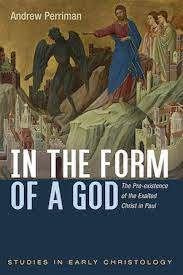
Details about “In the Form of A God”
The subtitle of the book narrows the subject of the book The Preexistence of the Exalted Christ in Paul.
Many scholars believe that Paul, our earliest Christian theologian, already held to the notion that before Jesus was “born of a woman” (Gal 4:4-6), he existed in heaven as a divine being “in the form of God” or as Perriman prefers “in the form of a god” (Phil 2:6).
His book asks the question: did Paul believe in the pre-existence of Christ? And if so, to what extent?
The Philippian Hymn (Phil 2:6-11)
Perriman has an interpretation of Phil 2:6-7 that is at variance from many scholars. First, he does not regard it as a hymn. He considers it an encomium, that is, rhetoric designed to praise a human being.
Second, he thinks it unlikely that Paul wrote it. Rather, Paul approves of it because he incorporates it into his letter.
Third, he focuses upon the phrase “in the form of (a) god” to demonstrate that the backdrop of this passage—at least the first verses of it—comes from a pagan background that is accustomed to god’s appearing in human form.
Jesus appeared in his ministry as a godlike figure. It is generally agreed that morphe, that is, “form” refers to an outward appearance not the essence of a person or thing.
Seize the Opportunity
The other key word in this passage is harpagmos, which Perriman regards as an opportunity to be seized. Perriman follows the case made by Roy Hoover in 1971 (see details below). He believes, the most likely reference goes back to Jesus’ temptation in the wilderness. The godlike man was presented with an opportunity to have the kingdoms of the world, and he turned it down.
Essentially, the passage (Phil 2:6-11) poses the question: how should a Gentile, a pagan understand Jesus?
The second half of the hymn or encomium is thoroughly Jewish because ultimately everything, every creature will bow down to the Jewish God, Creator of the heavens and earth. This is a strong allusion to a passage from Isaiah 45.
Finally
In the end Perriman regards this passage not so much as a hymn with a preexistence Christology. Rather it is rhetoric designed to make Jesus an example of humility and wisdom, a person worthy of imitation.
Agree or disagree? Leave a comment below.
See Roy Hoover, “The Harpagmos Enigma: A Philological Solution,” Harvard Theological Review 64 (1971) 95-11.
Here are more resources for you.
Check out more Stone Chapel Podcasts on some great topics here.
What’s more, you can get information on upcoming lectures at Lanier Theological Library. Just click here.





You must be logged in to post a comment.