Page 10 of 17

The Colossian Hymn–Colossians 1.15-20

Paul aimed to drive home the point of the sufficiency of Christ by quoting what appears to be a preformed tradition—either a hymn or a poem—that commemorates the person and finished work of Christ.  It is likely that either Paul or one of his associates was the author of this piece, although we cannot rule out composition outside the Pauline circle.  The hymn is based broadly on the Jewish wisdom tradition where divine wisdom (a) reflects the divine glory, (b) serves as the agent of creation and (c) the agent of redemption (Wisd 7:22-28; cf. Proverbs 8).   As early theologians like Paul mulled over the significance of Christ, they found wisdom an ever-ready concept through which to filter the activity of Jesus.  Wisdom language and texts provided them a wealth of symbols and images to construe their newly found faith in a variety of ways and contexts.  There is much to commend Michael Gorman’s judgment: Colossians is an “extended commentary on Paul’s claim that Christ is the wisdom and power of God (1 Cor 1:18-25).”[1]Jesus the sage
 

The hymn can be divided into two parts: (1) the Son as Creator of all things (1:15-17) and (2) the Son as Head of the Church and Reconciler of all things (1:18-20).  We have used the christological title “Son” in our description of the hymn because of its presence in 1:13.  There are in fact no christological titles in the surviving text of the hymn.  Unlike the Philippian hymn that ends with the triumphant acclamation, “Jesus Christ is Lord,” there is no overriding christological claim in the Colossian hymn.  What you do have is a well-constructed series of christological reflections patterned loosely on Jesus’ work as God’s wisdom.


The first stanza of the hymn declares the Son to be the “image of the invisible God, the firstborn of all creation” (1:15).  The phrase “image of God” resonates with the tonality of the Genesis narrative where a similar phrase refers to the creation of “the Adam” in God’s image and likeness (Gen 1:27; cf. 1 Cor 11:7).  But Adam’s twin he is not because he is also the agent of creation, the one through whom, in whom and for whom all things are made (1:16).  The emphasis on God’s invisibility stands in contrast to the Son’s incarnation and especially the reconciling blood of the cross (1:19-20).  Some have taken the phrase “firstborn of all creation” to mean that the Son is a created being.  This can hardly be the case, however, when in the next line He is heralded as the creative agent behind “all things in the heavens and upon the earth” (1:16).  The “first” is therefore not in reference to time but to status as v. 17 makes clear (“He is before all things”).   By “all things” the hymn explicitly cites heavenly and earthly entities, visible and invisible realities, along with an entire assortment of angels, principalities and powers.  These are the spiritual powers feared and placated in the folk religion around Colossae.  Whether or not they recognize it, these powers along with the rest of creation exist subservient to the Son who holds all things together (1:17).


The second stanza celebrates the headship of the Son over the church and the (eventual) reconciliation of all things—perhaps even the competing powers—by the cross.  Paul wrote: “And He is the head of the body (of) the church” (1:18).  The hymn is apparently combining two important Pauline emphases: (a) the church as the body of Christ (1 Cor 12:12-29 and Rom 12:3-8) and (b) the headship of Christ (1 Cor 11:2; cf. Col ???).   Paul and his co-workers were innovative theologians, evocative in their use of symbols and metaphors.  The image of the church as Christ’s body provided them with a variety of ways to configure the relationship.  Here the focus is on Christology not Ecclesiology so its construal emphasizes the headship and first-place-ness of Christ over against His people.  As the “firstborn from the dead” (1:18), the Son (cf. 1 Cor 15:20) leads the way from death to life.  He is the beginning of the new creation: in Him the resurrection from the dead has begun.  But there is more to affirm: the hymn continues “for in Him all the fullness [of God] was pleased to dwell” (1:19).   We have in this line a clear statement of what theologians refer to as “the incarnation,” namely, the man Jesus was the fleshy place of God’s indwelling.  This “indwelling” of God was not measured and cautious but total and daring.  In God’s good pleasure the totality of the divine nature and attributes filled the Son.  This made Him uniquely qualified to serve as the agent of reconciliation (1:20).  The working assumption of Paul is that humanity and the rest of creation had fallen out of God’s favor despite our glorious beginnings.  Furthermore, nothing below was able to establish peace, but God’s Son has come into the world and established peace through His blood on the cross.  For Paul, Christ on the cross was the locus of reconciliation.  And this reconciliation is not partial; it is universal with beneficiaries in heaven and on earth (1:20)


At one time the Colossians had been alienated from God because of evil.  “But now” God had reconciled them “through the body of His flesh” (1:21) so they could one day stand before Him holy and blameless.  The focus on the accomplished work of reconciliation was important for Paul because of how the Colossians were looking to other ascetic and spiritual strategies to “complete” their salvation.  The apostle wanted them to recognize that Christ was the agent of creation, the author of their reconciliation and the only true power in the universe.  What they needed to do now was to continue in that faith firmly established and not shift their focus to other, lesser powers.


[1] Gorman, 471.

Jesus and Capernaum (Part 2)

Capernaum is not mentioned in the Old Testament.  Although we cannot say for certain, it is probable any local population would have been killed or otherwise displaced in the Assyrian invasions in the 8th century BC. In fact there is little material evidence of human settlement before the 2nd century BC. Later Jewish writers refer to Capernaum as  “Kefar Nahum” (the village of Nahum—not likely the biblical prophet). Apparently, Capernaum was the site of some of Jesus’ earliest miracles, a fact that didn’t escape the hometown crowd in Nazareth (Luke 4.23). Matthew tells us that Jesus healed the centurion’s son from a distance in Capernaum and went on to heal Peter’s mother-in-law (Matt 8.5, 14).  He healed a paralytic after four of his friends peeled back the roof of a modest Capernaum house and lowered him in front of the Savior on his mat (Mark 2.1; Matt 9.1-8).  It was in Capernaum that Jairus, a ruler of the synagogue, implored Jesus to raise his daughter after the mourners had already gathered to grieve (Matt 9.18-26).  Despite all the miracles Jesus performed there, he still prophesied destruction against the village and people there because of unbelief (Matt 11.23). 

Capernaum is described in the Gospels as “his own city” (Matt 9.1), but the text is silent on why Jesus chose Capernaum as the center of his public life.  Perhaps it was the ease of travel on the flat plain along the shore of the Sea of Galilee.  Perhaps it was the speed of passage across the lake to the Gentile cities of the Decapolis.  Perhaps it was because Capernaum sat at some distance from Antipas’ seat of power.  It was Antipas after all who had John beheaded, and Jesus’ fate was supposed to end in Jerusalem not Galilee.  Still for reasons known only to him, Jesus chose Capernaum, and now for centuries Christian pilgrims have made their way to the place where Jesus first proclaimed with power the rule of God.   

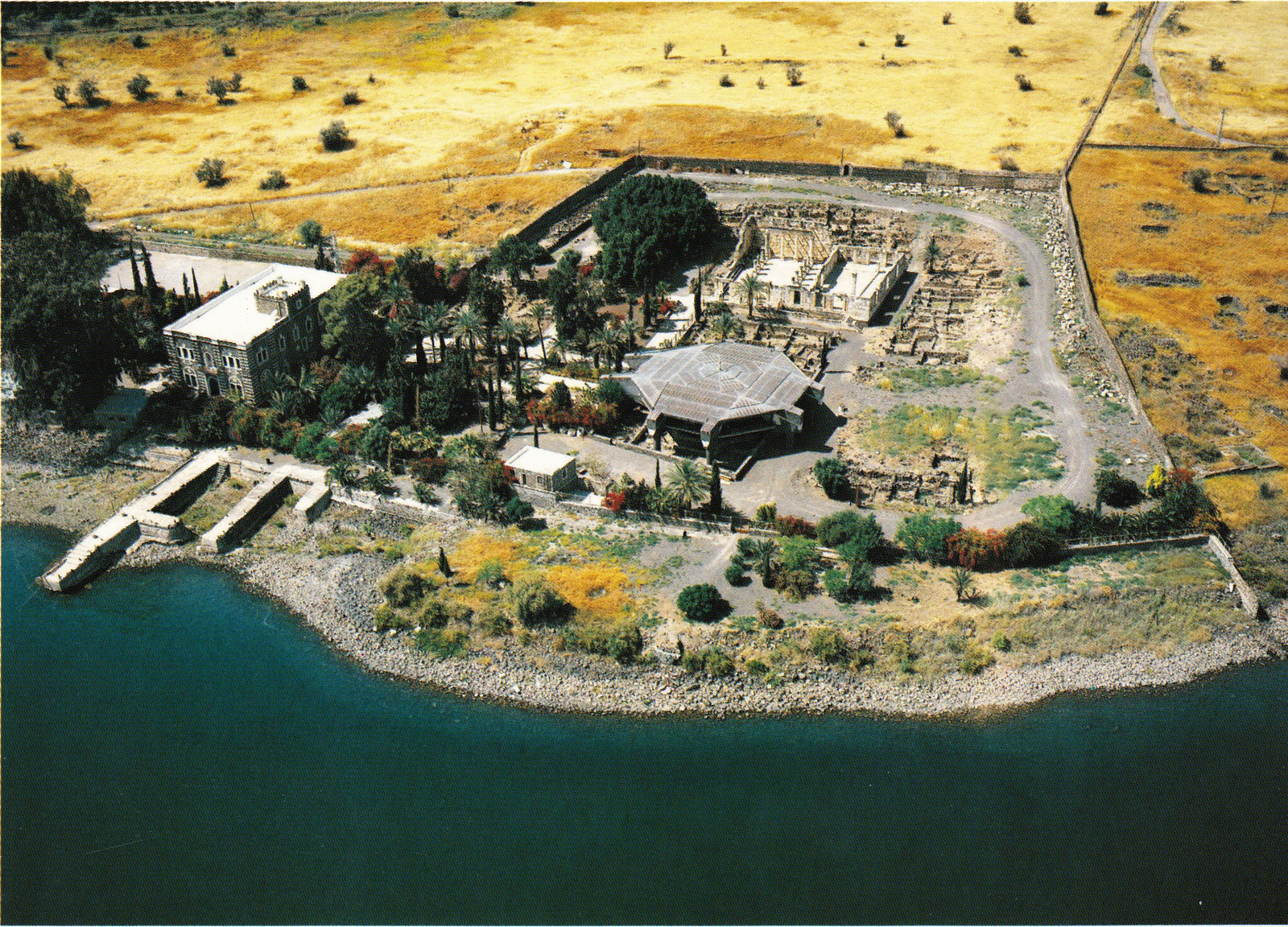
Modern visitors to Capernaum can explore the remains of a beautiful synagogue built in the Byzantine era.  It is one of the best preserved ancient synagogues in the Holy Land.  The large, white limestone blocks and columns stand in sharp contrast to the native stone which is a black basalt (volcanic) stone.  The Byzantine synagogue was apparently built over the site of an earlier synagogue whose floor archaeologists uncovered a few years ago.  It measures 60 feet wide by 79 feet long.  Since building materials were hard to come by, builders often incorporated stable parts of earlier foundations and walls into later structures.  This both concealed and preserved the earlier buildings.  Although we cannot say for certain, this may well be the floor of the synagogue where Jesus preached and exorcized evil spirits in Capernaum (Luke 7.1ff; Mark 1.21-28). 

In the fifth century AD Christians built an octagonal church building south of the synagogue.  Byzantine Christians loved the octagonal form and often used it to commemorate places they considered holy.  The building with its lovely mosaic floors had been constructed over the remains of a 4th century structure (likely a church) that had in turn been built over a first century house.  A particularly strong tradition holds that this is the Capernaum residence of Peter, one of the twelve.  The house of Peter, as it is called, was a modest, one-story house.  Its roof would have been made of branches, thatch and mud, not unlike the roof that was dug out to allow the paralyzed man access to Jesus (Mark 2.1-12).  The plastered walls of the large, central room contain over 150 inscriptions scribed like graffiti in the walls in the various languages of the early church: Greek, Aramaic, Hebrew, Syriac and Latin.

To preserve the house where tradition has it that Peter lived, believers have constructed a new church over the site. Like its ancient counterpart the modern structure has eight sides, but it sits several meters above the site atop eight pillars that describe eight sides.   It hovers above the Byzantine remains preserving and protecting the precious material culture of the past from Capernaum’s warm summers and winter rains.  Today Christian pilgrims, like their spiritual ancestors 1500 years ago, make their way to Capernaum to see the place where Peter lived and where Jesus began to turn the world upside down. 

Jesus and Capernaum (Part 1)

When Jesus heard that John the baptizer had been imprisoned, he left the Jordan valley and went north toward the district of Galilee (Matt 4.13).  His baptism by John in the river had been the turning point of his life.  From here on everything would be different.  Jesus had lived a private life; now he would become a public person.  He had earned his living as a carpenter selling his goods in Nazareth and likely Sepphoris, a larger, more affluent city a few miles away; now he would become a preacher of the Kingdom of God, healing and making disciples throughout Galilee, Judea, Samaria and the Decapolis.  He had grown up in Nazareth; now he would leave behind his hometown and settle in Capernaum.  

But why did Jesus go north to Galilee?  Why didn’t he head straight for Jerusalem, the city of prophets?  Well, the answer is simple.  He was guided by Scripture.  Hundreds of years before Mary labored and gave birth to her male child, the prophet Isaiah had foreseen a day when hope returned to the land mortally wounded by invaders from the north.  He prophesied:

 Isaiah 9:1-2  (NASV)  But there will be no more gloom for her who was in anguish; in earlier times He treated the land of Zebulun and the land of Naphtali with contempt, but later on He shall make it glorious, by the way of the sea, on the other side of Jordan, Galilee of the Gentiles.  2 The people who walk in darkness Will see a great light; Those who live in a dark land, The light will shine on them.

Jesus knew the Scriptures.  He understood that the renewal was to begin up north, in the ancestral lands of Zebulun and Naphtali, districts known in his day as Galilee.   That was only right in the justice of God because it was these regions that fell first to Assyrian and Babylonian aggression.  The villages and towns first to fall and walk in darkness were to be the first to have the light shine upon them.  Jesus was that light.  Capernaum would become his city.

Rather than return to Nazareth, his hometown, the Gospels tell us that Jesus “moved” to Capernaum and made it the headquarters of his ministry.  Capernaum was a village on the north-west corner of the Sea of Galilee.  It was the home of two sets of brothers–Simon and Andrew, James and John.  Fishing provided their families a living on the Sea of Galilee.  The sea also provided plenty of fresh water for the people residing there.  Population estimates during Jesus’ day for the village have conservatively been set between 1200-1700 inhabitants.  Although most of Capernaum’s citizens were Jewish, there is evidence some non-Jews also made it their home.  Still this is no thriving city.  Unlike larger cities it had no wall to protect it, no aqueducts, no colonnaded streets, no administrative buildings and no theater.  Its only significant public space was a synagogue that served as both a place of worship and a community center. Had Jesus not made Capernaum his base of operations, it is likely most would never have even heard of it. 

Join me next for Part 2 of Jesus and Capernaum.

Early Christian Hymns

The first generation of Christ followers gathered regularly in house churches for instruction, encouragement and worship.  A central part of these gatherings was the chanting and singing of hymns.  Explicit reference to the use of hymns in the Christian church is found in Paul’s admonition to sing psalms (psalmoi), hymns (humnoi)  and spirituals songs (ōdē) with gratitudeto God (Col 3:16; cf. Eph 5:19-20).  These three terms likely refer to the practice of using the biblical Psalter along with distinctly Christian compositions.  The worship of God with hymns had its immediate background in Jewish synagogue practices.  Psalms, particularly messianic psalms, were used by early believers to express uniquely Christian perspectives on God’s recent actions in the world. Likewise, Eph 1:3-14 is constructed on a Jewish hymn-pattern known as the berakah (“blessed is . . . “). While the pattern is clearly Jewish, the author used it in a way that is explicitly Christian.  Gentile believers too would have also been accustomed to hymn-singing in the ethos of Greco-Roman religion. 

Scholars have detected hymns and hymn fragments throughout the Gospels, Acts, letters and Revelation utilizing various criteria including introductory phrases (e.g., “therefore it says,” Eph 5:14), poetic parallelism, special uses of relative pronouns and participles, the presence of unusual vocabulary and rhyming features, and disruptions to the context.  Although not all scholars agree, there is a general consensus that the following passages represent early Christian hymns: Rom 11:33-36, Phil 2:6-11, Col 1:15-20, 1 Tim 3:16, 1 Pet 2:21-24, Heb 1:3-4, Rev 4:8-11 and 19:1-4.  These hymns may have been preformed traditions quoted or alluded to by a writer or spontaneous compositions understood to be Spirit-inspired.  Some hymns are so clear and self-contained that later generations of Christians name them (e.g., the Magnificat = Luke 1:46-55; the Benedictus = Luke 1:68-79).  The New Testament contains both hymns to Christ and to God the Father demonstrating a binitarian shape to early Christian devotion.  Furthermore, the content of early Christian hymns is directed to soteriological themes such as creation, incarnation, and redemption.  For early Christ believers hymnic praise was essentially a response to God’s saving actions in Christ.

Though not all agree, many scholars think that the earliest extant Christian hymn is the hymn to Christ found in Phil 2:6-11.  The hymn consists of two parts.  The first narrates the descent and humiliation of the pre-existent Jesus to become a man and to suffer a merciless death on the cross.  The second describes the ascent and exaltation of the crucified Jesus by God to receive the adoration of every creature and confession “Jesus Christ is Lord.”  This hymn functioned to recall the essential story and therefore had a didactic purpose.  Paul utilized it further to make Jesus the lordly example of humility and service (cf. 1 Peter 2:21-24).

By its nature poetic or hymnic language appears to affect those who use it in significant ways. Whether it was chanted or accompanied with musical instruments, hymns were easier to memorize and recall than other forms of instruction.  Therefore, it seems that early Christians used NT hymns for several purposes: (1) to instruct, (2) to express praise and thanks to God, (3) to confess faith, (4) to form communal identity, and (5) to provide an example for proper behavior.

Human Flourishing

Dr. Jonathan Pennington, associate professor of New Testament and director of the doctoral program at Southern Seminary, has written an important, new book on the Sermon on the Mount.  The title is The Sermon on the Mount and Human Flourishing: A Theological Commentary (Baker Academic, 2017).  You can find a link to Amazon here. The book is not exactly new; I’ve known about it for about a year now.  But it is new to me and perhaps to many of you.  Human Flourishing Pennington

Pennington is regarded broadly as an expert on the Gospel of Matthew.  Now, on the way to writing the prestigious Pillar Commentary on the whole Gospel, he paused and wrote an extensive theological commentary on the Sermon.  The Sermon on the Mount (Matthew 5-7) is probably the best known sermon of Jesus.  Oscar Brooks called it “the inaugural address” of Jesus because it laid out the platform for the kingdom of God.

At the heart of Pennington’s book, as the title shows, is an interpretation of the beatitudes and the Sermon as what we would call today “human flourishing.”  Essentially, what wisdom is needed and what virtues must be cultivated in order for humans–or in this case, Jesus-followers–to flourish.  He begins by re-translating the beatitudes (Matt 5.3ff) in a manner like: “Flourishing are the poor the spirit, . . . “; “Flourishing are those who mourn, . . . ”  You get the idea.  He moves the Greek word makarios out of the category of “happy” or “fortunate” or “blessed.”  While the term “human flourishing” may be anachronistic, it is heuristically valuable and gets at the heart of what is the good life and good society.

One of the most important features of the book is Pennington’s commitment to join together the Jewish wisdom tradition with Greco-Roman virtue ethics.  Rather than seeing these as discrete aspects of Galilean/Jewish culture, Pennington invites us to see these as mutually instructive.   He makes a good case for it.  But wisdom here is not just “this worldly,” it also has an eschatological dimension as well.  It is thoroughly Christ-centered and kingdom-focused.

Pastors and scholars have been writing on the Sermon for years.  My first encounter with a book devoted largely to it was Dietrich Bonhoeffer’s book The Cost of Discipleship.  I am not sure the trend will end, but I do think that Pennington’s book is likely to become one of the most significant books on the sermon for years to come.

To get the book, click here.