In fall 2014 I had the privilege of giving the 50th annual Hayward Lectures at Acadia Divinity College in Wolfville, Nova Scotia. The series title was “Paul’s Kyrios Christology.” I’m expanding those lectures into a book to be published in 2017 by Baker Academic entitled An Early High Christology: Paul, the Lord Jesus, and the Scriptures of Israel.
fleetwd1 has done a wonderful job wedding my PowerPoint slides with the video provided by Danny Zacharias at Acadia Divinity College in Nova Scotia. Thanks too to Mike Harris who captured each of the slides for production. Here is a YouTube link to the first lecture on fleetwd1:
I received a copy of James L. Papandrea’s book, The Earliest Christologies: Five Images of Christ in the Postapostolic Age (InterVarsity Press, 2016). I had read and reviewed the book prior to publication so this is my “thank you” copy from the publisher.
Papandrea is an associate professor of church history at Garrett-Evangelical Theological Seminary at Northwestern University. He has written other books on the Church Fathers and Trinitarian theology.
The second century (AD or CE, if you prefer) was a crucial period for what would become the Christian Church. A great deal is thought out, worked out, argued out about key issues like: What books do we read as Scripture? How do we relate to the Jews and other religions? How do we live out our distinctive calling? Who was Jesus . . . really?
It is this last question which occupies Papandrea’s attention for 127 pages. Was the Christ a man who was temporarily inhabited by the divine? Was he a spirit that only appeared to be flesh? Was he the enfleshing of the divine Logos? Was he a righteous man adopted by God for a special purpose?
In short, Papandrea has taken a complex and daunting set of texts from long ago and helped his readers sort out the language, concepts, and images. By its length and scope it is an introduction so it is on a shelf everyone can reach. Papandrea describes five views of Jesus in this period: Angel adoptionism, Spirit adoptionism, Docetism, Hybrid Gnosticism, and Logos Christology. Each idea was current among a sizeable group of Jesus people in the second century and, in some cases, beyond. But ultimately the Church would land on one option to answer the perennial question: “Who do you say that I [Jesus] am?” The only reason you haven’t probably heard some of these other options is because they were deemed insufficient, wrong, and heretical. So, over time, they died out. Ironically, vestiges of these approaches to Jesus remain in “orthodox” Christianity, but that’s another post.
The next time I teach this period and topic, I will be using The Earliest Christologies by James Papandrea.
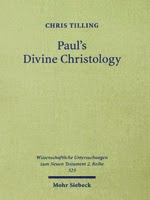
Chris Tilling’s important book Paul’s Divine Christology has been published in America by Eerdmans. I paid nearly $100 for it 2 years ago. Now you can get it on Amazon or through Eerdman’s for $25 or so. I recommend it highly if you have interest in how early Christians thought about and assessed the significance of Jesus. Here are excerpts from an earlier post that laid out the thesis of the book.
****************************
About 18 months ago I purchased a copy of Chris Tilling’s book Paul’s Divine Christology (WUNT 2.323; Tuebingen: Mohr Siebeck, 2012). Because I was busy writing and traveling, I had not had a chance to do anything more than browse it. This summer I’ve had a chance to sit down with mechanical pencil and highlighter in hand.
Chris is part of a new generation of scholars interested in the historical development of early Christianity. Born in 1975, Chris studied at the University of St. Andrews and completed his PhD at the London School of Theology. Although I don’t know exactly where he is teaching now, he has served as a tutor in New Testament at St. Mellitus College in London.
Chris Tilling
I don’t intend to do a full review of the book here but simply to alert you to a book which I—and many others—regard as an important contribution to the field. I’ll engage him more fully in a new book I’m working on tentatively entitled An Early High Christology: Paul, Jesus, and the Scriptures of Israel. That one, God willing, will be published in 2017.
Paul’s Divine Christology is Tilling’s contribution to a debate which has been going on over the last 30 years regarding whether Paul’s Christology can properly be described as “divine,” in what sense, and how it came to be. Tilling answers the question in the affirmative: Paul’s Christology is indeed a divine Christology. Other scholars (Gordon Fee, Larry Hurtado, Richard Bauckham, and I) have been arguing a similar point. Assuming the work of others on this topic (Cullmann, Hengel, and Moule, for example), each of us has offered something unique to the discussion. Tilling does a good job in setting the table, working through the primary and secondary sources, and offering a new pattern of data which had been noticed (by C. F. D. Moule) but not fully described.
A phrase which carefully summarizes Tilling’s approach is this: “the Christ-relation is Paul’s divine-Christology expressed as relationship” (p. 3). For those who have dabbled in Paul you realize that Christ-relation language is significant so significant that some scholars regard the center of Paul’s theology to be “participation in Christ,” a shorthand way of describing the many ways in which the Christ-believers stand in relationship to and participate in the life of Christ. Christ’s relation to his people stands in direct continuity with YHWH’s relation to his people Israel. To put it another way, when Paul speaks about the relation between Christ-believers and the risen Jesus, he used the same language and themes found in second temple Jewish texts to speak of Israel’s relation to YHWH. Tilling consistently says the data forms a pattern which Paul himself would have recognized. In Tilling’s own words:
[I]t will be maintained that this pattern of Christ-relation language in Paul is only that which a Jew used to express the relation between Israel/the individual Jew and YHWH. No other figure of any kind, apart from YHWH, was related to in the same way, with the same pattern of language, not even the various exalted human and angelic intermediary figures in the literature of Second Temple Judaism that occasionally receive worship and are described in very exalted terms. (p. 73, italics original)
In brief, I think Tilling is on to something important which scholars have noticed but frankly neglected.
I wrote the article “Christology” for Oxford Bibliography On-line. When I revise the article—which I have been asked to do recently—I will be sure to include Tilling’s book. It is one of the most important books on Paul’s Christology written in the last few decades. If you’re interested in these matters, go out and buy your own copy of Tilling’s book. If that is not possible, borrow a copy from your local library. Even if the library does not have it, most will have some sort of interlibrary loan program.
Chris Tilling’s important book Paul’s Divine Christology has been published in America by Eerdmans. I paid nearly $100 for it 2 years ago. Now you can get it on Amazon or through Eerdman’s for $25 or so. I recommend it highly if you have interest in how early Christians thought about and assessed the significance of Jesus. Here are excerpts from an earlier post that laid out the thesis of the book.
****************************
About 18 months ago I purchased a copy of Chris Tilling’s book Paul’s Divine Christology (WUNT 2.323; Tuebingen: Mohr Siebeck, 2012). Because I was busy writing and traveling, I had not had a chance to do anything more than browse it. This summer I’ve had a chance to sit down with mechanical pencil and highlighter in hand.
Chris is part of a new generation of scholars interested in the historical development of early Christianity. Born in 1975, Chris studied at the University of St. Andrews and completed his PhD at the London School of Theology. Although I don’t know exactly where he is teaching now, he has served as a tutor in New Testament at St. Mellitus College in London.
Chris Tilling
I don’t intend to do a full review of the book here but simply to alert you to a book which I—and many others—regard as an important contribution to the field. I’ll engage him more fully in a new book I’m working on tentatively entitled An Early High Christology: Paul, Jesus, and the Scriptures of Israel. That one, God willing, will be published in 2017.
Paul’s Divine Christology is Tilling’s contribution to a debate which has been going on over the last 30 years regarding whether Paul’s Christology can properly be described as “divine,” in what sense, and how it came to be. Tilling answers the question in the affirmative: Paul’s Christology is indeed a divine Christology. Other scholars (Gordon Fee, Larry Hurtado, Richard Bauckham, and I) have been arguing a similar point. Assuming the work of others on this topic (Cullmann, Hengel, and Moule, for example), each of us has offered something unique to the discussion. Tilling does a good job in setting the table, working through the primary and secondary sources, and offering a new pattern of data which had been noticed (by C. F. D. Moule) but not fully described.
A phrase which carefully summarizes Tilling’s approach is this: “the Christ-relation is Paul’s divine-Christology expressed as relationship” (p. 3). For those who have dabbled in Paul you realize that Christ-relation language is significant so significant that some scholars regard the center of Paul’s theology to be “participation in Christ,” a shorthand way of describing the many ways in which the Christ-believers stand in relationship to and participate in the life of Christ. Christ’s relation to his people stands in direct continuity with YHWH’s relation to his people Israel. To put it another way, when Paul speaks about the relation between Christ-believers and the risen Jesus, he used the same language and themes found in second temple Jewish texts to speak of Israel’s relation to YHWH. Tilling consistently says the data forms a pattern which Paul himself would have recognized. In Tilling’s own words:
[I]t will be maintained that this pattern of Christ-relation language in Paul is only that which a Jew used to express the relation between Israel/the individual Jew and YHWH. No other figure of any kind, apart from YHWH, was related to in the same way, with the same pattern of language, not even the various exalted human and angelic intermediary figures in the literature of Second Temple Judaism that occasionally receive worship and are described in very exalted terms. (p. 73, italics original)
In brief, I think Tilling is on to something important which scholars have noticed but frankly neglected.
I wrote the article “Christology” for Oxford Bibliography On-line. When I revise the article—which I have been asked to do recently—I will be sure to include Tilling’s book. It is one of the most important books on Paul’s Christology written in the last few decades. If you’re interested in these matters, go out and buy your own copy of Tilling’s book. If that is not possible, borrow a copy from your local library. Even if the library does not have it, most will have some sort of interlibrary loan program.
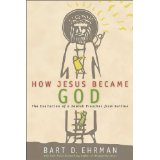
I’m heading to San Diego to attend the Annual Society of Biblical Literature meeting. I’m meeting with former and future publishers, scholars, and a variety of former students. One of my duties while there is to preside over a session of a program unit called The Extent of Theological Diversity in Earliest Christianity. The session will offer a panel review of Bart Ehrman’s new book, How Jesus Became God: The Exaltation of a Jewish Preacher from Galilee. The title and subtitle tells you the essential story; Ehrman suggests that Jesus was understood first as Jewish itinerant teacher from Galilee; only later did his disciples claim he is divine. How much time goes by he does not say, but apparently he thinks in some circles it happened early even though it took centuries for the language to be worked out in church councils. Accordingly, Jesus didn’t regard himself as divine in any sense, nor did his earliest disciples. Jesus was, in fact, an apocalyptic prophet who announced the end of the current evil age. He did believe and describe himself as the coming king of God’s future reign, the Messiah of God. Once the disciples came to believe that Jesus had conquered death and was exalted to God’s right hand, they came to hold to his divinity. It is an important new book, some say his most significant book to date.
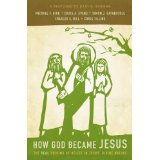
The book is published by HarperOne, an imprint of Harper Collins. Interestingly, when Bart’s book was being prepared, someone got the idea to commission a group of other scholars to respond to the book. This happened at Zondervan, which is now part of the Christian Publishing Group of . . . yep, Harper Collins. Nice stroke. Both ways, they win. “Heads, I win. Tails, you lose.” So editors at Zondervan appointed Michael F. Bird of Ridley College in Melbourne, Australia to edit the book, and he assembled an impressive group of internationally recognized scholars to answer various aspects of Bart’s book. Their book is entitled How God Became Jesus The Real Origins of Belief in Jesus’ Divine Nature. On the cover it also says it is “a response to Bart D. Ehrman.” The scholars Bird assembled include: Craig Evans, Simon Gathercole, Charles Hill, Chris Tilling. Each scholar takes on a different challenge. For example, Craig Evans addresses the question of burial practices at the time of Jesus. Ehrman claims Jesus was not buried; instead, in keeping with what happened with other crucified persons, Jesus’ corpse became food for scavengers. If there was no burial, there could be no empty tomb, so those traditions must have been invented by early Christians convinced Jesus somehow conquered death. Professor Evans presents evidence that crucified people were occasionally buried and makes the further claim that Jesus must have been one of them. This is the way it goes. Point. Counterpoint.
Both books make an important contribution to the study of early Christianity, in particular how early Jesus’ followers came to regard him as divine. In the history of the west and of the Christian church this may well be one of its most significant chapters.




 A Word in Edgewise
You must be logged in to post a comment.