Page 98 of 116

Slow to Judge

Last week I had the great honor of flying to Nashville to present at the sales conference for Harper Collins Christian Publishing (Zondervan & Thomas Nelson).  I spoke briefly on the topic of a book I have coming out next summer with Thomas Nelson entitled Slow to Judge: Sometimes It’s OK to Listen.  The book is about a lot of things, but it is especially about the problem Christians have of being judgmental and being perceived as anti-this and anti-that.  Too often Christians are defined by what they are “against.”

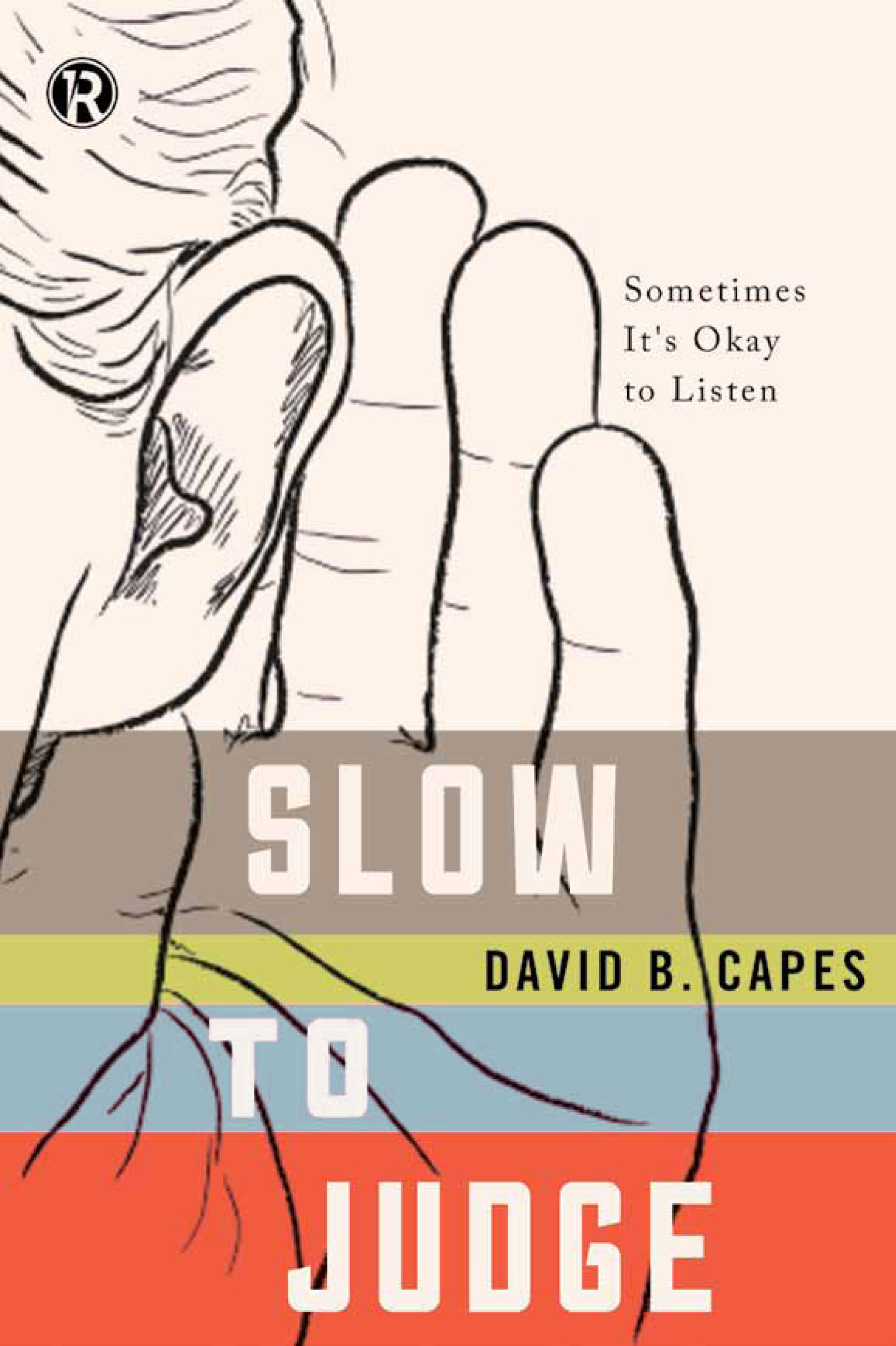
An early version of the cover art for SLOW  TO JUDGE
An early version of the cover art for SLOW TO JUDGE

The big idea in this book is that it is possible to stand up for your faith, bear witness to it, defend it against detractors and yet not do so in a judgmental way because we have taken James’ advice: be quick to listen and slow to speak.

The book is part of the Refraction Series.  Here is a link to 2 minute video on YouTube about the series:

https://www.youtube.com/watch?v=omBd_s13jfI

If you are interested in culture and faith, then you will want to track this series.  The first book is already out: How to Pick up a Stripper and Other Acts of Kindness by Todd Stephens.  A second book is out as well: The Reluctant Journey: Fulfilling God’s Purpose for You by Richard Leslie Parrott.

Slow to Judge is scheduled to release next summer.  I hope you’ll look for it particularly if you find yourself up close and personal with Muslims, Jews, Buddhists, and people from an assortment of faiths or no faith at all. It is chocked full of Scripture and events which have taken place over the last 30-40 years.  We’re living in interesting times. Here are my chapter titles:

Chapter 1        A Listening Heart

Chapter 2        “Do Not Judge” . . . Really?

Chapter 3        A Book by Its Cover

Chapter 4        Love & Forgiveness

Chapter 5        Homophobia, Islamophobia, Christophobia

Chapter 6        The Problem with Tolerance

Chapter 7        Authentic Tolerance

Chapter 8        Listening to a Muslim: Fetullah Gülen

Chapter 9        Listening to the Pagans: C. S. Lewis

From time to time I’ll share an excerpt from the book.  In the meantime watch for the Refraction Series.  The goal of the series is to help align God’s people with God’s purposes. My own effort has grown out of a radio show I co-host called “A Show of Faith.”  It airs Sunday evenings 7 to 9 pm (Central time) on 1070 KNTH The Answer out of Houston.  But, you can listen live weekly via the Internet or on the I Heart Radio app.

Is There a Better Word than “Lord”?


Recently, I gave the Hayward Lectures at Acadia Divinity College in Wolfville, Nova Scotia.  My topic was “Paul’s KYRIOS Christology.”  Kyrios is a Greek word most often translated “Lord” in English Bible translations.  Paul uses the word about 200 times in his letters to refer to his Lord, Jesus Christ.  On a few occasions he used the word in reference to God, the Father. The word can be used of people as well who possess some sort of recognized, superior status, a king, a master of slave, for example. logo_kyrios

One night after the lecture during the Q&A time, someone asked a good question. It had to do with the English word “lord” or “Lord” as a translation of Kyrios.  The fellow knew about The Voice translation and he appreciated that we had tried to find new words and associations which communicate well to a modern audience.  We translated words like Christos as “the Anointed” rather than “Christ.”  We translated apostolos as “emissary” rather than “apostle.” So he asked, is there a better word than “Lord” to translate kyrios?

The word “Lord” was used first to translate kyrios and other biblical words for English-speaking audiences in the middle ages when the upper classes were referred to as “my lord” or “my lady” by those who occupied lower status.  Given the sensibilities of the modern world, the fellow wondered whether there was a better word.  Though those titles are still used in some societies, they are rare in many countries including the United States.  They have lost currency in many places. The use of “Lord” is restricted to religious language most often referring to God, Christ or, in some cases, the Holy Spirit.  For some “Lord” functions as a name or title for God.

Well, I had no answer. No one had ever asked me that question before so I had never thought about it.  I’m embarrassed to admit I had no response given the fact that we rethought so many of the other key religiously-laden words. I’m still puzzling over it.  I’d be interested in your thoughts.  Is there a better word than “Lord” to translate kyrios in modern English? It would have to have the right meaning and sets of associations. It would need to convey the idea that the person holding the title had supreme authority and power.   Since it is most often used in the New Testament as a title for Jesus linking him with the One, True God, it must be an appropriate honorific (fancy word for “title”) for the Liberating King. I’m hard pressed to come up with anything. If we put our heads together, I bet we can think of something.  Then again, maybe not?!

Michael Bird’s Review of THE VOICE translation

Dr. Michael F. Bird is a well known New Testament scholar.  When I met him a few years ago, he was teaching at Highland Theological College in northern Scotland.  Since then he has taken a prestigious post in Australia at Ridley Melbourne College.  Recently, he offered some reflections on The Voice translation.  Mike Bird

Here is his review: http://www.patheos.com/blogs/euangelion/2014/10/reflections-on-the-voice-bible/

Dr. Bird is an able commentator on culture and Scripture.  Look for his books and blogs.  In addition, he is one of the funniest people I’ve met, especially among scholars who tend to be a rather dour lot.  While Dr. Bird takes his subject seriously, he doesn’t take himself too seriously.   One person has called him the Conan O’Brien of evangelical scholars.

One God, One Lord

In a few weeks I’ll fly to Nova Scotia to give a series of lectures at Acadia Divinity School.  The lecture series is known as the Hayward Lectures.  Some of the best scholars in the world have been invited to give the Hayward Lectures.  I’m not sure why they invited me.  I’m not being modest.  I’m being truthful.  The list of past lecturers is a veritable “Who’s Who” in biblical studies: N. T. Wright, James D. G. Dunn, John Stackhouse, John J. Collins, Edith Humphreys, Emmanuel Tov, James Charlesworth,  just to name a few.  So I’m honored to be part of this series. Acadia Divinity College

My topic is academic but it has to do with what it meant for early Christians to call Jesus “Lord.”  Where did the title come from?  What did they mean by it?  One of the passages I’m considering in the lectures is 1 Corinthians 8:5-6 (from The Voice):

And even if the majority believes there are many so-called gods in heaven and on earth (certainly many worship such “gods” and “lords”), this is not our view. For us, there is one God, the Father who is the ultimate source of all things and the goal of our lives. And there is one Lord—Jesus the Anointed, the Liberating King; through Him all things were created, and by Him we are redeemed.

The passage is Paul’s unique modification of a Jewish prayer and confession known as the Shema: “Hear, O Israel, the Lord is our God, the Lord is One” (Deut 6:4).

Paul’s expanded-Shema acknowledges the unfortunate reality of idolatry in the world and then trumps the claim that the world is populated with many so-called gods and lords.  They may be called “gods,” but “gods” they ain’t (if I can borrow a southern expression).  They may be called “lords,” but “lords” they ain’t.  For us (Christ-believers) there is One God, the Father, the source and goal of all reality, and One Lord, Jesus Christ, the agent of creation and redemption.

The confession Paul makes is properly-speaking binitarian.  It sees the two—God, the Father, and Lord, Jesus Christ—in unity.  The two are one.  We are not dealing with any sort of primitive ditheism, that is, two separate and distinct gods.  As a Jew Paul was an exclusive monotheist but now—given all that the God of Abraham has been up to—he understood that Jesus somehow must be reckoned within God’s unique covenant identity.

We should not fail to notice that the title “Lord” here, associated as it is with Jesus, has its roots in the Shema.  Spoken versions of the prayer substituted Adonay (Lord) for the divine name out of reverence for the name, but it is clear the original contains the covenant name of God: “Hear, O Israel: The LORD (YHWH) is our God, the LORD (YHWH) is One” (Deut 6:4, my translation). In The Voice we translated  every occurrence of the divine name as “The Eternal One” or “Eternal One.”  You can read about that in earlier posts.

AcadiaDivinityThe link between YHWH and Jesus in Paul’s version is unmistakable and remarkable.  What makes it all the more remarkable is that Jesus is not a figure of the ancient past whose legend and stature build over the centuries, but a man who recently walked the earth with people Paul himself had met and knew (Galatians 1).  The claim is audacious.  The link—if it were a fiction—would be scandalous.


In the Future Universities Will Not Need Libraries (Part 2)

My last post made a lot of people nervous.  The title was intentionally provocative and hyperbolic.  When Jesus said, “If your right hand offends you, cut it off and throw it away.  It is better to enter life with one hand than be thrown headlong into hell with two good hands” (my paraphrase), he was not advocating self-mutilation.  Some poor souls, however, appear to lack any nuance and can’t get beyond the literal reading.  My statement was like that.  It was provocative but not meant to be taken literally.empty shelves 2

I do think university libraries in the future will change and must change.  Digital technologies are here to stay and need to be incorporated into the mix. Cost and space are key factors here.  E-books generally cost less than their print versions.  You can hold thousands of books in a rather limited space.  With print-on-demand and small start up publishers the number of books produced each year is mind-boggling though most of those don’t deserve a place on any university library shelf or hard-drive.  For certain kinds of research, depending on the discipline, ebooks and digital formats work well. Case in point.  I recently finished writing a book for Thomas Nelson entitled “Slow to Judge.”  It will be released in July 2015.  When I received back my draft from the copy-editor, he/she had asked about several footnotes.  I had included the author and title but not the page numbers.  In several cases I didn’t own the books; they were from interlibrary loan.  So what did I do?  It was simple.  I went to Google Books on the Internet, found the title, then typed into the search-line part of the sentence I was looking for. Within seconds I was back to the quote and could see the page number.  In one case I realized I had not quoted accurately, so I made the appropriate changes and updated the footnote.  Each correction took me only a few minutes.  If I had to wait on Interlibrary loan, the changes would have taken several days not several minutes.  For cleaning up loose ends digital versions and the Internet are extremely valuable.

I don’t think, however, we are wise to try and do without books, journals, and other resources in print. I’m aware of a number of schools recently established which plan not to build libraries; instead they will have their students exploit available technologies. The verdict is out.  Will they be successful?  I’m not sure.  You see there are things you can do with a book in print you cannot do with a digital version.  Likewise, you can easily browse shelf after shelf looking for relevant titles you didn’t know existed.  On a number of cases I’ve gone to the library looking for a particular book I need for research only to discover 3 or 4 other books significant to the question I was investigating.  The brows-ability (I don’t think that’s a word. I just made it up.) of a standard library shelf is a thing of beauty and utility.

Not long ago I took about 20 graduate students through an exercise on how to read a book. I gave each student a copy of a book I’d co-authored REDISCOVERING PAUL (IVP, 2007).  I then showed them a number of strategies for quickly getting to the heart of a book.  What is this book about?  What is the big idea of this book?  As part of the exercise, I showed them the value of the “back matter.”  Back matter refers to the indices in the back of a book.  Most people ignore them because they don’t seem particularly relevant or interesting.  Not all books have them; but all good books have them, particularly the kind of books I want them using in research.  As part of the exercise, I showed them how to use scripture and ancient literature, author, and topic indices.  I told them: “If I have a text or a topic, then I can go to the library shelves pull down 10 books and in 20 minutes know which book will help me in my research and where the important page numbers are.”  Is this possible in digital format?  Not really.  First, you don’t have a brows-able shelf, and second, you can’t quickly flip from back matter to text.  It would take much more time in digital format.  You would miss a great deal in the process. Empty shelves at Princess Marina LibraryFinally, don’t forget the value of having a quiet, clean, and unencumbered space.  Stay home and try to research and you’ll be interrupted by 10,000 thoughts.  “I need to take the dogs out.” “I need to do laundry.” “I need to update my software.” “I forgot to clean the toilet.”  These thoughts and chores will interrupt you at home. When you leave your living space for library space, you leave those cares and thoughts behind.  You can focus on the task at hand.  It may not be as “organic” to your life, but it will get the job done better and more efficiently.

I’ve had the privilege of doing two (all too brief) sabbaticals at the Univ of Edinburgh in 2000 and 2009. I was appointed visiting fellow at New College which meant among other things library privileges.  In those short months I was able to accomplish more in the New College library the old fashioned way with books, journals, and copiers (OK, copiers aren’t really old fashioned) than would be possible using digital technology.

So, what do you think.  Will universities need libraries in the future?  I’d answer with a resounding “YES.”