Page 2 of 4

Who does Mark say that I AM?

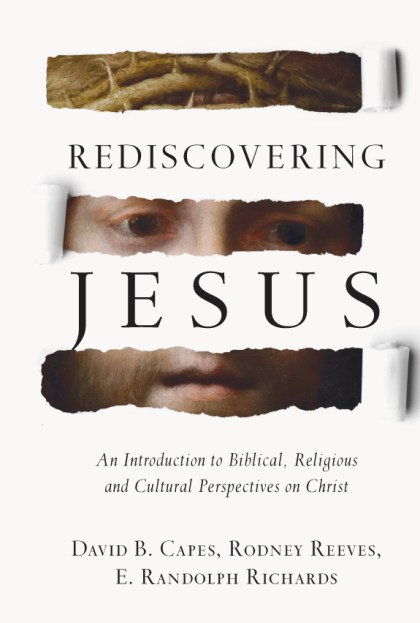
One of my favorite features of our book, Rediscovering Jesus (InterVarsity, 2015), comes in the Gospels themselves.  In each chapter we ask the question: Who does Mark/Matthew/Luke/John say that I am?  In effect, we take a look at how each evangelist tells the story of Jesus.  Here is an excerpt from the chapter on the Markan Jesus.

WHO DOES MARK SAY THAT I AM?

And who is this Jesus? He is the Messiah (Christ) and Son of God—that is, God’s end-timeRediscovering Jesus agent whose task is to liberate the world from evil, oppression, sin, sickness, and death. The world that Jesus enters is hostile and contrary to the human race. The Messiah appears in order to claim all that God has made on behalf of heaven. In Mark’s account Jesus moves quickly along “the way” challenging and disrupting demonic powers, disease, religious authorities, storms and, ultimately, the power of Rome itself.
But Jesus does not appear from nowhere; prophets such as Malachi and Isaiah have written of him long ago. They foresaw his coming, and John the Baptizer arrived right on schedule to prepare his way. If John is God’s messenger (Mal 3:1) and the voice crying out in the wilderness (Is 40:3), then surely Jesus is the “Lord” whose paths must be made straight (Mk 1:2-3). But the word “Lord” here is no polite address to an English country gentleman or a simple affirmation of a person in authority; it is the way Greek-speaking Jews uttered the unspeakable name of the one, true God of Israel. Jesus the Christ is no ordinary man, for the very name of God—a name protected by the Ten Commandments—belongs rightly to him. As Mark’s story unfolds, it is apparent why this is so.

When Jesus heard that a prophet had again appeared in Israel, he left Nazareth to see for himself. As he entered the Jordan River to be baptized, onlookers would have thought that Jesus was becoming a disciple of John. But it was what Jesus heard and saw next that dramatically changed his life. He saw a vision: the heavens were ripped open, and the Spirit descended on him like a dove. Then he heard a voice from heaven: “You are my Son” (Ps 2:7) and “with you I am well pleased” (Is 42:1). Whether or not anyone else saw or heard what was going on in the heavens that day is unclear. Mark tells us only that Jesus saw and heard; perhaps Jesus’ special sonship was a secret that needed protecting for a while. But it was enough for Jesus to see and hear it, because it was about him and him alone. He knew what he must do next. He must leave behind Nazareth and the anonymity of the workshop for a public life in Galilee and beyond. He must trade a builder’s tools for the skills of a traveling rabbi.


To read more, check out our book here.
Echoes of Scripture in the Gospels

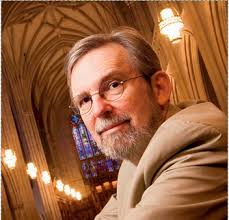
Richard B. Hays completed his new book Echoes of Scripture in Gospels (Baylor University Press, 2016) in record time thanks in large part to the heavy-lifting done by Carey Newman and his staff at Baylor University Press.  Hays was diagnosed with pancreatic cancer in the summer of 2015 and underwent successful surgery in the fall.  He stepped down from his role as dean of Duke Divinity School for medical treatment and used part of his recovery to finish up this book. Richard Hays

This book extends an earlier project, Reading Backwards: Figural Christology and the Fourfold Gospel Witness (Baylor University Press, 2014). It echoes an even earlier bit of research written up in Echoes of Scripture in the Letters of Paul (Yale University Press, 1993).  In the book under review Hays turns his attention to the four New Testament Gospels with similar method and surprising results.

Hays is influenced by Eric Auerbach’s approach to “figural interpretation” in his  book Mimesis: The Representation of Reality in Western Literature (Princeton University Press, 2013).  Figural interpretation involves linking two texts so that a past person (or event) signifies that person as well as another in the future.  The interplay between those two texts brings greater insight to both texts.  Each sheds light on the other.  It is a way of “reading backwards.” This has nothing to do with past predictions which are “fulfilled” in the future, although there are places when Gospel writers make those kinds of connections as well.  At the heart of it is the notion that a text might mean more than a human author ever intended. Once a writer has released his text, later audiences are able to read backwards through significant events/persons in order to see connections to these earlier texts.  The NT is awash in figural readings of the OT.

Hays does not spend his time working out and fine tuning a method.  In a sense he has done that already in earlier books mentioned above.  What he does do is work carefully through many Gospel texts listening for the echoes and helping his readers see and experience these in fresh and exciting ways.  One of my favorite examples is in the episode when Jesus walks on the sea of Galilee (Mark 6).  Although Mark does not make any explicit biblical allusions, the way he tells the story conjures up certain images from the first part of the Christian Scriptures.  In particular, he notes how Mark says Jesus appears to intend to pass them by and ends the pericope with the hanging question: “who is this that the winds and the seas obey?” As Hays says, there is only one right answer to that question.  It is found in Job 9, particularly the Greek version (LXX).  I won’t spoil the ending completely but Hays and I both think there is a not-so-subtle identification of Jesus with the God who created the land and seas in the first place.  Go back and read Job 9 in the Greek and it is apparent.

Hays is an advocate of an early high Christology, compared to the late, slow and low crowd. This means that the earliest evidence we have (the letters of Paul and the NT Gospels) are best read to include Jesus within the identity of Israel’s God.  As a charter member of the early high Christology club, I’m glad to make him a full-fledged member.

This is an amazing book. I cannot recommend it any higher.  I’m so glad to have it in hand as I’m thinking about a future book I’m working on entitled Matthew through Old Testament Eyes (Kregel, forthcoming 2018 or 2019).

A Man Attested by God


Daniel Kirk has written an important new book entitled A Man Attested by God: The Human Jesus of the Synoptic Gospels (Eerdmans 2016).  At the heart of his project is an attempt to resuscitate an idealized humanity at the heart of the Gospels.  The tendency for many, he thinks, is to read Matthew, Mark, and Luke through the lens of John’s Gospel or of Paul’s divine Christology expressed in say, the Philippian hymn (Phil 2:6-11).kirk-a-man-attested

For Kirk Jesus is an extraordinary figure of history.  But he is not just extraordinary because of his deity; he is extraordinary because of his humanity.  The grand scheme of the Bible presents the God of Israel as One who does not give up on humanity.  From the beginning (Genesis) God had a great plan and vision for what humanity was supposed to be.  So Kirk proposes that the Synoptics offer a high human Christology (a play on words based on the emerging consensus of “an early high Christology”).  In this case high does not equal divine, but a fully realized and idealized humanity. In other words the Synoptic Gospels present us with a Jesus who is everything humanity was created to be.

Now Kirk doesn’t deny the orthodox picture of a divine Christ.  He just thinks the Synoptics are telling a different sort of story, a story that can be easily lost in accentuating Jesus’ divinity.  As long as we stress Jesus’ divinity, we don’t have to take seriously what it means to walk as he walk, live as lived, love as he loved.  In other words “following Jesus.”

Kirk’s monograph stands in contrast to recent work done on the Gospels by the likes of Larry Hurtado, Richard Bauckham, and even his own former teacher, Richard Hays.  But more about this in another post.

Figural Reading . . . the Old in the New

Last year I had the great honor of being on a panel discussion at the Lanier Theological Library with some leading scholars.  The topic was “Figural Reading . . . the Old in the New.” Richard Hays had written an important book on the topic entitled, Reading Backwards: Figural Christology and the Fourfold Gospel Witness (Baylor University Press, 2014). That was the topic of our discussion.  It is an outstanding conversation hosted by Mark Lanier.

Richard Hays (Dean, Duke Divinity School)
Lynn Cohick (Professor, Wheaton College)
Carey Newman (Director, Baylor University Press)
David Capes (Professor, Houston Baptist University)
Mark Lanier (Moderator)

Here is a link to the site:

http://www.laniertheologicallibrary.org/seminar-videos-2/

The discussion takes place over 1 hr and 43 minutes.  If you’re interested in how NT writers read, interpreted and used their Bible–what we call the Old Testament but specifically the Greek version of the Old Testament–this will be a good video to watch.

I’m humbled and gratified to be a part of these conversations.


Jesus the God-Man

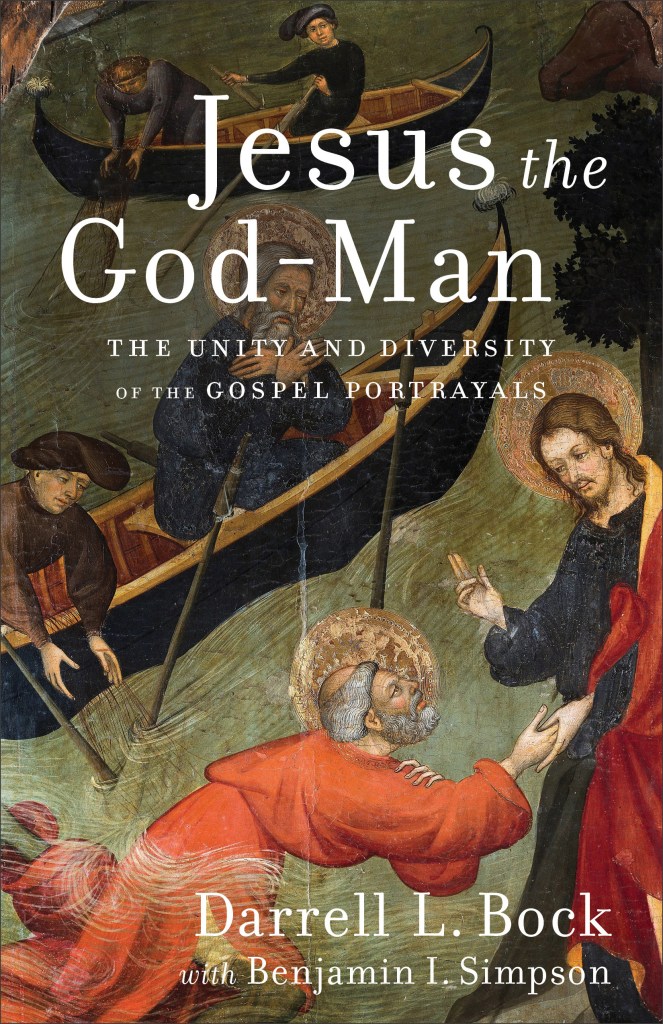
On my summer reading list is a new book by Darrell Bock and Benjamin Simpson, both faculty members at Dallas Theological Seminary.  The title of the book is Jesus the God-Man: The Unity and Diversity of the Gospel Portrayals (Baker Academic, 2016).  Bock and Simpson treat the Gospels as reliable sources for the life of Jesus, and they do give us a coherent, new reading of these diverse texts.  They are not just concerned with the Christ of faith but the Jesus of history, to use the traditional terms. Bock Jesus God-Man

It is typically understood that the Synoptic Gospels—Matthew, Mark, and Luke—provide us with the story of the human Jesus of Nazareth, God’s Anointed; the story of the Christ from above, that is the incarnate Word, is the subject of John’s Gospel.  Not so fast . . . Bock and Simpson say.  The portrayals in the Synoptics and John are far more interesting and complex.

At the end of the day, Bock and Simpson demonstrate that the Gospels give us different stories, different portrayals; but in their analysis their accounts are complementary not contradictory.  The Divine Christ is not absent from the Synoptics. The earthly Jesus is not alien to the Fourth Gospel.