Page 8 of 10

Jesus Monotheism

I met Crispin Fletcher-Louis in 1998 at a conference at St. Andrews. He was a rising star in historical and theological matters relating to the origins of Christianity. His star continues to rise.

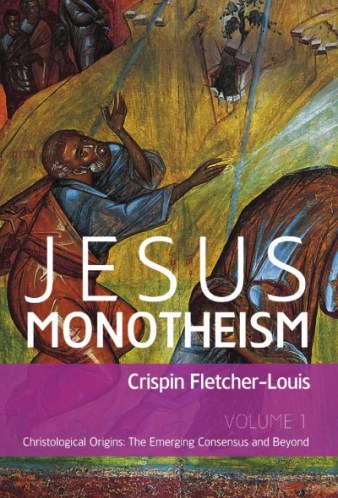
Recently he published the first volume of a four volume series entitled Jesus Monotheism. This particular volume is Christological Origins: The Emerging Consensus and Beyond (Cascade, 2015).

In this series Fletcher-Louis hopes to explain how it happened that early Jesus-followers came to see him as divine and worshiped him in continuity with the worship of the One God of Israel (what I like to call an early high Christology). His purpose is historical: where did it happen? With whom? What caused it? What shape did it take?jewish-monotheism
I’ll have more to say on this in an upcoming article.  For now at least let me introduce the key elements.

Fletcher-Louis thinks that there are antecedent traditions which anticipate the inclusion of Jesus in the divine identity (Bauckham’s phrase). While the worship of Jesus alongside God and beliefs in his divine identity are new and surprising, they could have been anticipated if we were attuned correctly to certain movements and ideas within second temple Judaism.

Fletcher-Louis situates the causative factor for an early high Christology not in powerful religious experiences post-resurrection but in Jesus’ own self-awareness. He claims that the historical Jesus had an incarnational self-consciousness. The resurrection, of course, is a key event. For the crucifixion appears on the surface to deny Jesus’ messianic and divine claims. In the event Christians call the resurrection something happened to reverse the negating elements of Jesus’ death and confirm not only that Jesus is Israel’s Messiah but that he is also the incarnation of a divine being. Now, for those of you who’ve been following the scholarship in this arena, that is a bold claim.

Fletcher-Louis starts with the emerging consensus. Frankly, I don’t know recall who coined the phrase but it is a good one. The emerging consensus among many scholars is that a divine Christology is indeed early (that’s why I am a founding member of the early high Christology club) and located historically within Jewish milieu. It did not arise late in the first century only after Gentiles had streamed in and overtaken the Jesus movement.   Divine Christology means that early followers included Jesus within the divine identity and engaged in actions toward him which can only be described as worship, or as Larry Hurtado has put it “Christ devotion.”

There are scholars, however, who haven’t emerged. These include Maurice Casey, Jimmy Dunn, James McGrath, and Bart Ehrman.

To this point Fletcher-Louis finds himself in broad agreement with the emerging consensus and its leading lights, Hurtado and Bauckham. Where he goes “beyond” is to try to locate (historically) the belief in a divine Messiah in pre-Christian Judaism and in the self-awareness of Jesus. Jewish writings which could have a pre-Christian origin such as the Life of Adam and Eve and the Similitudes of Enoch can be read in such a way to suggest that Jews before Jesus had a messianic expectation which included a divine Messiah who comes from heaven.

Hurtado has made the case that it is powerful religious experiences post- resurrection which caused these early, Jewish followers to consider Jesus divine and to worship him. Apparently, through visions and prophetic utterances early Christians “saw” Jesus enthroned at God’s right hand and came to believe that worshiping Jesus was the will of God. While Fletcher-Louis applauds Hurtado’s sense that we need to take seriously the role of religious experience, he does not consider it is enough to account for what happened so quickly after Jesus’ execution. The problem, as he sees it, is that with no precedent for the worship of a divine person or Messiah in pre-Christian Judaism or without taking seriously the possibility that Jesus’ himself had a sense of his own divine identity, it is hard to account for the speed and exact shape Christ devotion took in the first decades after Jesus’ execution. It is more believable, according to Fletcher-Louis, that Jesus had a divine self-consciousness.

Well, his chips are on the table. Scholars, emerging and otherwise, are likely to agree with some of his points and disagree with others. Three more volumes to come. These are a welcome additions to the conversation.


OnScript

I found a podcast series which may interest you.  Matt & Matt cohost this series which describes itself as “conversations on current biblical scholarship.”  The reason I found it is because a friend, Chris Tilling, was a guest on their podcast recently to discuss a topic I have interest in: New Testament Divine Christology.Chris-Tilling

If you’ve followed this blog, you know I’ve highlighted Chris’ book Paul’s Divine Christology on a couple of occasions.  Chris is on to an important and overlooked feature of early Christology.

In the podcast Matt & Matt do a good job in laying out the contours of where current Christological discussions have gone over the past 20-30 years.  Chris is well-versed in “the state of the question.”  If you’re interested in whether the earlies followers of Jesus regarded him as divine, then you will want to take some time and listen to Chris’ take on things.

Here’s a link:

http://onscript.study/podcast/chris-tilling-talking-new-testament-christology/

The Divine Name . . . before Nicea


Charles Gieschen, professor and dean at Concordia Theological Seminary (Indiana), has written what I regard to be a significant article.  I’d like for people to know about it.  It is in a refereed journal entitled Vigiliae Christianae 57 (2003): 115-158.   The title of the article is “The Divine Name in Ante-Nicene Christology.” His thesis is this: many references or allusions to the “name” of Jesus in early Christianity should be understood as signifying that Jesus possesses the Divine Name, the holy, unspeakable name of Israel’s God (YHWH), often called the Tetragrammaton.  The “name” of Jesus in these contexts does not refer to the name given to him on the eighth day by his parents.  Gieschen spends a good deal of time in the New Testament but he also considers such extra-canonical texts as 1 Clement, the Ascension of Isaiah, the Odes of Solomon, the Shepherd of Hermas, the Gospel of Thomas, the Acts of Thomas, the Gospel of Philip, among others. gieschen

Clearly, I think Charles is onto something.  He cites favorably my own book Old Testament Yahweh Texts in Paul’s Christology, WUNT (Tubingen, 1992), that showed how Paul, the earliest Christian theologian, took Scriptural texts containing the Divine Name and applied them to Jesus.  The name “Jesus” was a common name in its day, even if it is unusual in English-speaking circles.  It is a transliteration through Greek, into Latin, into English of the Hebrew name “Joshua.”  I’ve been to many a baseball game where players from Latin American countries were named “Jesus” (pronounced Hay-soos).

When Paul says that “at the name of Jesus, every knee will bow, and every tongue confess that Jesus the Messiah is Lord . . .” (Phil 2:9-11), it seems clear that the Greek genitive should be rendered possessively “the name that belongs to Jesus.”  And what name belongs to Jesus?  Gieschen argues, and I think he is correct, the covenant name of God revealed to Moses at Sinai (YHWH).

Gieschen concludes his study asking why a Divine Name Christology fades in the next Christian centuries.  He gives two reasons.  First, as the Jesus movement became more and more Gentile, knowledge of the Divine Name is no longer determinative for how Christ followers assess his significance.  This begins to happen even among Greek-speaking Christians who read Kyrios as the standard translation/ rendering of the Divine Name in Hebrew biblical texts. Knowledge of the Divine Name traditions began to fade. Second, it seems that heretical groups in the 2nd and 3rd centuries AD are those who utilize and keep the Divine Name Christology in tact. The “orthodox,” in responding negatively to the “heretics,” set aside their teaching which associated Jesus so clearly with the Divine Name.

To cite one example:

“One single name is not uttered in the world, the name that the Father gave the Son, the name above all things: the name of the Father.” (Gospel of Philip II.54.5-8)

If Gieschen is correct, the heretics kept alive a neglected aspect of early Christology.


Is there a “center” in Paul’s theology?

An earlier generation of scholars were fond of questing for the “center” of Paul’s theology.  Even in the midst of occasional, contingent situations, they believe there was an inner logic, a coherence to Paul’s thinking.  Today, scholars are less prone to talk about “center” though they do use adjectives like “central,” “integral,” and the like.  I’m wondering are we beyond trying to locate a theological center for Paul, a conceptual place from which he theologizes?  St. Paul

In an earlier book (Rediscovering Jesus, IVP [2007], with E. R. Richards and Rodney Reeves)I went in quest for the center of Paul’s theology and decided on the following criteria.

How can the center of Paul’s theology be determined? Put another way, what criteria will lead us to the center? The center will be that/those aspect/s of Paul’s theology that best satisfies the following criteria:

The center must be

1.. integral: it finds expression in all parts of all his letters.

2.. generative: it participates in—and to some degree generates—all his theologizing. It can help to explain everything else.[1]

3.. experiential: it results from encounters he has with the risen Jesus.

4.. traditional: it is consistent with the traditions he inherits and uses.

5.. scriptural: it serves as the interpretive key to new readings of Scripture.

6.. theological: given Paul’s commitment to monotheism, the theological center is ultimately a word about God, explaining and revealing him.

7.. presuppositional: at times it sits beneath the surface of Paul’s letters, supporting and limiting the argument.

The aspect or aspects of Paul’s theology that fit these criteria are likely candidates for the center of Paul’s theology.

[1]E. P. Sanders, Paul and Palestinian Judaism: A Comparison of Patterns of Religion (Philadephia: Fortress, 1977), p. 441, states it negatively: “a theme cannot be central which does not explain anything else.”

I’m wondering if the quest for a “center” or what is central/ integral is still relevant.  What do you think?

The (W)right Way to Read Paul

My coauthors (Rodney Reeves and Randy Richards) and I are working on the second edition of our book Rediscovering Paul: An Introduction to His World, Letters and Theology (InterVarsity, 2007).  It is a substantial rewrite, not just a cosmetic upgrade. Rediscovering Paul cover

Chapter 10 is our chapter on Paul’s theology and, as I’m rewriting, I’m (re)reading N. T. Wright’s two volume Paul and the Faithfulness of God (Fortress, 2013).  At the beginning of the second big volume he lays out his agenda.  His central argument is that Paul’s worldview and his theology must be understood together.  They are interdependent.  When you grasp Paul’s theology correctly and faithfully, you “do justice to the whole and the parts;” you understand the shifting historical contexts in which he lived, the forces and factors that influenced him, and you read his letters a bit more faithfully.

The (W)right way to read Paul holds together and in tension the various themes of his letters which scholars often pit against one another.  There is, he says, an “inner coherence” which emerges when you try to understand the sequence of his arguments. The letters are not a collection of detached sayings; they are robust arguments.  They are grounded in the larger themes and narratives of his Scripture and Jewish heritage.

Wright cites with approval Kasemann (Romans, 1980) when he noted that Paul’s letters do have a central concern, a coherent, inner logic which can be investigated and known.

So Wright builds his project on three platforms:

First, he begins with Paul’s Jewishness as a given, expressed in a framework of three major aspects of second temple Jewish thought: monotheism, election and eschatology.  For Wright, these elements are integrated not detached.  You cannot, for example, understand Paul’s soteriology in isolation from election, theology and eschatology.  These three elements cover the wide, gaping central concern of Paul who remained a thoroughly Jewish thinker.

Second, this framework had to be rethought, reimagined, and recast around Jesus and the Spirit.  Paul had a new understanding of what God had been up to in the Messiah and the gift of the Spirit.  He could no longer continue to think about these central categories in the same way.  The cataclysmic event of the cross and resurrection of the Messiah had changed everything.

Third, Paul’s christologically and pneumatologically redefined categories (monotheism, election, and eschatology) were deployed through the Gentile mission in three ways.

  1. They became the major aims of his letters. His letters were part of his missionary strategy, that is, to establish Jesus-infused and Spirit-directed communities across the Mediterranean.  His letters reflect this radically reworking.
  2. Paul’s own charismatic readings of Scripture were not based on proof-texting; they were grounded in reading large swaths of Scripture and attuning his mind to the great narratives of Israel which reached their appropriate climax in the Messiah. It is Paul’s full intention that his Jesus-infused and Spirit-directed communities inhabit these stories.
  3. Even as Paul’s own theology demands the formation of “churches,” he is also engaging the pagan world of his day (again in three ways).
  • the philosophers’ quest for the good life is upstaged by the good news of the gospel
  • the religious quest of late antiquity for salvation (broadly understood) with its obsession with gods and spiritual powers finds its final destination in the church
  • the imperial quest of empire is outmaneuvered by the acclamation of Jesus’ lordship, Israel’s true Messiah

Paul, according to Wright, draws from paganism everything which he thinks is true.  But pagan idolatry had ruined any chance for the wise of this age to achieve their human potential.  The human-happiness project of pagan philosophy never achieved what it promised.

But the gospel made people more human not less because, among other things, it placed in the center the only human whose life was worth imitating.

In the end Wright believes there is a coherence to Paul’s thought.  It is a coherence which holds together all the parts, uniting the disparate elements of his arguments even thought each letter is written over against a contingent situation.

An early generation of scholars was fond of talking about “the center” of Paul’s theology.  It was identified by some as justification by faith, by others reconciliation, and still by others participation in Christ.  Each of these were different ways of dealing with the broad theological category, soteriology.  Wright does not utilize the language of “center,” but his discussion of what is central, coherent appears to operate along a similar track.