Page 78 of 126

Jesus and Capernaum (Part 1)

When Jesus heard that John the baptizer had been imprisoned, he left the Jordan valley and went north toward the district of Galilee (Matt 4.13).  His baptism by John in the river had been the turning point of his life.  From here on everything would be different.  Jesus had lived a private life; now he would become a public person.  He had earned his living as a carpenter selling his goods in Nazareth and likely Sepphoris, a larger, more affluent city a few miles away; now he would become a preacher of the Kingdom of God, healing and making disciples throughout Galilee, Judea, Samaria and the Decapolis.  He had grown up in Nazareth; now he would leave behind his hometown and settle in Capernaum.  
But why did Jesus go north to Galilee?  Why didn’t he head straight for Jerusalem, the city of prophets?  Well, the answer is simple.  He was guided by Scripture.  Hundreds of years before Mary labored and gave birth to her male child, the prophet Isaiah had foreseen a day when hope returned to the land mortally wounded by invaders from the north.  He prophesied:

 Isaiah 9:1-2  (NASV)  But there will be no more gloom for her who was in anguish; in earlier times He treated the land of Zebulun and the land of Naphtali with contempt, but later on He shall make it glorious, by the way of the sea, on the other side of Jordan, Galilee of the Gentiles.  2 The people who walk in darkness Will see a great light; Those who live in a dark land, The light will shine on them.

Jesus knew the Scriptures.  He understood that the renewal was to begin up north, in the ancestral lands of Zebulun and Naphtali, districts known in his day as Galilee.   That was only right in the justice of God because it was these regions that fell first to Assyrian and Babylonian aggression.  The villages and towns first to fall and walk in darkness were to be the first to have the light shine upon them.  Jesus was that light.  Capernaum would become his city.

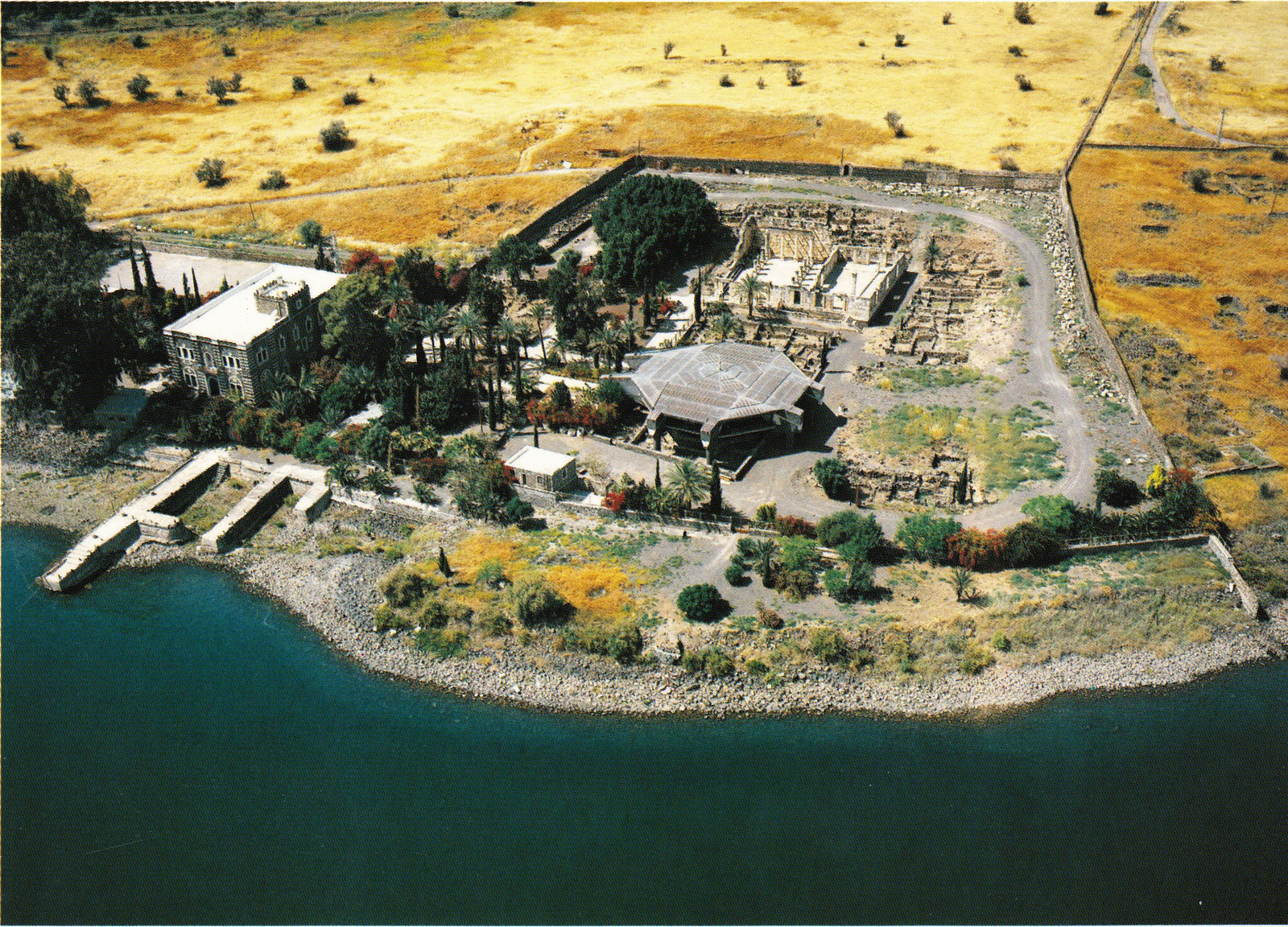
Rather than return to Nazareth, his hometown, the Gospels tell us that Jesus “moved” to Capernaum and made it the headquarters of his ministry.  Capernaum was a village on the north-west corner of the Sea of Galilee.  It was the home of two sets of brothers–Simon and Andrew, James and John.  Fishing provided their families a living on the Sea of Galilee.  The sea also provided plenty of fresh water for the people residing there.  Population estimates during Jesus’ day for the village have conservatively been set between 1200-1700 inhabitants.  Although most of Capernaum’s citizens were Jewish, there is evidence some non-Jews also made it their home.  Still this is no thriving city.  Unlike larger cities it had no wall to protect it, no aqueducts, no colonnaded streets, no administrative buildings and no theater.  Its only significant public space was a synagogue that served as both a place of worship and a community center. Had Jesus not made Capernaum his base of operations, it is likely most would never have even heard of it. 

Join me next for Part 2 of Jesus and Capernaum.

John Williams, Star Wars, and the March of Kingship

Dr. Adam Miglio, Associate Professor of Archaeology at Wheaton College, discusses the way Hebrew words are repeated in order to provide a “bread crumb trail” to focus our attention on key themes we might miss in translation.  It’s not unlike the musical score of “Star Wars.” Adam Miglio wheaton.jpg

Here is the URL :  http://exegeticallyspeaking.libsyn.com/john-williams-star-wars-and-the-march-of-kingship

Or click here.

Emeril Lagasse, Idou, and the Gospel of Matthew

Mark Lanier, lawyer and founder of the Lanier Theological Library, considers idou, often translated “Behold,” and its frequent use in Matthew. “Bam” (Emeril Lagasse) or “Look it!” (Lubbock, TX) may be better translations.

Mark and Becky LanierHere is the URL:

http://exegeticallyspeaking.libsyn.com/emeril-lagasse-idou-and-the-gospel-of-matthew

Or click here.

Early Christian Hymns

The first generation of Christ followers gathered regularly in house churches for instruction, encouragement and worship.  A central part of these gatherings was the chanting and singing of hymns.  Explicit reference to the use of hymns in the Christian church is found in Paul’s admonition to sing psalms (psalmoi), hymns (humnoi)  and spirituals songs (ōdē) with gratitudeto God (Col 3:16; cf. Eph 5:19-20).  These three terms likely refer to the practice of using the biblical Psalter along with distinctly Christian compositions.  The worship of God with hymns had its immediate background in Jewish synagogue practices.  Psalms, particularly messianic psalms, were used by early believers to express uniquely Christian perspectives on God’s recent actions in the world. Likewise, Eph 1:3-14 is constructed on a Jewish hymn-pattern known as the berakah (“blessed is . . . “). While the pattern is clearly Jewish, the author used it in a way that is explicitly Christian.  Gentile believers too would have also been accustomed to hymn-singing in the ethos of Greco-Roman religion. 

Scholars have detected hymns and hymn fragments throughout the Gospels, Acts, letters and Revelation utilizing various criteria including introductory phrases (e.g., “therefore it says,” Eph 5:14), poetic parallelism, special uses of relative pronouns and participles, the presence of unusual vocabulary and rhyming features, and disruptions to the context.  Although not all scholars agree, there is a general consensus that the following passages represent early Christian hymns: Rom 11:33-36, Phil 2:6-11, Col 1:15-20, 1 Tim 3:16, 1 Pet 2:21-24, Heb 1:3-4, Rev 4:8-11 and 19:1-4.  These hymns may have been preformed traditions quoted or alluded to by a writer or spontaneous compositions understood to be Spirit-inspired.  Some hymns are so clear and self-contained that later generations of Christians name them (e.g., the Magnificat = Luke 1:46-55; the Benedictus = Luke 1:68-79).  The New Testament contains both hymns to Christ and to God the Father demonstrating a binitarian shape to early Christian devotion.  Furthermore, the content of early Christian hymns is directed to soteriological themes such as creation, incarnation, and redemption.  For early Christ believers hymnic praise was essentially a response to God’s saving actions in Christ.

Though not all agree, many scholars think that the earliest extant Christian hymn is the hymn to Christ found in Phil 2:6-11.  The hymn consists of two parts.  The first narrates the descent and humiliation of the pre-existent Jesus to become a man and to suffer a merciless death on the cross.  The second describes the ascent and exaltation of the crucified Jesus by God to receive the adoration of every creature and confession “Jesus Christ is Lord.”  This hymn functioned to recall the essential story and therefore had a didactic purpose.  Paul utilized it further to make Jesus the lordly example of humility and service (cf. 1 Peter 2:21-24).

By its nature poetic or hymnic language appears to affect those who use it in significant ways. Whether it was chanted or accompanied with musical instruments, hymns were easier to memorize and recall than other forms of instruction.  Therefore, it seems that early Christians used NT hymns for several purposes: (1) to instruct, (2) to express praise and thanks to God, (3) to confess faith, (4) to form communal identity, and (5) to provide an example for proper behavior.

The Great Commission: All Nations?

On this edition of the podcast, “Exegetically Speaking,” Dr. Ed Stetzer, dean of the School of Mission, Ministry and Leadership at Wheaton College, discusses the Great Commission (Matt 28.19-20) and what Jesus meant when he sent his disciples to “all nations.”  Our phrase “all nations” may not adequately capture the Greek phrase panta ta ethne.  Ed StetzerGive us seven minutes and we’ll change the way you think.

Here is the URL:

http://exegeticallyspeaking.libsyn.com/great-commission-all-nations

or click here.