Page 106 of 126

Chapters and verses (pt. 1)

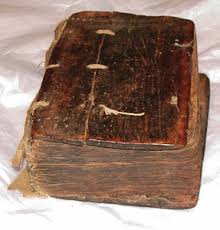
Two prominent features in modern Bible translations are the chapters and verses.  People often ask me how they got there.  Some think they were there from the beginning but they weren’t.  When Paul wrote the book of Romans, he didn’t divide it into sixteen chapters.medieval bible

One of the things we hoped to do with The Voice project was to help people understand that the Bible is not actually a single book.  It is a veritable library of books, sixty-six in all, written over a period of more than 1000 years.  The current configuration of the Bible didn’t just happen.  The order of the books and the collection itself represents a driving theological force which Christians believe was orchestrated by the Holy Spirit.  But what about the chapters and verses?

When the many authors, co-authors, and secretaries wrote their respective books, they didn’t include chapters and verses.  They composed their books from beginning to end without putting in breaks.  Now this doesn’t mean there were not structures in place which became breaks.  For example, the book of Psalms is composed of 150 hymns which had an introduction or superscription describing who the author was or to whom it was dedicated along with other directions for how it was to be chanted or sung.  Clearly, these were breaks but they weren’t the same as our chapters and verses.  Likewise, the book of Lamentations is written in an acrostic style which is discernible only in the original language (Hebrew).  The Voice translation tries to replicate that acrostic style in an English translation.  So clearly these superscriptions and acrostic forms provide structure, but structure is not the same as chapters and verses.

There were early attempts to provide a convenient structure to the books of the Bible but the one we use today goes back to the 13th century.  A fellow named Stephen Langton divided the Bible into chapters in 1227.  He was a professor at the University of Paris.  Later he would go on to become the Archbishop of Canterbury.

The verses we use today were added centuries later by a French printer named Robert Estienne.  In 1551 he divided the Greek New Testament into verses.  Since the official Bible of the Catholic Church in those days was the Vulgate—a Latin translation—the first programmatic use of chapters and verses for the whole Bible was published in 1555.  The first English New Testament to make use of these chapters and verses was a translation by William Whittingham (1557).  The first English full Bible to use chapters and verses was the Geneva Bible (1560).  Since then Bible translators and publishers have adopted and standardized the use of chapters and verses.  Some editions of the Bible have been published without them, for example, Richard Moulton’s edition The Modern Reader’s Bible (1907).

Chapters and verses are handy because they make it possible for people to find the same book, chapter, and verse for public reading or study.  Otherwise, we’d have to say, “Go to the passage where Luke tells us the early Christians were devoting themselves to the teachings of Jesus’ apostles.”  Now which book would you go to, and which part of the book would you find that passage in?  The answer is Acts 2:42.  Much easier, right?

While chapters and verses are a handy way of indicating specific places in the Scriptures, they sometimes cause us to disregard the narrative flow of a text or in a worse case scenario misread it altogether.  We will consider these in the next couple of posts.

Locusts and Honey

I want to float an idea but don’t have time to develop it into a full-fledged argument. Still I want to propose a reading for an unusual text we find in the Synoptic Gospels. Since Mark is likely the first Gospel written, I’ll start there recognizing that what is true for Mark is also true for Matthew and Luke.0417locusts

For years I’ve puzzled over the description of the John the baptizer as eating locust and honey (Mark 1:6).   Translations differ. Some seem to underscore that John’s diet consisted of locust and honey as if that was all he could get in the wilderness (NLT, The Voice). Other versions don’t interpret it at all.   Many commentaries notice the statement but have little to say about it. I’ve wondered why we are given this bit of information in a hard-hitting, fast-moving Gospel like Mark’s. After all we’re not told Jesus’ diet, and he’s the main character in the story. Is the statement about John eating (present participle; Mark 1:6) designed to present him as a desert-dwelling ascetic with odd habits? If so, that seems to fail since locusts are kosher and though most westerners cringe at the thought of biting into one, it would not strike a person of John’s day as strange. Then there is honey, a desirable natural sweetener on everybody’s wish-list.

So what is the point? Well let me suggest a reason. The description of John and his activities (living in the wilderness, preaching, baptizing, and his manner of dress) are part of John’s prophetic message. Where he was, what he was doing and how he did it were key aspects of his person and mission.

Prophets were known not only for speaking a message but also acting it out on occasion. This is uncontroversial. Isaiah (ch. 20) walks naked for two years to portray what would happen to the Assyrian captives of Egypt and Cush. Jeremiah (ch. 32) buys real estate as the barbarians are at the gate to depict a hopeful future after the exile. Ezekiel (ch. 4) famously constructs a small model of Jerusalem, portrays a siege against it, lies down on his left side for 390 days as a sign to Israel of things to come. Then God instructs him to lie on his right side for 40 more days and prophesy against it. Prophetic words were certainly memorable but prophetic actions garnered even more attention.

My proposal is this: John ate locust and honey as part of his message. So we shouldn’t imagine John sitting behind a rock snacking on locust and honey right before a big sermon. Rather, I suggest he makes eating locusts and wild honey part of his sermon.

So what would/could this mean? Well consider the prophetic record and what locusts represent. Joel may be the best place to look. An invasion of locusts offers a sign of things to come when an army invades from the north and strips the land bare. Locusts then are a sign of judgement. God’s people have behaved badly now disaster was going to come upon them. Yet even as judgment is announced there is a conditional promise of salvation. If God’s people will repent, return to God, and plead with God to deliver then, then God will restore to them everything the locusts have stripped away (Joel 2:12-27). Joel 2 ends with a triumphant declaration of God’s salvation when he pours out his Spirit (Joel 2:28-32). As many will recognize this passage is picked up in Acts 2 as Peter’s interpretation of the day of Pentecost: “This is what was spoke of through the prophet Joel” (Acts 2:16).

So what does it mean for the prophet to eat the locust as part of his sermon? Well it dramatizes that God is on the move. The Destroyer is being destroyed. The Consumer is being consumed. And finally, the shame of their long exile is coming to an end when YHWH himself returns to his people (Joel 2:27):

Then you will know that I am the midst of Israel,

And that I am the LORD (YHWH) your God

And there is no other;

And my people will never be put to shame.”

Anyone who heard John in those days would have gotten the idea that the current invaders and consumers (the Roman occupiers) were going to meet their match when enough of God’s people repented and submitted to John’s baptism. The long day of judgement was coming to an end.

So what of the honey? Well, when enough Jews repented and turned from their wicked ways, when God himself intervened by destroying the Destroyers and consuming the Consumers, then the land would once again return to its richness for God’s people. Most will recall that when the recently freed Hebrew slaves first peered in from the wilderness, they said of the promised land: “Here is a land flowing with milk and honey.”

I can imagine John lathering his hand in honey, putting it to his mouth and savoring its sweetness as he stood in front of a group of pilgrims from Jerusalem or Judea proclaiming the imminence of God’s kingdom and warning his detractors of the coming judgment if they persisted in their hypocrisy.   John could have simply spoken the message, but by dramatically acting it out, his message stayed with them and had a much greater influence on those who came to see him in the desert.

Now as I said above.  This is only a proposal.  It is not a full-fledged argument.  I welcome your thoughts and comments.

The Church and Early Christianity

We are only about 5 weeks out from the start of our theology conference at HBU.  The theme is “The Church and Early Christianity.”  The conference is scheduled for April 16-18, 2015.  While it is too late to propose a paper for the conference, it is not too late to plan to attend.  Ben Witherington, John Barclay, and Everett Ferguson will offer plenary addresses.  We will have dozens of other papers from regional and national scholars.

Here is an announcement with all of the details you’ll need:

http://www.hbu.edu/Choosing-HBU/Academics/Colleges-Schools/School-of-Christian-Thought/ConferencesandEvents/HBU-Theology-Conference.aspx

Theology Conference at HBU

Houston Baptist University is sponsoring a theology conference April 16-18, 2015.  The theme of the conference is “The Church and Early Christianity.”  Our keynote speakers include Dr. Ben Witherington (Asbury Theological Seminary), Dr. John Barclay (University of Durham), and Dr. Everett Ferguson (Abilene Christian University).  If you would like to attend, please follow the link here and plan to join us.

If this link fail, please copy and past the following into your web browser:

http://www.hbu.edu/Choosing-HBU/Academics/Colleges-Schools/School-of-Christian-Thought/ConferencesandEvents/HBU-Theology-Conference.aspx

Papers and Abstracts
We are inviting papers representing a variety of approaches from scholars and graduate students in this area of study.  We are particularly interested in the relationship of early Christian communities within their wider theological and cultural contexts. This includes theological developments related to ecclesiology as well as the social relationships with Second Temple Jewish practices and institutions (e.g., the Synagogue), the relationships within early Christian communities, and the relationship of early Christian communities with the wider Greco-Roman society. Participants will have 25-30 minutes to present papers (inclusive of Q&A).  Please submit a 200-300 word abstract to Dr. Ben C. Blackwell at bblackwell@hbu.edu by February 15, 2015, with notification of acceptance by March 2.  Registration by March 23 is required for those who will present at the conference.

Hayward Lectures Fall 2014

I was invited to give the Hayward Lectures at Acadia Divinity College (Nova Scotia) in October 2014. The series is entitled “Paul’s Kyrios Christology.” They were recorded expertly by Danny Zacharias and are now available on YouTube.  My friend, Nijay Gupta, has made them available on his blog.

Click here to view the three lectures. Thanks to both Danny Zacharias and Nijay Gupta for making these available.

These three lectures will become a basis of a book to be published in 2016 by Baker Academic.  Acadia Divinity College