Page 77 of 113

Writing is Better Than . . .

Almost everyone these days shows up to class with a computer.  I’m not sure exactly what people do on them because I only see lid of the computer; the screen is pointing away from me.  They could be checking their email or posting on Facebook or, please God, they could be taking notes or keeping up with the class PowerPoint.  writing

There is some new research which says that the act of writing is better than typing on a computer or other digital device when it comes to learning and retaining information.  Why? First because writing engages a different part of your brain, a part more suited to memory and learning.  Second, writing forces you to process information in a different way.  In other words, it forces you to think more about what you are doing.  I’ve seen secretaries type letters and then when you ask them what was that letter about, they had no idea. Third, research shows that it creates a better pathway for your memory and helps to facilitate recall.  Last, writing things down is a different kind of kinetic experience (moving) which gives you an edge when it comes to remembering and understanding concept.

Now, I have to admit that I have sensed this for a while, but it has been confirmed by a number of things I’ve read recently from Michael Hyatt, who is a leadership guru and a giant techie.  Still he has had to admit that going back to the old fashioned way of taking notes and writing down tasks is superior to just typing it on a screen.

One last thing.  I alluded to it earlier.  Computers and technology have a way of distracting us from what we should be thinking and doing.  We’ve all seen families out to eat in a restaurant, and all are on separate devices.  Instead of talking to one another and enjoying the meal together, they are distracted by what might be the phone.   I have seen students on Facebook or email in class instead of being on track with a lecture or class discussion.  Not a pretty sight, especially if you’re the professor.  These devices do one thing well; they distract us from what is truly important.

So instead of going to Best Buy and spending $700 to $1700 on a new computer for class, just go to Walmart spend about $7 on a notebook and a good pen (or pencil).

Jesus, the Eternal Son

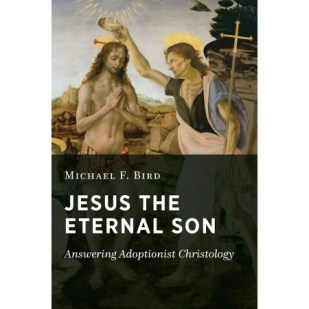
I just read a new book my Michael Bird, Jesus the Eternal Son: Answering Adoptionist Christology, Eerdmans.  I think it is scheduled for release later this year by the good folks at Eerdmans Publishing. Bird Jesus the Eternal Son

Adoptionism was a second and third century “heresy” that has persisted in theological corners to today.  Adoptionism  claims that Jesus was a human being and not inherently divine.  He acquired divine status as God’s Son sometime during his earthly life.  Some say it happened at his birth, others his baptism, still others at this resurrection.  One way to say it is that Jesus was not the Son of God but he became the Son of God.   His elevation from human to divine status is often considered the default Christology of the Ebionites, Theodotians, and Paul of Samosata.  A number of modern scholars (Knox, Dunn and Ehrman) think it was also the most primitive form of Christology expressed in texts like Rom 1:3-4 and Acts 2:36.  Only later, do they say, that a fully incarnational Christology emerges.

In this brief and compelling book Michael Bird challenges those scholars who think the earliest recoverable Christology was adoptionism.  Instead he proposes that the earliest Christologies formed a pattern of convictions and practices which featured Jesus at the center of Christian devotion.  Only later, in the second century among the Theodotians, did adoptionism emerge full scale in debates over select texts and how they should be interpreted.   A careful answer to the perennial question: who was/is Jesus?

The Kingdom of God and the Mission of the Church


I met René Padilla a few years ago when he was visiting Houston.  Padilla is one of the best known and most influential Latin Church leaders.  He actually helped me think through the translation of a phrase in Paul’s letters normally translated “the righteousness of God” (dikaiosunē theou).  When we were working on THE VOICE translation, we decided to translate the phrase (e.g., Rom 3:21-26) “God’s restorative justice.”rene-padilla

I recently read an article by Padilla in a book of essays,  Mission between the Times: Essays on the Kingdom (Grand Rapids: Eerdmans, 1985).  The last chapter in that book is “The Mission of the Church in Light of the Kingdom of God.”  It is an amazing chapter that captures, in brief, so much of what I have been thinking for years.  Although we have been influenced by different cultures, we’ve read some of the same scholars: George E. Ladd, Oscar Culmann, W. Pannenburg.

For Padilla the Kingdom of God cannot be equated with the church because it has to do with God’s redemptive purpose for all of creation.  Padilla is well versed in Jewish apocalyptic eschatology and understands the two ages of history.  He works from a framework of already and not yet, like so many who grapple with Jewish and early Christian eschatology.  Padilla is right to affirm that it is impossible to understand Jesus apart from his message, spoken and acted out, of the Kingdom of God.

Jesus, of course, founded a community of disciples that became the church but the church is not the Kingdom of God.  The church is the community of the Kingdom but not the Kingdom itself.  It is inhabited by Kingdom citizens;  but as the rule of God, it transcends the society of men (to borrow Ladd’s phrase).   I really like Padilla’s phrase: “The church is not the Kingdom of God, but it is the concrete result of the Kingdom.”  As the Kingdom is active in the world by the Spirit, the church is born and lives and moves and has its being.

This means, among other things, that the mission of the church cannot be understood apart from the mission of Jesus.  As his body, the church extends the mission he started.  So the mission of the church is twofold: to proclaim the gospel and to promote what Padilla calls “social responsibility.”  He does not understand social responsibility as a programmatic attempt by people to engineer society so that it becomes like heaven on earth.  Rather Kingdom involves God’s action in the world by the Spirit, not human action on behalf of God. On the other hand, the Kingdom of God is also not some private, interior spiritual thing that sits comfortably in the heart but uncomfortably in public.  The Kingdom is not just about God ruling over my heart.  It is God ruling as Lord of creation. All of us are invited to participate in that, because we are part of creation.

Padilla’s essays are worth reading.  Though he wrote them over 30 years, they are still worth reading and pondering.

Why is Jesus’ Genealogy different in Matthew and Luke?

I had the privilege in 2014 of giving the Hayward Lectures at Acadia Divinity School in Nova Scotia.  While there I met a young scholar who is working on various topics in the Gospels.  His name is Danny Zacharias.  He had recently finished a project on the question of why Matthew (ch. 1) and Luke (ch 3) have different names in their genealogies of Jesus. Some point to this as a contradiction  which cannot be solved, thus undermining the reliability of the Gospel accounts.  Others see the differences as a matter of purpose and focus. Matthew starts with Abraham and moves forward to Jesus to show that Jesus is the true son of Abraham, the embodiment of Israel.  Luke starts with Jesus and moves back through Abraham to Adam, demonstrating that Jesus is the Savior of all sons of Adam and daughters of Eve.   One traditional “answer” has been that Matthew has Joseph’s genealogy while Luke records Mary’s. Not all, of course, think this is the case.

Dr. Zacharias offers an intriguing approach to the question.  Here is a link to a brief video he did a few years back:

http://www.dannyzacharias.net/blog/2014/10/1/why-is-jesus-genealogy-different-in-matthew-and-luke 

I think you may find it helpful.  If so, please let him know.


Xmas: Is it taking Christ out of Christmas?

I remember my fourth grade teacher, Mrs. Potts, opening a vein when anyone wrote “Xmas” instead of “Christmas.”  She felt there was a war on Christmas  and that people who abbreviated the name of the holiday were trying to take Christ out of Christmas.  I suppose that is true for some people, but when you look into the real story of “Xmas” you realize that something else is at work.

The story begins with the Ten Commandments.  One of those commandments says, “Do not take the name of the LORD in vain.”  The name by the way is not “LORD,” that was a respectful translation or substitute for the name.  In Hebrew THE NAME is four letters, yodh-he-vav-he. The technical term for the name is the tetragrammaton (literally, “the four letters”).  Scholars today think the name may have been pronounced—when it was pronounced—Yahweh or Yahveh.  But we aren’t sure.  This was the covenant name of God, the name revealed to Moses and Israel at Mt. Sinai. nomina_sacra
Under the influence of the commandment about the misuse of God’s name, the faithful spoke it less and less.  By the time of Jesus speaking the name was considered blasphemous in almost every circumstance. The rabbis made their mark by building a hedge about the law. If you never spoke God’s name, you could never be guilty of taking the name in vain. It was a way of safeguarding the name.  Even when reading Scripture in the synagogue, a substitute word was used.  In Aramaic-speaking synagogues the readers said “Adonai.”  In Greek-speaking synagogues they said “kyrios.”  Both mean something like “Lord” or “Master.”

The Dead Sea Scrolls provide good evidence for how the name of God was written in the centuries and decades leading up to the New Testament era.  In many of the biblical scrolls the name of God is written in paleo-Hebrew script.  That would be like shifting to a Gothic font when writing the name of God.  In other scrolls the name is not written at all; it is represented by four, thick dots written in the center of the line. In yet other scrolls where the name of God should be there is a blank in the line just large enough for the tetragrammaton.  Scholars theorize that the blank was left by a junior scribe and would have been filled in later by a senior scribe who had permission to write the name. Where there is a blank in the line, we think the senior scholar never got around to writing the divine name in the blank. These were some of the ways the faithful showed respect for the name of God.

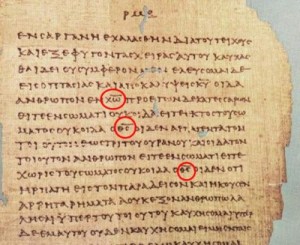
Early Christians developed their own way of signaling respect for the names and titles associated with God the Father, God the Son, and God the Holy Spirit.  Copying the New Testament books in Greek, they abbreviated the names (usually first letter and last letter) and placed a line above those letters. You can see this in the picture.  Scholars refer to these as nomina sacra (Latin for “sacred names”).  Copyists continued to write sacred names this way for centuries.  It remains a common practice still among artists who create the icons used in the eastern churches.  Many names and titles were written this way including “God,” “Father,” “Jesus,” “Son of God,” “Son of Man,” “Christ,” “Lord,” “Holy Spirit.” For our purposes note the nomen sacrum for “Christ;” it was written XC. Now remember these are letters from the Greek alphabet not our Latinized version. It is not “X” (eks) the 24th letter of our English alphabet but the Greek letter “Chi,” the first letter of the title “Christ.”

Earliest versions of writing Christmas as “Xmas” in English go back to the Anglo-Saxon Chronicle (about 1100).  This predates the rise of secularism by over 600 years.  The Oxford English Dictionary cites the use of “X-“ for “Christ” as early as 1485.  In one manuscript (1551) Christmas is written as “X’temmas.”  English writers from Lord Byron (1811) to Samuel Coleridge (1801) to Lewis Carroll (1864) used the spelling we are familiar with today, “Xmas.”

The origin of “Xmas” does not lie in secularists who are trying to take Christ out of Christmas, but in ancient scribal practices adopted to safeguard the divine name and signal respect for it.  The “X” in “Xmas” is not the English letter (eks) as in “X marks the spot,” but it is the initial Greek letter “Chi” (X), the first letter of the title “Christ.”  No doubt some people today use the abbreviated form to disregard the Christian focus of the holy-day, but the background tells a different story, a story of faithful men and women showing the deep respect they have for Jesus at this time of year.

Merry Christmas or should I say “Merry Xmas”!