Page 111 of 112

You are dust

Easter comes early this year: March 31, 2013.  A long time ago it was decided to set the date of Easter as the first Sunday following the first full moon after the vernal equinox (or the first day of spring).  The decision was a long and complicated one, but a key factor was this: since Jesus rose from the dead and appeared to his disciples on a Sunday, then Easter should be on a Sunday.  Other proposals had it so Easter could fall on any day of the week.  The church, in its wisdom, decided instead to have Easter fall every year on Sunday.  In a real sense, every Sunday is a little Easter.ash-wednesday

But Easter is such a profound holy day on the church’s calendar that our spiritual ancestors decided to preface it with a season of preparation marked by prayer, fasting, and spiritual reflection.  So the season of Lent was created to make the transition from more ordinary time to the day of resurrection.

Lent begins on Ash Wednesday—this year celebrated on February 13, 2013—and ends on Holy Saturday, the day prior to Easter.  On Ash Wednesday Christians gather to remember a sobering fact: we are dust and to dust we will return.  This year I will stand in line—or as my British friends prefer to say, “I will queue up . . . “—and have someone make the sign of the cross on my forehead in ash and they will say: “You are dust and to dust shall you return.”

Ash Wednesday means different things to different people, I suppose, but at a very basic level the ritual we gather and perform is designed to remind us that we are not immortal, that these bodies we coddle, clothe, decorate, protect, nurture, feed, and insure will go the way of the earth.  The first man (Hebrew, Adam) was made of the dust (Hebrew, Adamah).  The Adam came from the Adamah.  That is what we are. That is who we are.  On my best day.  On my worst day.  I am dust, and on another day not of my choosing I will return to the dust.

Yet, there is another reality, the resurrection.  Listen to what Paul wrote (Philippians 3:20-21, The Voice):

But we are citizens of heaven, exiles on earth awaiting eagerly for a Liberator, our Lord Jesus the Anointed, to come and transform these humble, earthly [read . . . dust] bodies into the form of His glorious body by the same power that brings all things under His control.

All of us dust-men and dust-women down here on earth really belong to another kingdom.  Right now, we wait, hope, and long for the world to come.  It is our true home.  When the resurrected Jesus returns, resurrection will become our reality  just as it is for Jesus.  On that day we will exchange these mortal bodies for glorious ones.

Ash Wednesday and Easter are two sides of an important, very human, deeply spiritual reality.

We enter the season with this confession: “I am dust . . . “

We arrive at the pinnacle of our holy day with this confession: “Christ is risen.  He is risen indeed.”


The Power of Contentment

I don’t want to rain on anybody’s parade, but I’m afraid I’m about to.  I recall a professor of mine saying repeatedly, “I don’t want to piously believe something that is not true.”  I wonder how much of what we think or believe is just not true, regardless of how passionately we believe it.  Case in point: Philippians 4:13.  Like many of you I memorized it from the King James Version: “I can do all things through Christ who strengthens me.” Superman 2

For many people Philippians 4:13 has been one of their favorite verses from the Bible.  They quote it consistently as they are facing some obstacle. Some take it almost as proof of nearly super-hero status.  I CAN DO ALL THINGS.

Faster than a speeding bullet, more powerful than a locomotive, able to leap tall buildings with a single bound.  Who disguised as mild-manner Joe Christian fights the unending battle for truth, social justice, and the Christian way.  .  . (with apologies to Superman)

The problem is this.  When I began to read the Scriptures in the original Greek I realized something: the word “do” is not there.  It has been supplied by the translators.  But is it the right word?  It’s a bit complicated but a good Greek lexicon, grammar, or commentary can help you begin to sort it out. The Greek verb which is there is “I am able.”  But the verb typically takes an infinitive complement, that is, an infinitive to complete the idea.  Like this: “I am able TO SING;” “I am able TO MAKE sloppy joes.”  So if there is no infinitive to complete the idea, what do you do?  Well you look to the context.  The context supplies the verbal idea.  Walk up to someone and say: “I can.” And they will say, “You can what?”  The “what”  is the contextual idea.  So read carefully the verses before 4:13.  What are they about?

I am not saying this because I am in need.  I have learned to be content in whatever circumstances.  I know how to survive in tight situations, and I know how to enjoy having plenty.  In fact, I have learned how to face any circumstances: fed or hungry, with or without.

Now here is another way to translate the text:

 I can be content in any and every situation through Christ who empowers me.

Paul was not talking about the power TO DO anything.  He was celebrating the fact that he had learned TO BE CONTENT regardless of the situation.

Now I realize that may not have the appeal of saying I CAN DO ALL THINGS.  But again: do you want to piously believe something that is not true?  Can you really do all things?  If you could, then wouldn’t you be God.

Think for a moment about the power of contentment.

 True contentment is the result of a heart committed to the risen Lord.  Think of all the sins, pain, and brokenness that come from coveting [the opposite of contentment].  Adultery, murder, stealing, and lying can all be traced directly to a prior condition where hearts and minds are frustrated and discontent.

Notice that Paul says contentment doesn’t come naturally; it is learned.  The normal, natural state of humanity is discontent and quiet desperation.  It takes a powerful, spiritual presence to transform anxiety into joyous satisfaction.  Ironically, it may be the shackles more than his freedom that schools Paul in the art of contentment. Despite the chains, Paul discovers this beautiful state of inner peace through the power of Jesus residing in him.

There is power in contentment. It is the power of shalom at work in your life.  It will not be long until the next round of worry, anxiety, discontent, and frustration hits you.

“Saved”

“Saved”


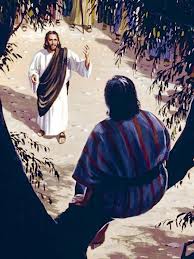
Jesus and Zacchaeus
Jesus and Zacchaeus

I grew up at a church where the word “saved” was used a lot.  “Are you saved?” someone might ask.  Or a testimony might begin, “I was saved when I was 12 years old.”   In that context “saved” meant that a person is going to heaven after he or she dies.  Assurance of salvation then refers to the confidence people can have in knowing that they are going to heaven after they die.  Now this is a perfectly good way and important way of using the word “saved;” but the more I read the Bible, the more I learn that the word “saved” and all the other words the Bible uses to talk about being “saved”—words like redeemed, forgiven, set free, justified, chosen, set apart, adopted, reconciled, glorified—reveal that salvation is far more than knowing that after death we will be present with the Lord.

I don’t have time or space to talk about all these images of salvation in the Scriptures.  If you’re interested, I’ve written about this at some length with two colleagues (Dr. Rodney Reeves and Dr. Randy Richards) in a book entitled Rediscovering Paul (InterVarsity, 2007).  It’s available in hardback, paperback and on Kindle.

Let me give an example or two from Paul.  The apostle uses various metaphors or images to describe salvation; one of those is “reconciliation” (read 2 Corinthians 5:17-21).  Reconciliation is a relational metaphor; it implies that every person is separated from God and at odds with each other.  The solution to that problem is to be reconciled to God (and one another) through Jesus so that we can enjoy restored and healthy relationships with God and others once again. 

But, if we are honest, we must agree that there is more wrong with us than this. Our plight is far more complicated and insidious than being at odds with God.  In Romans 6-7 Paul acknowledges that not only do we commit sins (acts of rebellion and disobedience against our Creator), but that sin is a power that enslaves us and causes us to do things we don’t want (read Romans 6-7 carefully).  If we are enslaved to sin and sin has power over us, what is the remedy?  Well, what is it that any slave wants and needs? The answer is this: to be set free from sin and its power.  In a word “liberation.”

Some people have asked why we translated Luke 19:10 this way in The Voice: “For the Son of Man came to seek and to liberate the lost.”  Most translations render it “to seek and to save the lost.”  Now, this is a good translation.  But, what did Dr. Luke mean by “to save?” Did he mean that the wee-little man Zaccheus would be assured that he would go to heaven when he died? I don’t think that the issue.  Well, what then?

First, look at any standard Greek dictionary and you’ll see the Greek word often translated “save” (sōzō) means to “rescue,” “liberate,” “heal,” “preserve from harm.”  It is a broad, general word for salvation.  Second, take a look at how Dr. Luke sets the stage in his Gospel for what salvation is.  Jesus’ synagogue sermon in Luke 4:16-30 provides us with the foundational text.  You remember the story.  Not long after Jesus began his public ministry, he returns to his hometown in Nazareth and reads the Scripture during the Sabbath service (Isaiah 61:1).  After he reads, he sits down and tells the audience that these words are fulfilled even as they hear them.  What did Jesus mean?  That the Spirit of God was on Him and had designated Him to be God’s representative to preach good news to the poor, to announce to those held captive that they will be set free, to bring sight to the blind, to liberate those held down by oppression.  In a word to proclaim the jubilee of God’s grace!  For Luke salvation was all about liberation.  Go back and read the song of Zacharias (Luke 1:67-80) and the song of Mary (Luke 1:46-55).  That is a key reason we used the phrase “the Liberating King” as an explanatory paraphrase in The Voice to describe Jesus’ role as God’s Anointed, the Messiah.  What Zaccheus needed was to be set free from his love of money, forgiven for crimes committed against his people, and restored as a honored member of his community.

Salvation is more than knowing that when we die, our souls will go to heaven.  As important as that is, that is only a part of what it means to be “saved.”  Salvation means that

  • one day death’s grip will be released and these lowly bodies—not just our souls—will be made glorious
  • broken relationships will be restored
  • sins will be forgiven
  • sin’s power over us will be broken  
  • the outcast will be brought near
  • the poor will be exalted
  • the worn out, used up will be made new
  • the orphan will be made part of the family
  • the blind will see and the lame will walk
  • the sick and dying will be made whole
  • those who are not right will be made right with God
  • those held in political prisons will be released
  • creation itself will be liberated from corruption and decay
  • the image of God in all humanity will be restored

Salvation is . . . all of the above!


“Watered down”

One of the criticisms made of all contemporary, readable Bible translations is that they are “watered down” versions of God’s Word.  Interestingly, the people who make those charges never give examples of how the new translations dilute the Scripture.  Still that doesn’t stop them from making what amounts to a baseless accusation.watered down 

A different version of same argument was made around 500 years ago when the language of the church was Latin and the Scripture read in mass was The Vulgate.  “If people want to read the Bible,” they said, “let them learn Latin. Don’t put the Scripture in the language of the people.”  The Bible, they thought, was too important to be rendered in a tongue as banal as English.  You see, in those days English was considered a vulgar language, the language of the masses.  Important documents were written in Latin.  The language spoken in the English court was French (in those days France and England were getting along).  If a member of the aristocracy spoke to a peasant about spreading fertilizer in his field, he spoke English.  But if he spoke to an equal, he used a proper language like Latin or French.  No wonder people objected to having Scripture in so common a tongue.

A similar dynamic is at work today.  English may no longer be considered a vulgar language, but there are elites among us who think we need to keep Scripture in a form which makes it hard to reach.  Some apparently prefer the sound of “Biblish” to English and think others ought to prefer it too.  But when you study the Scriptures carefully, you realize the language of the New Testament was “common Greek.”  It wasn’t written in some highfalutin tongue spoken only by the pretentious.  It was the way people spoke in the market, at home . . . essentially, where people lived.  Apparently, God wanted the Bible to be in a language where the most people could get it, read it, understand it, and live it.     

I learned a long time ago that the smartest people around are those who can take complicated language and hard concepts and teach them so that others can understand.  But the true intelligentsia may not be those leading graduate seminars in the elite universities; they are likely to be found teaching 4th graders in public schools or middle-schoolers in Sunday School.  Just because translation committees have put the Bible on a shelf that people can reach does not mean it is watered down; it means that more and more people will be reading, paying attention, and living it.

This is why we did The Voice.

What Is a Story?

“A story is a way to say something which can’t be said any other way, and it takes every word in the story to say it.”  –Flannery O’Connor

I thought I’d revisit a post I wrote back in 2011 because it received a number of comments and continues to be relevant. I was inspired recently by a statement Flannery O’Connor made about “story.”  She was a gifted southern writer whose stories continue garner attention. 

We received a question on our Voice Facebook page from one of our fans.

Question: “What is propositional-based thought and how does it apply to us?”

The fan is referring to the introduction in one of The Voice products where we observe that people do not respond to propositions as well as they respond to stories. This, of course, is nothing new. People have been telling stories for thousands of years. Humans are hard-wired to tell stories, remember them and pass them along to others. 

Not long ago when people were sharing “the gospel,” they would boil it down to a set of manageable propositions:

1.  God loves you and has a wonderful plan for your life.

2.  But you are a sinner separated from God.

3.  Christ died for your sins and helps to bridge the gap between you and God.

4.  So put your trust in Jesus to be saved and you .

Now these propositions are true, but they make little sense when isolated from the greater story of God’s plan and purpose for the world and us. 

Let me illustrate it this way.  Here are some lines from one of the greatest films of all time (Casablanca 1942):

“Here’s looking at you, kid.”

 “Major Strasser has been shot. Round up the usual suspects.”

  “Play it, Sam. Play ‘As Time Goes By.’”

 “Of all the gin joints in all the towns in all the world and she walks into mine.”

 “If that plane leaves the ground and you’re not on it, you’ll regret it. Maybe not today. Maybe not tomorrow. But soon and for the rest of your life.”

Now these are some of the most memorable lines in the film. But without the rest of the story you have no clue what it going on. They might punctuate the story, remind you of the story, illustrate the story, but they are no substitute for the story itself.

Imagine deciding whether or not to marry someone based on a resume. You might say, “Well, he looks good on paper.” No. We would never do that. On a first date you don’t exchange resumes or give a list of your strengths and weaknesses (you don’t, that is, if you expect a second date!). No. You sit down over a good meal and begin to tell your story. You talk about where you come from, what you love to do, what it was like to be the older brother or sister in a family of four, or whatever is unique to your own story.  This is how we woo a potential partner and how we make friends, by telling our unique stories to those willing to listen. 

God did not give us a list of propositions to follow. He could have, but he didn’t. Instead he gave us 66 books that detail an amazing story of love and redemption. Thomas Nelson has created The Voice Bible because they recognize the power of stories to tell the truth and call us into a new life.