Page 62 of 126

F. F. Bruce

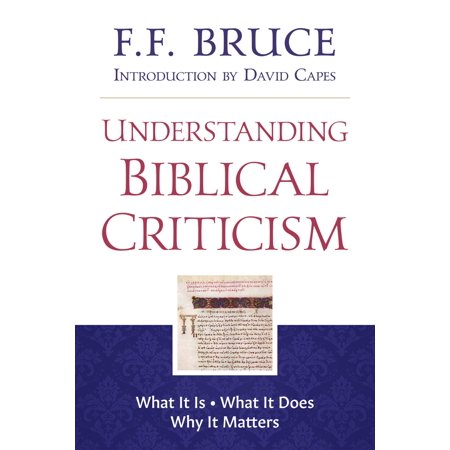
A few years ago I was asked to write the introduction to articles and essays by F. F. Bruce on biblical criticism.  Bruce (d. 1990) was a British classicist and well known New Testament scholar.  His judgments were always sober and insightful.  I never met Bruce but a good friend of mine was a student of his.  He has great stories about Bruce.  I did, in a way, meet Bruce through at least half a dozen books of his and articles I read.  He was one of the most influential Protestant biblical scholars of the 20th century.  His book Paul Apostle of the Heart Set Free was my first or second serious academic work on Paul

These essays are accessible and helpful.  It is available in ebooks.  Look for the title.  Bruce cover image


One God, One Lord (Part 7)

I continue to work through the preface of Larry Hurtado’s classic, One God, One Lord: Early Christian Devotion and Ancient Jewish Monotheism. It has been published in its 3rd edition recently by Bloomsbury T. & T. Clark, as a part of its Cornerstones Series. Larry-Hurtado-1756565

In the 1990s there were a number of books published  on theology and Christology which Hurtado felt deserved special notice.  They were:

Larry Kreitzer, Jesus and God in Paul’s Eschatology (JSNTSup 19; Sheffield: JSOT     Press, 1987).


David Capes, Old Testament Yahweh Texts in Paul’s Christology (WUNT 2/47; Tubingen: Mohr-Siebeck, 1992)


Carl Davis, The Name and Way of the Lord: Old Testament Themes, New Testament Christology (JSNTSup 129; Sheffield:Sheffield Academic Press, 1996).


Carey Newman, Paul’s Glory-Christology: Tradition and Rhetoric (NovTSup 69;  Leiden:Brill, 1992).


Neil Richardson, Paul’s Language about God (JSNTSup 99; Sheffield: Sheffield Academic Press, 1994).


Philp Davis rightly noted three patterns of mediation established in Jewish religious texts of the time.  He referred to (a) the legacy pattern—which had to do with the role a mediator figure played in the past (e.g., creation); (b) the present pattern—which emphasized the role of a mediator in the present; (c) the future pattern—which anticipated a future or eschatological figure (e.g. messianic).  Davis, however, in Hurtado’s opinion, could never account adequately for the kind of honor and reverence early Christians granted to Jesus as Messiah.  All three patterns come together in a single figure in Christ.

John Collins’ critique of Hurtado was that he did not pay enough attention to royal messianic figures.  Hurtado does speak of messianic figures in ch. 1 of ONE GOD, ONE LORD, but his point is not to dwell on messianic figures.  His purpose was to focus on those kind of figures that had some analogous heavenly status to the risen Jesus in early Christianity.  Messianic figures in most Jewish sources (except 1 Enoch).could be characterized as having a more earthly orientation.  This is why Hurtado paid attention to exalted patriarchs and principal angels.

Most studies during this period were focused more on religious language and religious beliefs related to the Lord Jesus.  Hurtado’s primary emphasis was and continued to be the practices of early Christians, particularly as they related to granting Jesus any sort of divine status.

Max Turner proposed that experiences of revelation and inspiration by the power of the Holy Spirit or what believers took to be the spirit sent by the risen and exalted Jesus contributed heavily to the notion that Jesus was divine and was therefore worthy of worship.  Hurtado appreciated Turner’s study and the work of his student, Mehrdad Fatehi.

Hurtado ends his preface to the second edition expressing appreciation for the renewed interest in Christology at the time.  The final word on the subject had not been written by Wilhelm Bousset (Kyrios Christos) and Oscar Cullman (A Christology of the New Testament).  More was yet to be discovered for anyone daring enough to take a second look.

 

Conversion

I am fortunate to be one of the editors to the Library of Early Christology (Baylor University Press).  I am honored to be listed alongside April DeConick of Rice University and my dear, late friend, Larry Hurtado.  Both have made a big mark in contemporary scholarship on Christian Origins.

Our latest volume is Conversion by A. D. Nock, a classic work in the field.  A must read for people interested in Mediterranean religions and early Christianity.  The scope of the book takes you from Alexander the Great to Augustine of Hippo.

I’m grateful to the Lanier Theological Library for their many resources.

Nock Conversion BUP

One God, One Lord (Part 6)

I continue to work through the preface of Larry Hurtado’s classic, One God, One Lord: Early Christian Devotion and Ancient Jewish Monotheism. It has been published in its 3rd edition recently by Bloomsbury T. & T. Clark, as a part of its Cornerstones Series.

Hurtado contended that divine agents, or better principal agents, provided a conceptual category whereby earliest Christians were able to understand how a second figure (like Jesus) could be closely associated with God in creation and sustaining the world, in redemption and future judgment.  For Hurtado, a good deal of early Christians’ assessment of Jesus and his significance owed its substance to this category.  But he never contended that divine agency (principal agency) was sufficient in and of itself to account for the rise of Christ-devotion in the early decades of the Christian movement.  What is unparalleled in second temple Judaism vis-à-vis the principal agent figure is the kind of cultic devotion that arose with Jesus as the rightful (God willed) recipient.  This is truly a “novel development,” that represented what he called a binitarian pattern of devotion.

One factor Hurtado noted was the powerful religious experiences that convinced Jesus followers that it was right and good to reverence the Lord Jesus as Jews were reverencing God.  Moreover, that to reverence Jesus did not distract in any way from one’s devotion to God.  The experiences had to be so forceful and compelling as to persuade scrupulous Jews to consider it God’s will that they reverence Jesus.

larry-hurtado 5
Larry Hurtado, outside of New College, Univ of Edinburgh

Some scholars have questioned whether religious experience could have the kind of generative effect as Hurtado argued.  But he made the point in various articles that sociologists and anthropologists increasingly were recognizing that religious experience, particular “revelations,” did lead to significance innovations.  Any religious experience and language used to express it were culturally and religiously determined.  But there are novel interpretations of religious phenomena that led to structural changes in communities, new beliefs and practices.

The New Testament demonstrates that believers like Paul, a significant minor founder figure, had revelatory experiences that shaped and determined their lives (Galatians 1; 2 Corinthians 13; Acts 9).  These revelations caused Saul/Paul to rethink the concepts, beliefs, and practices that had previously characterized his life.  Whatever value he found in his previous life is now recast in light of knowing Christ (Philippians 3). As a result of his “conversion” or “call,” he joined a new group, the ecclesia of Christ, and found himself at odds with his previous community.  The role of “revelation” is significant in early Christianity.  Hurtado sensed this from the earliest sources and knew that it had sculpted what early Christianity was becoming in its first century.

One God, One Lord (Part 5)

I continue to work through the preface of Larry Hurtado’s classic, One God, One Lord: Early Christian Devotion and Ancient Jewish Monotheism. It has been published in its 3rd edition recently by Bloomsbury T. & T. Clark, as a part of its Cornerstones Series.

Both Maurice Casey and Jimmy Dunn do not think that Jesus is truly reverenced by believers until the later NT period, that is, once the communities left behind the so-called constraints of Jewish monotheism. Perhaps it is first witnessed in the Gospel of John (hereafter GJohn). As evidence they cite the absence (prior to AD 70) of Jews condemning what Hurtado called “Christ-devotion.”  Since there is no condemnation, the reverence accorded Jesus must not have violated the Jewish sensibilities of God’s oneness. Larry Hurtado 3 Therefore, no mutation in Jewish religious practices, as per Hurtado, had taken place.

Hurtado responded that prior to AD 70 there is evidence that some Jews considered Christ devotion a “dangerous development” (xvi).  He has pointed this out in various publications.  In particular, L. W. Hurtado, “Pre-70 c.e. Jewish Opposition to Christ-Devotion,” Journal of Religion 80 (2000), 183-205.  We will take this up in a subsequent post.  We might well ask the question: what did Saul, the Pharisee, find so problematic about the church that he was willing to destroy it prior to his revelation (Galatians 1; Acts 9)?  While he does not say explicitly why he was so aggrieved, his letters might be a source of information for what he found so offensive.  Might it have been the reverence early Jewish Christians were according to Jesus?

Therefore, in historical terms Hurtado argues that it is accurate to say that a mutation in Jewish religious practices had already taken place and was a regular feature of Christian churches prior to AD 70. But clearly by the end of the first century AD–about the time GJohn is written–other developments had taken place.  He regards this as “a more advanced stage of polemical confrontation with the Jewish religious leadership of synagogues in the late first century” (xvi).  It may not be too much to say that Christ devotion caused profound outrage among some Jews; what Christians were saying about Jesus and how they were reverencing him alongside the God of Israel would have been a stumbling-block.