Page 113 of 126

Rethinking Hell


A friend of mine Edward Fudge is hosting a conference this summer, July 11-12, at the Lanier Theological Library.  The title is “Rethinking Hell.”  Edward Fudge, as you may know, has written the definitive book on hell as annihilation.  Here is an announcement I received recently on it.  If you are in or near Houston this summer, you should plan on attending.  Go to the site http://www.rethinkinghell.com for more details. 

Eleven weeks from now, registrants from countries on three or four continents arrive in Houston for the first ever Rethinking Hell Conference. Awaiting them will be a schedule that includes high academic prowess and ground-level practice, historical exhibits, a live podcast interview with audience involvement, screening of a feature movie, and never-before-seen excerpts from an international documentary film now in progress.

All this happens in a world-renowned venue, the Lanier Theological Library and Chapel, whose professional staff is accustomed to tourist buses, even on ordinary days with nothing special on the calendar. The calendar for this conference is brief, though packed, beginning on Friday evening, July 11, and ending Saturday night, July 12. In keeping with the sponsor’s mission and vision, and unlike many conferences, this one is open to anyone who wishes to register (for a very modest fee) and attend.

The sponsor and its mission

Less than two years ago, God wondrously brought together a small group of disparate individuals scattered halfway around the world, by inspiring in them the uniting vision of a joint mission. They differed in age, location, occupation, and theology–but in truth they shared very much indeed. They all were Christian believers and all held to evangelical convictions. Additionally, driving this conference on July 11-12 in Houston, the sponsors all held the understanding of final judgment known as conditionalism or conditional immortality.

The group named their mission the Rethinking Hell Project, and took as their first assignment the creation of a powerful website called RethinkingHell.com . Next, they organized an international conference on the subject that brought them together.

What is conditionalism?

The term “conditionalism” reflects the biblical teaching that human beings are not inherently immortal, and that human immortality is “conditional” as God’s gift to the redeemed. At the time he has appointed, God will raise all the dead, both righteous and unrighteous, for judgment and their final reward.

However, while the redeemed are raised immortal, the unrighteous are not. Instead, they are banished into hell, also called Gehenna, and the Lake of Fire. There they finally “perish” (John 3:16), are “destroyed” both soul and body (Matt.10:28), and experience the “second death” (Rev. 21:8)–from which there will be no restoration, return, or recovery forever. This is the view set out in my 1982 book, The Fire That Consumes, which was something of a leader in its field.

Conference speakers and presenters

The conference will feature two plenary speakers–Dr. John Stackhouse of Vancouver, Canada, and Dr. Glenn Peoples of Wellington, New Zealand. Dr. Stackhouse holds the Sangwoo Youtong Chee Chair of Theology and Culture at Regent College, an international graduate school of Christian studies. Dr. Peoples blogs (Right Reason) on issues of philosophy, theology, biblical studies and social issues. His is the most widely listened to podcast on philosophy or theology in the southern hemisphere.

Presenters at breakout sessions and panelists include philosophers, theologians, authors and clergy; but also an evangelist/apologist in more than 100 countries; an appellate judge, a filmmaker and a psychiatrist, each bringing a unique perspective. Dr. Stackhouse is also slated to preach on Sunday, July 13 at Bering Drive Church of Christ in Houston, and those attending the conference are specially invited to attend.

Will you join me there?

Click here for links to the conference schedule, cost, and hotel and other information. With only eleven weeks to go, why not register now and plan to join me there!


You are currently subscribed to edwardfudge as: dcapes@hbu.edu
Add edward@edwardfudge.com to your email address book to ensure delivery.
Forward to a Friend | Manage Subscription | Subscribe | Unsubscribe

Did Jesus Commit Suicide?

This may strike you as a strange question until you recall this was a question posed during Jesus’ lifetime.  Here is the dialogue from the translation The Voice:

Jesus (to the crowds): 21 I am leaving this place, and you will look for Me and die in your sin. For where I am going, you are unable to come.

Jews: 22 Is He suicidal? He keeps saying, “Where I am going, you are unable to come.”

Given the strange things Jesus keeps saying, it is no doubt some of them wondered whether he intended to kill himself.  Scholars think this kind of question persisted long after Jesus’ death.  By the time of the Johannine community this may have been an ongoing charge against Jesus.  If Jesus did kill himself, then he violated one of the ten commandments.  Self-murder is still murder and is a grievous sin.  How could Jesus then have been the Messiah?

Jesus sacrifices himself on the cross

If suicide means to take actions which will likely lead to one’s own death, then the charge may stick.  In all four Gospels Jesus’ actions put him on a collision course with powerful people who had a vested interested in putting him to death.  Jesus pushed them too far.  Scholars think it was the temple incident—often mischaracterized as his cleansing of the temple—which put the nail in his proverbial coffin.  Even at his defense or lack of defense, he handed his Jewish interrogators the charge that finally stuck: blasphemy.  False witnesses were so inept they could not agree so Jesus came along and condemned himself with his own words.

Consider the modern example of suicide by cop.  It happens dozens of times every year in this country.  A person takes a handgun into a crowded mall and starts brandishing it about.  He has no intention of hurting anyone other than himself.  He wants to die and for whatever reason can’t bring himself to do it alone.  Some terrorized person calls 911 and soon the police arrive.  The man takes refuge in the back of a store.  Perhaps he has taken a few faux hostages.  It’s all part of the ruse.  The man lowers the gun in the direction of the officers and a peace officer, fearing for his life, squeezes off three rounds in rapid succession.  When they examine the dead man’s gun, they realize it was not loaded.  Some poor policeman will have to live with it for the rest of his life. But he could not have known.

The man acted in a way which would likely lead to his death at the hand of another.  Jesus did the same . . . or did he?  One one level, the answer could be yes, until that is you factor in his motivation.

The suicide charge only works depending on one’s motive.  In the case above of suicide by cop, the man wanted to die.  He was hurting physically, mentally, emotionally and he wanted the hurting to stop.  So he killed himself.

But there are those who sacrifice themselves for others.  They act in such a way which will likely lead to their deaths, but they do so for noble reasons.  Consider the soldier who falls on a grenade losing his life but saving the lives of his friends and others.  Or consider the secret service agent who steps in front of a bullet meant for a presidential candidate.  He loses his life to save another. Or consider the firemen who rush into a burning building to save a homeless man trapped in the building.  The building collapses on them, and they all die.  Factor in motive, then it changes everything.  It is no longer suicide; it is now the greatest sacrifice of all.

I’ve always found it interesting when we talk about ultimate things we are driven to religious language.  When firefighters give their lives in the line of duty we don’t turn to theater and say “they exited, stage left.”  When soldiers give their lives in Afghanistan or any war for that matter, we don’t turn to sport and say, “they took one for the team.”  No, we turn to religion because only religious language can carry the weight of ultimate things.  This is why we say, the firefighters and soldiers made the ultimate sacrifice.  Now, no one would  say God was looking for human sacrifice because he wasn’t.  He ruled that out a long time ago.  Sacrifice is the only way we have to speaking of the sheer gravity of their selfless actions.

So Jesus did not kill himself, but he did act in such a way so as to bring about his death.  In some extraordinary way he seemed to control those final hours and what ultimately happened to him. He could have avoided the cross altogether, gotten married and moved to the south of France.  But Jesus had a different plan and a nobler motive grounded in love. Though he did not want to die, he did wish to lay down his life for others. When trying to make sense of the death of Jesus, early Christians turned where we do in order to talk about what happened.  In some ways it was more natural for them because they lived in the shadow of the temple where real sacrifices went on daily.  But again, no one was saying that God was looking for and demanding a human sacrifice.  Still the language of sacrifice is the most satisfying way of thinking and pondering what happened to Jesus on the first Good Friday.


Jesus and the Easter Bunny

Last year I wrote a article for the E3 Foundation on Easter bunny and Jesus.  Here is a link.  Just in case you are interested.

I found some things I had not expected.

Jesus and the Easter Bunny

Reading the Bible Backwards

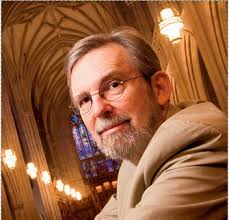
Richard Hays, dean of Duke Divinity School and one of the top New Testament scholars in the world, was on the campus of HBU recently to give the A. O. Collins lectures in theology. He gave two lectures exploring the ways in which the New Testament evangelists read and incorporate Israel’s Scriptures into their Gospels. Hays is working on a book which will be published in the next year by Baylor University Press, so I won’t give away too much; I’ll only hint at certain things which hopefully will make the book something you want to read for yourselves.

Richard Hays
Richard Hays, Dean of Duke Divinity School, Duke University

The title to his first talk was: “The Manger in Which Christ Lies”: Figural Readings of Israel’s Scriptures.” The title was taken from the introduction to one of Martin Luther’s books. Rather than seeing the Old Testament as somehow different from, indeed alien from the New, Luther used the image that the Old Testament is like the manger in which Christ lies, the swaddling clothes which both contained and concealed him. Christians, he insisted, must read the Old Testament as Christian Scriptures in worship and in personal devotions.

To make that more meaningful, Hays suggests that we need to understand how the NT writers went about reading Moses, the prophets and the writings. By delving into their imaginative world, Hays believes, we will be able to read the full Bible more faithfully. He calls that strategy “figural readings.” The word “strategy” is my own word and probably says too much. Strategy implies intent and planning. Figural readings were just the way they read and engaged the Scripture. It was as natural to them talking or eating.

At one point Hays said: “The Gospels teach us how to read the Old Testament (reading backwards).” Now the Old Testament is prior to the Gospels so any reading would have to be backwards. But the Gospels are full of quotations, allusions, images, and echoes of Israel’s Scripture written hundreds of years before Jesus was born. He gave several examples of how reading episodes and parables from the Gospels offer us greater and greater insight when we pay attention to the echoes of Scripture contained in these chapters. From start to finish Hays’ lecture was brilliant. Hundreds who heard it were moved and helped.

As Hays was lecturing, it struck me that the process we used in translating The Voice was a kind of “backwards reading.” In other words we began with the New Testament, translated it; then we turned our attention to the Old. Now this is often the kind of things translation committees do. Why? Well, the New Testament is only about ¼ the size of the Old. You can get it done more quickly. Plus, it is not uncommon to see the New Testament published alone, without the Old. In Christian circles you never see the Old Testament without the New.

But our backwards reading-translation meant that along the way, we had to make certain adjustments to how we thought about certain words, phrases, indeed entire books. By reading the Old Testament with New Testament eyes we do what the church has been doing since the first Jesus-followers struggled to make sense of what had happened among them. When we allow the Gospels and other New Testament books to guide our reading of Israel’s sacred texts, we are joining the saints of old in a noble enterprise which will enrich our lives and instruct our churches.

Are the Miracles in the Bible Simply Myths and Legends?


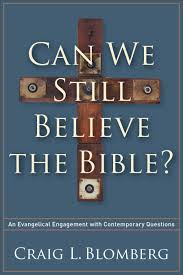
I want to summarize and respond to chapter six in Craig Blomberg’s book, Can We Still Believe the Bible? An Evangelical Engagement with Contemporary Questions (Baker Academic, 2014).  The chapter has to do with the miracles in the Bible.  For many people miracles are a stumbling block to trusting in the reliability of the Bible.  Because they have never seen one or experienced one for themselves, some people conclude miracles can’t occur.  Others think science itself and philosophy have proven miracles are impossible.  Still others think they can explain the miracles in the Bible as myths and legends.  It is this last group—those who think the biblical miracles are simply myths and legends—that most interests Professor Blomberg.Blomberg book

Now Craig is not disinterested in the question of science and miracle.  He deals it with throughout the chapter as he engages the broader question of how to understand the miracles in the Bible.  Indeed,

“Philosophers of science are also increasingly stressing that the miraculous by definition lies outside the bounds of science because it cannot be tested or experimentally reproduced in a laboratory” (p. 179).

I’m sympathetic with Craig’s straightforward statement that miracles cannot be defined out of existence as a violation of nature law.  While Craig seems amenable to the notion that a miracle involves the temporary suspension of natural law, I’m more comfortable with the claim that a miracle involves the invocation of a higher law.  Craig mentions this as a possibility early in his chapter. To offer a simple and probably flawed example, everyone knows that gravity is what keeps our feet firmly planted on mother earth.  But Bernoulli’s principle and the laws of aerodynamics make it possible for us to leave the ground and wing our way to new places without suspending or violating gravity.  Gravity is still at work on us and on the plane (otherwise flight would be impossible).  Temporarily and with a great deal of energy expended, these other laws of the physical universe make air travel possible.  I suspect that the miracles we see in the Bible belong more to this category than any other.  God, as the maker of nature and its laws, invokes a higher law for a higher purpose for a brief time.  Frank Tipler, a physicist who teaches at Tulane, appears to make this argument in The Physics of Christianity (Doubleday, 2007). Physics of Christianity

After introducing the chapter, Blomberg points to the exhaustive collection of modern miracle accounts in Craig Keener’s book, Miracles: The Credibility of the New Testament Accounts (Baker Academic, 2011).  Keener has brought together hundreds of reports of well documented healings of people with serious, chronic conditions from across the world.  Modern medicine appears to have no explanation for these healings.  Keener concludes that New Testament-like miracles are happening today all over the world.  Blomberg agrees and points to several events near to him which appear to him to be miraculous.  But the fact that miracles occur among people who practice faiths other than Christianity does not bother Blomberg; in the end these reports call into question the claim that atheism and naturalism are the best explanation for the world as it is.  In fact, Blomberg memorably states:

Even the occurrence of just one extraordinary event that naturalism cannot explain demonstrates that naturalism is not a comprehensive worldview that can account for all that happens in the universe. . . . But atheism has to be able to account for every scientifically inexplicable event apart from God for it to be necessarily true. Thus it takes at least as much if not more faith, not founded in empirical evidence, to be an atheist than it does to be a Christian.

Blomberg spends the bulk of the chapter rehearsing many of the miracles of the Old and New Testaments, showing how unique they are from the kinds of legends and myths found in ancient literature dealing with gods or God.  After cataloging most of the Old Testament miracles, Blomberg categorizes them into four groups: (1) events that show Yahweh’s superiority to other so-called gods; (2) interventions at critical moments to protect God’s people and demonstrate God’s covenant faithfulness; (3) judgment against rebellion in Israel serious enough to jeopardize God’s people; and (4) events that authenticate something new in God’s dealing with his covenant people.  In each case, Blomberg distances these OT accounts from the kinds of claims made about other gods in the ancient near east.Craig Blomberg

He does much the same with the miracle stories in the Gospels and Acts of the Apostles.  After briefly relating many of these stories, he shows how these are different from the kinds of miracle stories found in Greco-Roman religion and culture.  According to Craig, the claim that this or that legendary account is parallel to what is found in the New Testament is not convincing.  The only convincing parallels come from post-New Testament sources where it is more likely that stories about Jesus have been borrowed in order to build up the reputation of another.  The closest parallels to New Testament miracles are found in the Old Testament.

Blomberg points to the resurrection as the miracle which could not be mythical or legendary.  It is the very nature of myths and legends that they take time to develop, often generations. Yet within a very short period (no more than a year if not less) reports of an empty tomb and resurrection appearances were central to the gospel.  Paul, our earliest writing theologian, says it is of primary importance that Christ died for our sins and was raised on the third day and that he appeared to hundreds of witnesses  (1 Cor 15:3ff.).  This is the gospel he preached, but it was also the gospel he opposed no more than a year or two after Jesus’ execution.   The speed with which the resurrection stories circulated demonstrates they were not legends as traditionally understood.  If the chief miracle of the New Testament was not a myth, then we may well question whether accounts of Jesus healing the sick and feeding the multitudes ought to be classified as legends.

In the end Craig hopes that believers will avoid two extremes.  One the one hand, he is concerned about those who claim miracles ceased at the end of the apostolic age.  Miracles continue today, he says, all over the world.  They are not occasional and random. They are happening regularly especially in the Majority world.  On the other, Craig warns that abuses and “quackery” (209) often follow powerful and influential religious movements.  Charismatics need to be careful not to try to imitate the Spirit by their own strength and in their own flawed wisdom. Cessationists should be mindful not to try to limit how God is working in the world today.  Both need to examine themselves carefully in light of Scripture.

This chapter, as well as the other chapters in Blomberg’s book, is well worth reading if you have questions about the Bible’s reliability and concerns about the miracles.  While I find myself in friendly agreement with much of what Craig writes, there are a few places where I must stand in friendly disagreement. I’m not sure Blomberg’s arguments will convince many close-minded skeptics who have concluded a priori that miracles cannot happen.  What I do think he accomplishes is a fresh challenge to those open-minded enough to reconsider the quality and quantity of biblical and modern miracles.