
Page 27 of 29

Strategic Ambiguity: East of Eden

Recently, Dr. Adam E. Miglio, Associate Professor of Archaeology at Wheaton College, joined me on “Exegetically Speaking” to demonstrate that exegesis involves knowing more than grammar and vocabulary. Often biblical authors employ strategic ambiguity to cause us to slow down and ask what a word or phrase means.  He treats Genesis 4.7 and the phrase “you must/will rule over it,” which characterizes life ‘East of Eden’.

Dr. Adam Miglio

To hear the 7 minute podcast you can cut and paste the following URL into your favorite browser:

http://exegeticallyspeaking.libsyn.com/strategic-ambiguity-east-of-eden-genesis-47

Or click here.

“Exegetically Speaking” is a weekly podcast of the friends and faculty of Wheaton College, IL and The Lanier Theological Library. Hosted by Dr. David Capes, it features language experts who discuss the importance of learning the biblical languages—Hebrew, Aramaic, and Greek—and show how reading the Bible in the original languages “pays off.” Each podcast lasts between seven and eleven minutes and covers a different topic for those who want to read the Bible for all it is worth.

If you’re interested in going deeper, learn more about Wheaton’s undergraduate degree in Classical Languages (Greek, Hebrew, and Latin) and our MA in Biblical Exegesis

You can hear Exegetically Speaking on SpotifyStitcherApple Podcasts, and YouTube. If you have questions or comments, please contact us at exegetically.speaking@wheaton.edu. And keep listening. 

Pre-incarnate Bling in the Christ-Hymn (Philippians 2:5-11)

Dr. Nijay Gupta, Professor of New Testament at Northern Seminary, has authored several books and articles, including his recent, Paul and the Language of Faith(Eerdmans, 2020). Recently, we had the chance to connect on Exegetically Speaking to discuss the “poetic” language of one of the New Testament’s most important passages about Christ. Nijay questions whether we’re dealing here with poetry or something else. He prefers to call it an Ode to Christ. As I recall, Gordon Fee referred to it as exalted prose. At any rate, Dr. Gupta does a great job helping us work through part of this passage, one of the most famous in the New Testament.

To listen to the podcast, you can cut and paste the following URL to your brower:

http://exegeticallyspeaking.libsyn.com/pre-incarnate-bling-in-the-christ-hymn-philippians-25-11

or click here.

Dr. Nijay Gupta, Northern Seminary

“Exegetically Speaking” is a weekly podcast of the friends and faculty of Wheaton College, IL and The Lanier Theological Library. Hosted by Dr. David Capes, it features language experts who discuss the importance of learning the biblical languages—Hebrew, Aramaic, and Greek—and show how reading the Bible in the original languages “pays off.” Each podcast lasts between seven and eleven minutes and covers a different topic for those who want to read the Bible for all it is worth.

If you’re interested in going deeper, learn more about Wheaton’s undergraduate degree in Classical Languages (Greek, Hebrew, and Latin) and our MA in Biblical Exegesis

You can hear Exegetically Speaking on SpotifyStitcherApple Podcasts, and YouTube. If you have questions or comments, please contact us at exegetically.speaking@wheaton.edu. And keep listening. 

The Name of God

Dr. Aubrey Buster, Assistant Professor of Old Testament at Wheaton College, joins me on “Exegetically Speaking” to discuss the meaning of the Hebrew Name that God takes for himself during his first appearance to Moses. What its meaning was, why it was given, how it has been spelled and pronounced in the Hebrew and English traditions, and why these later forms were adopted.

The podcast is about 7 minutes.

To listen, just cut and paste the following URL into your favorite browser:

http://exegeticallyspeaking.libsyn.com/the-name-of-god-exod-314

or click here.

“Exegetically Speaking” is a weekly podcast of the friends and faculty of Wheaton College, IL and The Lanier Theological Library. Hosted by Dr. David Capes, it features language experts who discuss the importance of learning the biblical languages—Hebrew, Aramaic, and Greek—and show how reading the Bible in the original languages “pays off.” Each podcast lasts between seven and eleven minutes and covers a different topic for those who want to read the Bible for all it is worth.

If you’re interested in going deeper, learn more about Wheaton’s undergraduate degree in Classical Languages (Greek, Hebrew, and Latin) and our MA in Biblical Exegesis

You can hear Exegetically Speaking on SpotifyStitcherApple Podcasts, and YouTube. If you have questions or comments, please contact us at exegetically.speaking@wheaton.edu. And keep listening. 
Context is King

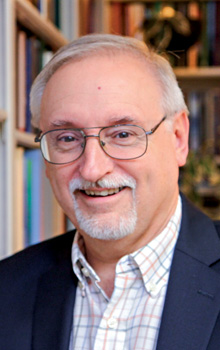
Dr. John Walton, Professor of Old Testament at Wheaton College Graduate School, and I recently had a chat on Exegetically Speaking. He lays out the importance of knowing the context of a passage to understand it.  After discussing four kinds of context for exegesis, he focuses on the historical context.  As a test case, he takes us to Daniel 7:1 to understand what is happening historically at the time of Daniel’s fantastic vision. 

To hear the 7 minute podcast, you can cut and paste the following URL to your browser:

https://exegeticallyspeaking.libsyn.com/context-is-everything-historical-context-daniel-71

or click here.

“Exegetically Speaking” is a weekly podcast of the friends and faculty of Wheaton College, IL and The Lanier Theological Library. Hosted by Dr. David Capes, it features language experts who discuss the importance of learning the biblical languages—Hebrew, Aramaic, and Greek—and show how reading the Bible in the original languages “pays off.” Each podcast lasts between seven and eleven minutes and covers a different topic for those who want to read the Bible for all it is worth.

If you’re interested in going deeper, learn more about Wheaton’s undergraduate degree in Classical Languages (Greek, Hebrew, and Latin) and our MA in Biblical Exegesis

You can hear Exegetically Speaking on SpotifyStitcherApple Podcasts, and YouTube. If you have questions or comments, please contact us at exegetically.speaking@wheaton.edu. And keep listening. 

Mr. Greek

Bill Mounce

Dr. Bill Mounce (https://www.billmounce.com/about), Mr. Greek himself, recently stopped by the Lanier Library with his sweet wife, Robin. I had the chance to interview him briefly for “Exegetically Speaking,” Dr. Mounce is the the founder and President of BiblicalTraining.org. He also serves on the Committee for Bible Translation (responsible for the NIV translation of the Bible), is author of Basics of Biblical Greek and other works, and was formerly a professor at Gordon-Conwell Theological Seminary and Azusa Pacific University. In this episode, he joins me to talk about his own pilgrimage as a student of Greek and the vision and work of BiblicalTraining.org.

To listen to the podcast, click here.

“Exegetically Speaking” is a weekly podcast of the friends and faculty of Wheaton College, IL and The Lanier Theological Library. Hosted by Dr. David Capes, it features language experts who discuss the importance of learning the biblical languages—Hebrew, Aramaic, and Greek—and show how reading the Bible in the original languages “pays off.” Each podcast lasts between seven and eleven minutes and covers a different topic for those who want to read the Bible for all it is worth.

If you’re interested in going deeper, learn more about Wheaton’s undergraduate degree in Classical Languages (Greek, Hebrew, and Latin) and our MA in Biblical Exegesis

You can hear Exegetically Speaking on SpotifyStitcherApple Podcasts, and YouTube. If you have questions or comments, please contact us at exegetically.speaking@wheaton.edu. And keep listening.