Study in Jerusalem: Online and In the Land
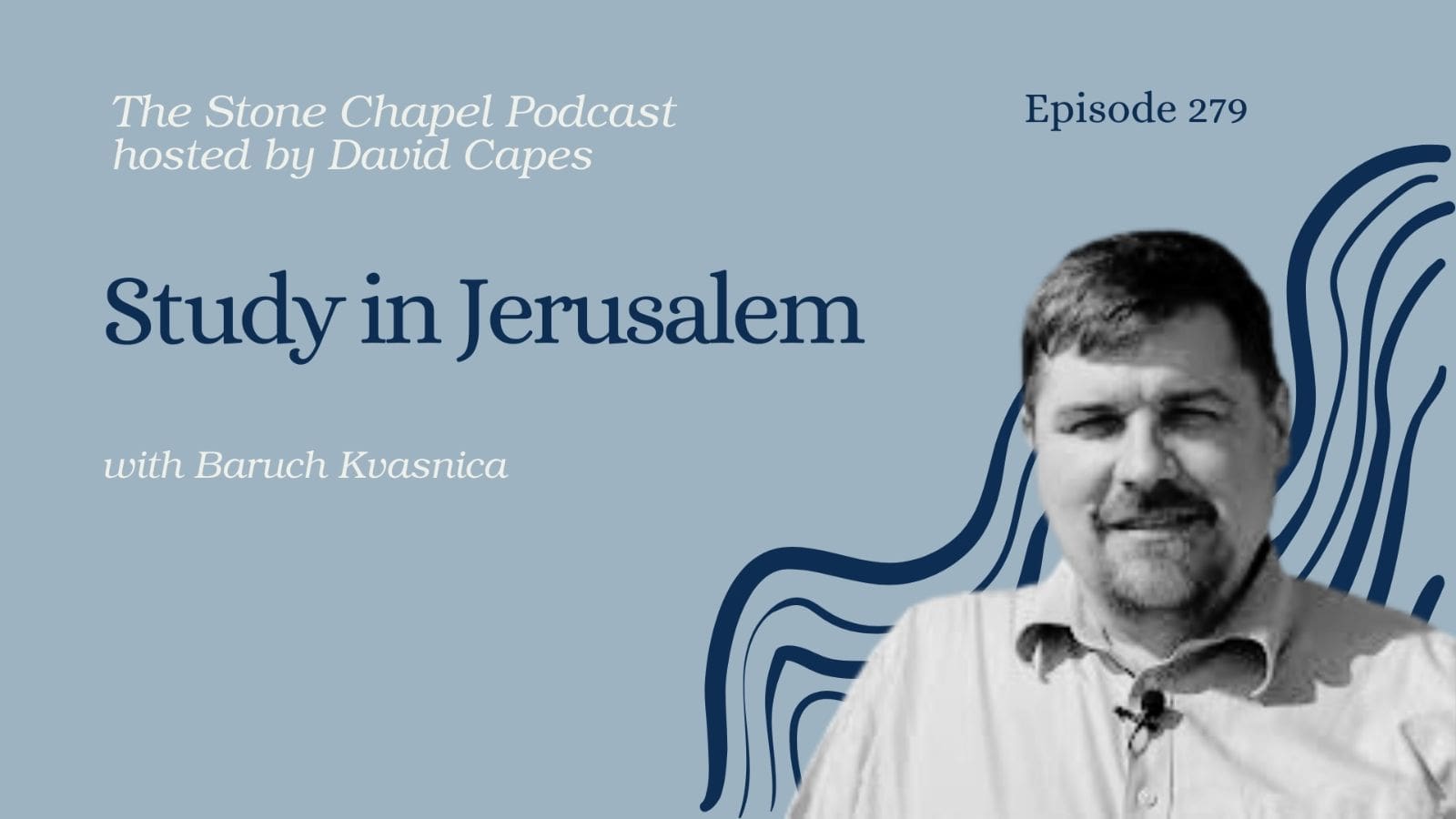
Baruch Kvasnica
My name is Baruch Brian Kvasnica, and I’m president of Jerusalem Seminary.

David Capes
Dr. Kvasnica, good to see you, Baruch.

Baruch Kvasnica
Good to be here.

David Capes
Thanks for being with us. We’re here together face to face, which is always good. Now you’re president of Jerusalem Seminary. We’re going to find out more about that in a minute, but I want to find out about you now. For those who don’t know you, who is Baruch Kvasnica?

Baruch Kvasnica
I was born in Michigan and raised mainly in Michigan, as well as the Philippines and Papua New Guinea, where I graduated as a Wycliffe MK. I loved my time there as a kid, growing up with a broader mission than just a local church, but also the whole world. I went from Ukarumpa High School in Papua, New Guinea, to Houghton University in Western New York. Knowing that I had Jewish heritage, that idea expanded in college, getting to know a person who was born and raised in Israel. And that piqued my interest.

I really wanted to study early Christianity in the land of the Bible. I went there in the summer of 1994, and I couldn’t believe how much I didn’t know. I thought I knew my Bible well, and then I went to the land. It showed all these places where I had gaps that I hadn’t focused on, or I didn’t understand, or hadn’t paid attention. And I just ate that up. I jumped on an Anglican priest course at Tantur with Jim Fleming and Kenneth Bailey. And I couldn’t believe that. It was amazing. I studied under Petra Heldt at Hebrew University on Eastern Christianity. As a history and religion major, I thought I knew my history of Christianity, but I didn’t know it very well.

David Capes
Now you’d already graduated from Houghton?

Baruch Kvasnica
No, this was between my junior and senior year. I was there just for nine weeks during my summer break. I went back to Houghton and became pastor of a little country church, as well as finishing up my honors project on John Wesley’s Religious Epistemology. I applied to different seminaries, and I got a full-ride offer to an Ivy League school. But I decided not to take it because my life was influenced so powerfully by those nine weeks in the summer of 1994. I went back [to Israel] after Houghton and started studying religious studies, comparative religions between early Judaism and early Christianity.

David Capes
Where were you studying at that point?

Baruch Kvasnica
At Hebrew University of Jerusalem. The Harvard of Israel.

David Capes
Our good friend, Emmanuel Tov, teaches there. He’s great.

Baruch Kvasnica
Yes, he’s been my neighbor down the street for the past 10 years.

David Capes
So, are you married?

Baruch Kvasnica
I’ve been married very, very happily for 24 years to Shoshi, my wife. She was born and raised there in Israel. She’s a messianic Jewish gal.

David Capes
So, how’d you get the name Baruch?

Baruch Kvasnica
Baruch has been my name for the past 15 years. I was walking one day in 1998 with my dad, and he said, if I ever immigrate to Israel, I think I’d be Baruch instead of Bob. And then when I became a permanent resident there, I said, hey, this is a good opportunity for me to recognize my latent Jewish heritage. I’m still a believer. I’m a Christian. I’m the same person, but I’ve seen a lot of Jewish believers assimilate to the point that their Jewishness is no longer realized. Statistically, two to three generations after a person becomes a believer, their children don’t understand themselves as being Jewish anymore.

David Capes
Though by heritage and by blood, they are.

Baruch Kvasnica
Yes, so I thought this is a way to reaffirm what my dad felt, and who my grandfather was. I feel like I’m blessed. My wife and I have seven children, and we’re so thankful. We’re living in the land which is a blessing and a challenge. Baruch means “blessed, blessing.”

David Capes
You’re president of Jerusalem Seminary. Tell us a little bit about it. What is its mission?

Baruch Kvasnica
When I went first in 1994, I couldn’t find a place where I could do a Master’s of Divinity in English. I needed that to be ordained. I looked for different ways to do that. I couldn’t find an easy way to do it. Later on, I could do it online. But I didn’t really want to do it online. I wanted to do it in person, if possible, or some component in person.

So, I thought, there’s not a seminary in the land of the Bible. Why not create one? That’s the short story. The longer story is that my life was so transformed by being in the land and learning Hebrew, and not just Greek. I learned Greek too, and that’s awesome, but knowing both Greek and Hebrew really impacted my faith. It rooted me in the land and history of the people of Israel, that strengthened my faith. It challenged it a little bit too. And I thought, God, this is so amazing. I want to share this with other people. I started guiding and teaching pastors and academics and lay people. In 1998 I saw that it was
also beneficial for them. I started training Bible translators in Hebrew.

I saw the impact that Hebrew in the land had, both in my life and for others. I thought, wow, everyone going into ministry should have the opportunity to spend some amount of time with the right people in the land of the Bible. And so that’s really the driving passion of why Jerusalem Seminary exists, to give that opportunity that I had, that I hope many, many thousands of others can have in the coming years.

David Capes
Now, are you an online seminary, or are you residential? How does that work?

Baruch Kvasnica
We started in 2018.

David Capes
Okay, so at this point you’re only seven years old.

Baruch Kvasnica
Yes, and this is just before the pandemic. Our first school of Hebrew was founded in 2018, and this was geared towards Israelis, to have them learning Biblical Hebrew in a lived or communicative manner. Israelis know a little bit of biblical Hebrew, because modern Hebrew is not too different. The first 1,000 words are about 88% the same vocabulary. But beyond that, the poetry and a lot of the syntax is different.

We wanted to train them, and not just teach them Biblical Hebrew, but teach them how to teach in this lived, expressive, spoken way. They became the core of our teachers, both residentially, abroad and online. What we’re doing still is training Israelis to learn how to teach Biblical Hebrew, and they do that by going to Mongolia, Nigeria, Togo, Myanmar, Grand Rapids. Two by two, we send these Israelis, these Messianic Jews who know Biblical Hebrew inside and out and express that. All of the learning is done in that manner. That’s our School of Hebrews, founded in 2018.

In 2021 we started the School the Bible, which started right in the midst of the pandemic. We started that completely online. We were able to have some short-term courses come in 2022 and 2023. And we’re looking to expand that. But our School of the Bible, started in 2021, and this is more on a BA level, more for enrichment. This fall, just a month or two ago, we started our School of Graduate Studies, and this is our first degree, a MA in Biblical studies.

David Capes
In these other programs, you don’t earn a degree. They are more of a certificate program. But the graduate studies, you’re offering the full degree.

Baruch Kvasnica
Yes, that’s right. But our certificates are not lightweight, meaning that almost half of our students are Bible translators. Because I’ve been training Bible translators in the land of the Bible for about 15-20, years. They know about us, and they know, by God’s grace and for His glory, how incredible our School of Hebrew is. They are coming to learn online and in person in August. For example, every August for the past eight years, and diaspora Hebrew month-long intensives, we call them. So even though they’re certificates, they’re actually very serious.

David Capes
Yes, they can be. This is fascinating! All right, so if people have heard something today and they want to connect with you, how would they get connected with Jerusalem Seminary and you as President?

Baruch Kvasnica
Well, jerusalemseminary.org is our website, and that has our course catalog.

David Capes
jerusalemseminary.org.

Baruch Kvasnica
Yes. They can see the course catalog and can register for both individual classes. They can take them for credit. They can take them for audit. There are also certificate programs. And there’s also the new MA in Biblical Studies that requires them to be in the country twice. So, everything can be done online, except for two residential intensives in the land.

David Capes
Are those one week, or two weeks?

Baruch Kvasnica
Two weeks.

David Capes
Two weeks each. Do you have residences that they can occupy?

Baruch Kvasnica
Yes, as soon as we received money, that was given from here in Houston, back in 2017. As soon as I knew about this seed money, I immediately thought of the building that we’re in. It’s the Alliance Center. It’s where a number of institutions have been born, and it has eight dorm rooms. It has a beautiful chapel, it has classrooms, has offices. It’s right downtown in central Jerusalem.

David Capes
Oh, wow. So, this is not tin he Old City.

Baruch Kvasnica
It’s about a seven-minute walk from the Old City. On Prophet Street. It’s even biblical!

David Capes
Nevi’im the prophets! So, people can get to know the city of Jerusalem. Do they go up to the Galilee, over to the Dead Sea, and Jericho? Places like that.

Baruch Kvasnica
Yes, we often start our short-term courses down in the Negev just like the patriarchs and the wanderings in the wilderness and the manna. And then we move up to the Galilee at some point for a couple days or so and see the coast. Then focus at least half the time in Jerusalem. So yes, it’s definitely an active field trip and lecture combination for our short-term courses.

David Capes
How has the war affected you and your institution?

Baruch Kvasnica
It’s been a long journey. Not only the war, but COVID was tough for everyone. Israel tried to be really tough.

David Capes
Everything was shut down.

Baruch Kvasnica
Yes. Then the war has persisted in bringing challenges. It’s been a very difficult psychological challenge. We’ve had staff that have been involved in serving. They’ve been pulled out for reserves because about 75% of our staff are local, so that makes us a little unique too. There’s a number of institutions in the land. God is building us in such a way that we can be there, long term. We pray, so that we can have a lasting effect.

Some of my children are needing to serve because that’s required by law, boys and girls. That clipped our wings as far as bringing students in the land, but we’re looking forward to a new era. Now that there’s greater peace, we have a number of seminaries and Bible colleges interested in coming back to the land. Having short-term courses or a semester abroad or a year-long program. We’re looking forward to the future.

David Capes
I know some of the people who teach for you, but for our listeners, tell us a few people that teach for you. If I were to come and study, besides working with you and learning Hebrew, who could I study with?

Baruch Kvasnica
We have Dr. Gerald McDermott, who’s been with us from the beginning, Dr. Petra Heldt, who was my first teacher in Hebrew University in 1994 and she is amazing. We’re trying to get her to write a book. We have Randall Buth, who’s doing some of the lecturing for the gospels course. We have Dr. Halver Ronning, who has been here. Nick Aaronson is coming on board. Walter Kaiser is on our Advisory Council.

David Capes
What does the future look like over the next three to five years?

Baruch Kvasnica
We are looking forward to having hundreds of students come each year. Our goal is 1,000 a year in about 5-10 years, but looking for hundreds to come and be in the land or online. We have about 250 students now, each year, but only about 20% of them are in the country. We want to just expand that from 250-1,000.

David Capes
Your students are from different countries?

Baruch Kvasnica
Yes. This semester, I think we have 14 different countries. Last semester, we had 85 from 21 countries. This is mainly because we have so many Bible translators. But the wonderful thing about Bible translators is, often, they’re not just translating Bible. They’re also preaching, yeah. So we get two for one, preachers and Bible translators at the same time,

David Capes
All right, once again, for those who want to be in touch with you. Maybe they feel like they want to donate some money, or maybe they feel they’d like to study in the land. I’d like to go over there for two weeks and have some time or take a short-term course or be involved in a program of study. How would they do that?

Baruch Kvasnica
They can connect us with us at jerusalemseminary.org. They can write, email, call. If they’d like to donate, there’s a “Give” page. I totally believe that this is God’s doing. That the Kingdom needs to advance in the land of the Bible. Meaning that pastors can be rejuvenated. Seminarians can be rooted in the land and will have a much more fruitful ministry by being connected to the land and language of the Bible. If people would want to join what God is doing at Jerusalem Seminary, feel free to check us out at jerusalemseminary.org.

David Capes
That sounds great. Dr. Kvasnica, thanks for being with us today on “The Stone Chapel Podcast.”

Baruch Kvasnica
Thank you very much. My pleasure.

12
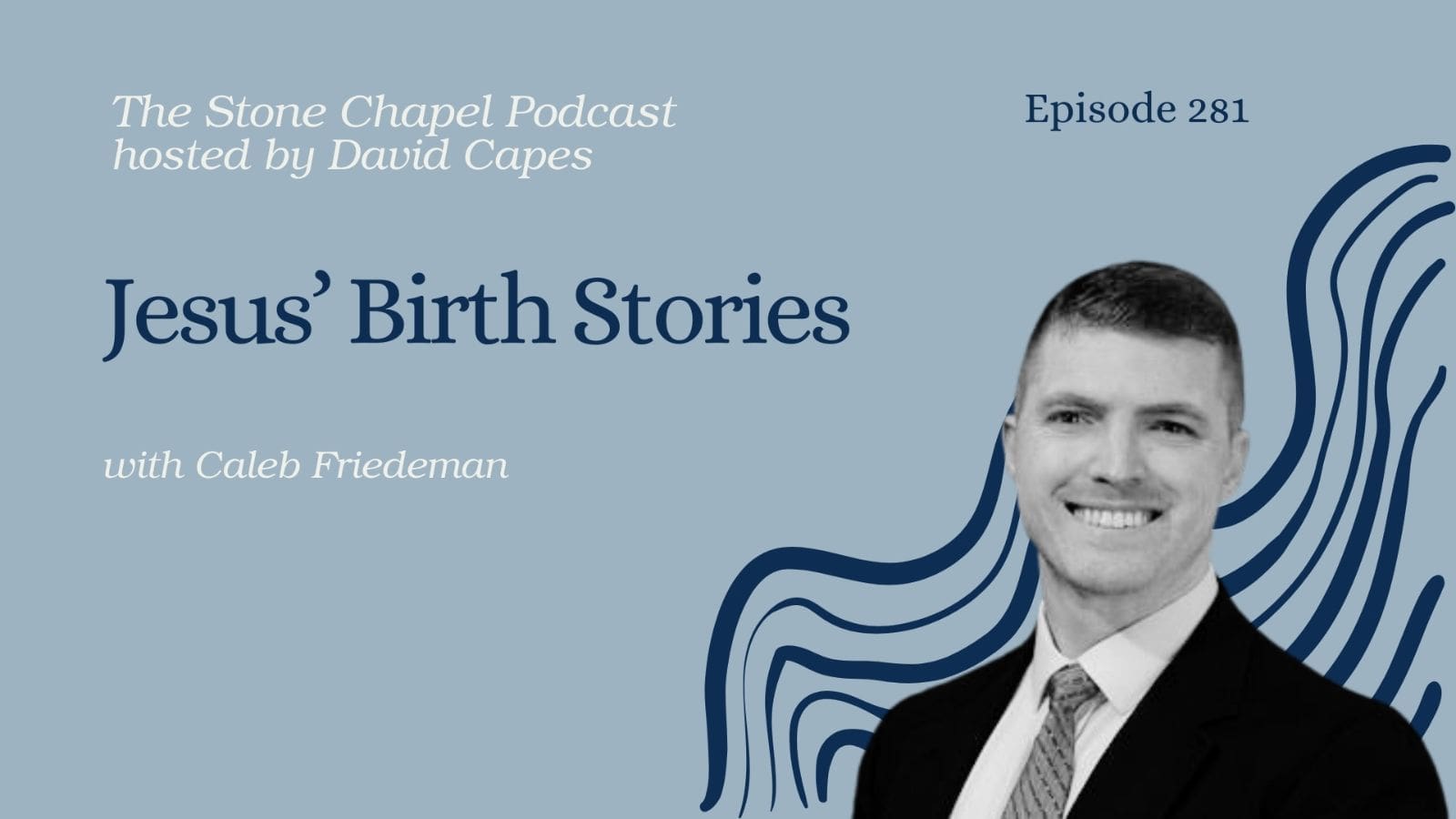
Jesus’ Birth Stories with Caleb Friedeman

To hear the podcast click here.

This transcript has been edited for clarity and space. 

Caleb Friedeman 

Hi, I’m Dr Caleb Friedeman, and I serve as David A. Case Chair of Biblical Studies and Associate Research Professor of New Testament at Ohio Christian University. 

David Capes 

Dr Caleb Friedeman. Caleb, good to see you. This is your first appearance on The Stone Chapel Podcast

Caleb Friedeman 

Yes, great to be on. Thanks for having me. 

David Capes 

I got to know you at Wheaton College a few years back when you were there, and since then, you have finished your degree. You’ve graduated, got your PhD, and are doing great work at your university. 

Caleb Friedeman 

Yes! I had a great time at Wheaton and enjoyed getting to spend a little bit of time together there. And the Lord blessed me with the opportunity to come to Ohio Christian University after I graduated, I’ve been here for going on eight years now. It’s hard to believe, in some ways. It’s been a good ride. And have had a lot of opportunities to preach, to teach, to write, and just feel very blessed. 

David Capes 

Well, you’ve written some great things, and the book that we’re going to talk about today is no exception to that. It’s a very interesting thesis, that is cutting some new ground. But let’s give a little bit more information about you. For those who don’t know, Caleb Friedeman, who is he? 

Caleb Friedeman 

I grew up in Jackson, Mississippi, and the Lord led me through my education. I went to Asbury University for undergraduate, and then Wesley Biblical Seminary for an MA. Then I went to Wheaton College for PhD work, which, of course, is where you and I met. Then the Lord opened up this job at Ohio Christian University. Right after that, I am married to Isabella. She’s from Honduras, and we have one son, Paul. I’m an ordained elder in the Church of the Nazarene. So, I am both a biblical scholar, but I also have a pastoral piece to my calling as well. And I do have some interest outside of writing and teaching. In high school I was a competitive power lifter, and I play piano and guitar as well. Transcribed by https://otter.ai – 2 – 

David Capes 

Well, you’ve written a terrific book entitled Gospel Birth Narratives and Historiography. The subtitle is Reopening a Closed Case. It’s published by Baylor University Press. It’s a really impressive book. Congratulations on it. First of all, let’s talk a little bit about it. What’s the big idea of the book? What are you trying to do here? 

Caleb Friedeman 

Well, as the subtitle implies, the Gospel birth narratives have really been a closed case when it comes to historical Jesus scholarship, for quite some time, I’d say. Easily, reaching back five to six decades, and maybe even longer. Just as one sounding on that, if you do a run through major books on the historical Jesus over the last 40-50, years, you’ll be hard pressed to find a substantive discussion of Jesus’s birth and childhood, even in significant, lengthy monographs. And sometimes, if you do find any kind of discussion, it’s simply to say why they’re disregarding the material. We do have these two birth narratives in Matthew 1-2 to and Luke 1-2, but scholars typically haven’t taken them very seriously. And so I try to dig into that in the book, and I distinguish between two things, two kinds of skepticism you can have toward a source. 

One is skepticism of intent, which is basically to say, I don’t think that this source is intended to be historical. For example, if someone is trying to reconstruct the historical person Don Quixote, using the novel Don Quixote, then you might protest that this source is not intended to be historical. So, you’re just off on the wrong foot from the beginning. But the other kind of skepticism would be skepticism of truth. So that basically says, I recognize that this source is intended to be historical. I just don’t think that it’s correct at a given point. 

If you look at those two, they’re both valid, and they’re both very important to use at certain points if we’re trying to do historiography. But skepticism of intent is a lot more efficient if you can pull it off. Which is to say, if I can convince you that what you’re looking at is more like Don Quixote or Goldilocks or something, than it is like Thucydides or some other historian or some historical biography, then we don’t really need to discuss the historicity of individual events. Because we’re just not dealing with that kind of a source. 

And what I basically suggest in the introduction to the book is that the unique skepticism the scholars have leveled at the gospel birth narratives really is unique. I don’t know of another part of the gospels that we disregard in that way. That unique skepticism really depends on the skepticism of intent, because it’s hard to produce truth-oriented reasons that would justify ignoring historical sources in that way. And interestingly, you have had a good number of scholars, who really articulated a skepticism of intent. Even people like John Meyer, for example, doesn’t think that the birth stories are intended to be historical, necessarily. 

David Capes 

So, you have these two kinds of skepticism. Both can be useful in their own way when you’re dealing with the right kind of material, as you articulate. Since Richard Burridge’s work on the Gospels, a lot of Transcribed by https://otter.ai – 3 – 

people accept the idea the Gospels are meant to be an ancient kind of biography. That means they are intended to be taken as historical. 

Caleb Friedeman 

Yes, and I think Burridge and that whole trend of recognizing the Gospels are ancient biographies is really where my project starts. And interestingly, one of the things that I agree with scholars, whom I disagree overall with, is the fact that the Gospels are ancient biographies. And certainly, if not that, at least that ancient biographies give us the best comparisons for how we should be reading the gospels. One thing that’s interesting is, if you look at scholars who have made these kinds of arguments for why birth material should be regarded as legendary or, ahistorical, they’re typically appealing to ancient biographies. 

You might say the argument goes something like this. From the other side, the side that I’m pushing back against scholars will say something like this: birth material, or birth stories in ancient biographies was not intended to be historical. The Gospel birth narratives are in ancient biographies, and so the gospel birth narratives also are not meant to be historical. 

I basically take that argument on and say, I’ll grant you that we’re dealing with ancient biographies here and that that needs to be the backdrop. But I actually disagree on all points. I basically say, let’s start with ancient biographies and look and see how it seems like their authors intended them to be read. My argument is basically birth material in ancient biographies was intended to be historical. And as ancient biographies, then the birth material that we find in the gospels, like in Matthew 1-2 and Luke 1-2 is also intended to be historical. I spend the first part of the book dealing with a range of different ancient biographers and looking at how they write their birth material. And then I get into the gospel birth narratives in part 2. 

David Capes 

Let’s talk about some of those historians, or historical figures that you’re talking about. Give us a bit of a rundown. 

Caleb Friedeman 

I’m basically looking for biographers who wrote within a century of the Gospels on either side. And I’m also looking ideally for biographers who have written more than one biography that has birth material we can look at because a sample size of only one biography for an author isn’t the most helpful. I end up going with Cornelius Nepos, and he is actually our first Roman biographer. And then I do Philo, who only has one biography, his Life of Moses. But that has been such a major player in these discussions. Because it’s our only Jewish biography at all that it’s worth dealing with, even given that we only have the one. And then I also do Plutarch. Of course, many people are going to be familiar with Plutarch’s Lives, and those are some of our most important sources for reconstructing what ancient biography was like. And then I do Suetonius as well. I spend a chapter on each of those authors. 

Just a little bit of the backstory of this book too. I mentioned earlier that there are these scholars who are making these cases about ancient biographies. When I was getting into scholarship, even preparing for PhD work, I started to read this scholarly literature about gospel birth narratives. And it wasn’t just Transcribed by https://otter.ai – 4 – 

about the historical parts. I was just reading things like Raymond Brown’s Birth of the Messiah and reading a whole range of works about the gospel birth narratives. And I kept encountering this claim by various authors that this material wasn’t intended to be historical. They were citing ancient biographies to back this up. And at some point, I just said to myself, okay, I want to go read this stuff for myself and see what’s going on. 

I started reading the kinds of biographies that were cited. For example, Plutarch’s Life of Alexander or Romulus or Suetonius Biography of Augustus. I just kept noticing these features that didn’t really track with the story I’d been told about what these biographies were supposed to be doing. For example, they would do things like cite sources for the information they were giving. Well, that’s an odd thing to do if you’re just writing something that’s meant to be legendary. I don’t find a lot of source citation in fairy tales. I would see something like that, or I would find a biographer mentioning differences among their sources. There are three accounts of how this happened. Here’s how the first one goes. Here’s how the second one goes. Here’s how the third one goes. And then they might even go further and say, and I’m going to evaluate these and tell you which one I think is the most accurate or truthful. Or maybe I’ll come up with my own reconstruction of what’s going on. 

And then one last thing is they would sometimes distance themselves from more miraculous or supernatural kinds of claims, or just more fantastic kinds of things. What I mean by distancing is basically putting distance between their authorial reputation and the claim that’s being made. Instead of simply asserting that, a God had intercourse with the subject’s mother and then that led to this person being born. They might say it is said that and then give the tradition. Plutarch might not want to be held accountable for that material, but it allows him to pass on this information into sources without taking responsibility for it, which again, indicates a historiographic consciousness. 

Those four things that I just mentioned, I call those historiographic features, and they’re the basis of the analysis in this book. Those would be sources. And by that, I mean citation of sources in some form or indication that an author has sources. And then transparency, that’s where you note differences between accounts. Then evaluation, where you evaluate the trustworthiness of those accounts, and then distancing, where you distance your reputation from a claim. I basically use those as at least one key part of my analysis when I get to these ancient biographers, and then also when I talk about the gospel birth narratives in part two. 

David Capes 

You have these criteria that you’ve looked at and evaluating. Now, Plutarch writes, in his Lives, I think about 50 plus different people. But he doesn’t give birth narratives to everyone right? 

Caleb Friedeman 

Correct! 

David Capes 

So, birth narratives aren’t necessarily a given feature of every biography. 

Caleb Friedeman Transcribed by https://otter.ai – 5 – 

Yes, that’s right. I would say some people have failed to notice that, and other folks have noticed that, but failed to consider the significance. One of the things that I talk about for Cornelius Nepos, Plutarch and Suetonius, because that’s the only place where you have the opportunity to talk about absence. Because obviously Philo has got birth material, so he’s not going to have absence because he has no other biography. When I am looking at these authors that have multiple ancient biographies, one of the things I talk about is how we make sense of the absence of birth material from their biographies. 

So not only do we find historiographic features in the birth material of many of these biographies, we also find that many of their biographies don’t have any birth material at all, or that the amount varies a lot. In some cases, you might have only a line or a sentence or two on somebody, or just even a very short sentence, if they’re just spinning all this out of whole cloth, and they don’t need any sources. They’re just making stuff up. Why not just have the same amount of birth material for everyone, or have the amount of birth material scale to how much they like the figure that they’re writing about. Which, again, just doesn’t seem to be the case. 

You find all kinds of places where you don’t have that kind of scaling. For example, I believe Thrasybulus is one of Cornelius Nepos favorite subjects, and he doesn’t give him birth material. Why? If all this stuff is meant to be is some sort of legendary, non-historical anticipation of what this person is going to become as an adult. It just doesn’t seem to make a lot of sense. I think that the better explanation for that absence is actually that the reason we have absence, in some cases, is either because the biographer lacks sources, which is the kind of problem a historian or a historical biographer would have for sure. Or the information in their sources just wasn’t relevant or interesting enough to include. But what that really keeps out of bounds is the idea that, they’re just making this stuff up. 

David Capes 

Yes. I like that. I think that’s an important part of the argument. Now, what we find too, in the New Testament is that Mark begins and has no birth narrative. And same thing is said of the Gospel of John as well. There’s not really a birth narrative. There’s a theological prologue in GJohn that talks about his pre-existence. But that seems to be of a different class than saying the things that you say in these birth narrative 

Caleb Friedeman 

Yes, I would say the fact that Mark and John don’t have what we might call a birth narrative proper has actually become a lot less surprising to me the more that I’ve studied ancient biographies Because you just begin to recognize this is not a requirement or even a norm necessarily that you’re going to have these. There are too many exceptions to say that this was a universal requirement, or even something that was odd to leave out. 

Just for example, as you look across those four authors that I mentioned, Nepos, Philo, Plutarch and Suetonius, I analyze 95 biographies from those authors. I can only discuss so many of those in detail in the chapters, but I give tables at the end of the book in appendixes that actually give an analysis of historiographic features of things like omens and miracles if they’re there. Then something called time elapsed, which we can come back to. But I give my analysis and those tables at the back. Transcribed by https://otter.ai – 6 – 

If you go through and look, I also talk about where the birth material actually is in each life. I think it’s 18 of the 95 that don’t have any birth material whatsoever. And then that’s even being very gracious, because I’m counting things like, if there’s a sentence that pertains to the person’s childhood or birth. I’m including that as birth material. So on that count, actually, if you were to grant that any kind of claim about someone’s childhood or birth counts as birth material, then you might say that Mark and John have a little bit because, you’ll find a mention about being the son of Mary or the son of Joseph. 

David Capes 

And it’d not necessarily in the first chapter or the first writing that you encounter, but you encounter in the story that he has brothers and sister and those types of things. 

Caleb Friedeman 

And by the way, if you want to say, let’s not count that kind of stuff, and you then had a harder line analysis for all these other ancient biographies that I deal with. Well, you might end up saying that a lot more than 18 don’t have birth material. 

David Capes 

Yes, exactly. 

Caleb Friedeman 

I just say that I think what we find as you cross the four Gospels and whether or not they have birth material is within the range of what we’d expect for ancient biographies. I don’t think that it’s particularly unusual that Mark and John don’t have a birth narrative, and then that Matthew and Luke do. 

David Capes 

I guess the bottom line is that ancient biographies, when they did talk about birth material, their intention was to say, I’m writing history here, and I’m making judgments about that history. And so when we come to the Gospels, we can say that at least the intention of Matthew and the intention of Luke is to say that I’m writing history here. Not only in the things that Jesus said and did as an adult, but also in the stories of his origins, the stories of his family. Even those that are interlaced with some dream interpretation and visions and those kinds of things. 

Caleb Friedeman 

I think that’s exactly right. And I guess the way that I would put it is Matthew and Luke and other ancient biographers wrote their birth material with historiographic intent. That’s to say that they didn’t have a unique approach to this material vis a vis other parts of their biographies. All I’m really saying is we need to read this material the same way we would read anything else in a nature biography. Instead of treating it as a special case, we just should approach it with the same kinds of assumptions that we approach their accounts of the person’s adulthood. And that should be self-evident, but I think it hasn’t been in scholarship, and that has generated the need for this kind of book. 

In addition to historiographic features and the absence of birth material that I look at, I also look at a couple other elements. One is their use of supernatural elements. Here I include both omens, which are Transcribed by https://otter.ai – 7 – 

things that today we might call coincidences, but the people in ancient times often saw significance to. You would maybe have a coincidence, and then you would interpret it in a certain way. So that would be something like an omen. Then you actually have supernatural events, which you might call miracles, where the biographer is actually affirming that something happens. One thing that’s really interesting coming out of that is that number one, you really don’t find biographers typically making miracle claims in birth material a lot. 

Usually, if they’re going to relate something supernatural, I would say the vast majority of the time, they’re going to include a historiographic feature that’s going to either distance them from it or make it just an act of transparency, where I have this in my sources. But it’s actually fairly rare to find a biographer affirming that kind of stuff. The number of supernatural claims that you find in birth material and these four ancient biographers that I deal with is actually fairly minimal. 

The other thing that’s interesting that I look at is the time elapsed between the subject’s birth, and when the biographer is writing the biography. And obviously it’s a little hard to analyze that, because you don’t know exactly when these things were published or and it’s even harder to say when the research began. When did Plutarch begin researching this person’s life? But I do that kind of calculus, just as a broad way of making a comparison. If you look across those four authors and their biographies, what I find is that the average time elapsed across all 95 biographies from those four biographers is over 360 years. 

David Capes 

Wow, that’s a long time. 

Caleb Friedeman 

That’s the kind of remove that they’re operating in. And. It doesn’t tell you anything about their intention, but it does tell you something about the kinds of sources they would have had available to them, or that they wouldn’t have had available to them. For example, in very, very few, if any cases, are these four biographers, outside the Gospels, going to have access to eyewitness sources, or even to family members of the person. Or people who knew eyewitnesses well. 360 years. Then you do a comparison to Matthew and Luke, and it becomes really interesting. 

But I just wanted to mention those two things, because they are pretty important for part one of the book. What all that does I think, is resituates the burden of proof when you get to the gospel birth narrative. If ancient biographers tended to write their birth material intended to be historical, then that means that if we’re going to deny that for Matthew and Luke, we need to have really good reasons why. But prior to that kind of analysis, I think many people would have said, well, you need to have extraordinary reasons to think that Matthew and Luke did intend their birth material to be historical. And I’m saying actually no, it’s the other way around. 

David Capes 

Yes. There are certain assumptions driving scholarship very often. And I’m curious what your conclusions were about the time between the events of the birth of Jesus and then the writing of that. You’re not talking about 360 years. You’re talking about, in some cases, maybe 60 years later, or 70 Transcribed by https://otter.ai – 8 – 

years later. There are some that would date Luke, and Matthew, or both into the second century. But more and more, it’s interesting to note that people are actually beginning to date the Gospels a bit earlier than they were just even a few years ago. This is really fascinating. You’ve done a fantastic job. We’re talking to Caleb Friedeman about his book, Gospel Birth Narratives in Historiography: Reopening a Closed Case. So, is it closed again, or is it still open? What do you think? 

Caleb Friedeman 

Well, I guess the case that I want to open is actually talking about the historical value of what Matthew and Luke are saying about Jesus’s birth and childhood. I think the reason it’s reopening a closed case is because it’s saying these are historical sources that we need to analyze as historical sources. As opposed to simply dismissing them as being legendary or non-historical. The analysis that you still need, or where the scholarship still needs to be done, is to say, if they’re intended to be historical, how well do they achieve that? I would say, by and large, scholars haven’t really even been asking that question for several decades. You might be able to find a few exceptions to that, but I would say by and large, we really haven’t been asking the question about truth. If we’re talking about intent and truth, I think I’ve done my best to answer the intent question in this book. Now the truth question remains, where I’d like to see us do more work. 

David Capes 

Dr Caleb Friedeman has been with us today to talk about his book, Gospel Birth Narratives in Historiography: Reopening a Closed Case. It’s a fascinating book, an important contribution to the study of the New Testament and of the life of Jesus, the historical Jesus. He is reopening a case that has been closed on many accounts. Thanks for being with us today. Dr Friedeman. 

Caleb Friedeman 

Thanks, David. It’s been great to be here. 

Not Every Woman at the Party is a Concubine with Aubrey Buster

To hear the podcast click here.

Daniel 5:2, within the Aramaic portion of Daniel, has always been taken to refer to the king, his nobles, his wives, and his concubines, but a fresh look at the Aramaic and its context suggests that the last were female officials, not concubines. Dr. Aubrey Buster, who has been with us before, is Associate Professor of Old Testament at Wheaton College. Her publications include Remembering the Story of Israel: Historical Summaries and Memory Formation in Second Temple Judaism. She and John Walton are co-authoring a major commentary on Daniel (NICOT). The first volume on Daniel 1-6 is due out soon.

The Exegetically Speaking podcast is about 10 minutes in length. It is a joint effort of Wheaton College and the Lanier Theological Library.

“She’s Not Who You Think” with Jennifer Powell McNutt

This transcript has been edited for clarity and space.

Jennifer Powell NcNutt  

Hi, I’m Dr Jennifer Powell McNutt, and I’m the Franklin S Dyrness Professor of Biblical and Theological Studies at Wheaton College.

David Capes 

Dr. Jennifer McNutt, Jennifer, good to see you. Welcome to The Stone Chapel Podcast. Your first appearance. It took two years for us to be able to, do this podcast. We kept missing each other between kids, travel and work. You’re a busy lady. In a minute, we’re going to talk about your book, The Mary We Forgot, and the subtitle is fascinating. We’re going to talk about what the “apostle to the apostles”, teaches the church today. It’s fascinating. I learned a lot just by reading the book and all the things I didn’t know about Mary Magdalene and her significance and her ongoing potential significance, in the church today. 

Let’s start with you.  For those who don’t know, who is Jennifer Powell McNutt?

Jennifer Powell NcNutt  

I’ll start with my teaching. I teach at Wheaton College in the Liftin Divinity School, and I run the master’s programs in theology and history of Christianity. You and I have worked together, so that’s delightful. And my husband and I are from California. Originally I went to Westmont College and Princeton Theological Seminary and then the University of Saint Andrews. And I’m married to David McNutt. He is the senior acquisitions editor in theology at Zondervan. And we have McNuttshell Ministries. We love to work together and to do ministry together in our Presbyterian tradition, and we wrote a book together too recently.

David Capes

You’re an author along with a lot of other things. You travel and you speak all over the place. We’ll put a link in the show notes to your McNuttshell Ministries. That’s really interesting, and I’d like to learn more about that someday.

Jennifer Powell NcNutt  

Yes, we work to bridge the church and the academy. 

David Capes

That’s what we do at the Lanier Theological Library. That is our mission. And that’s a little bit of a heavy lift at times, but at other times, at least these days, it’s working hand in glove. We’ like to get you down here sometime to be one of our speakers and maybe we’ll even bring David too! Okay, we’re talking about your book, The Mary We Forgot: What the Apostle to the Apostle Teaches the Church Today

All I have is a promotional copy. So I’m asking you to send a signed copy my way. I’ll have the full version at that point. All right, let’s talk a little bit about the fact that you have done a lot of work in reformation studies, and now all of a sudden, you’re heading back to the early church, and that tradition. What was the impetus for you to move from a focus on later church history, back to the beginnings?

Jennifer Powell NcNutt  

For this book, it was just tracing the history of Mary Magdalene’s interpretation. And also, not only across time, but also across the different traditions and branches of the church. So, I’m looking at the Roman Catholic, the Eastern Orthodox and the Protestant. But of course, I’m writing from a Protestant perspective and experience of her. We have to go back to the beginning to see these early interpreters and how they are addressing Mary Magdalene, how they’re highlighting her role, what they’re thinking about exegetically and theologically, about her presence. 

Then I was hoping to see how that eventually gets us to the point where we are today. There were surprises along the way, and there were other things that we will be familiar with, especially this idea of her as a prostitute, which is very well known in our modern popular cultural world. I’m seeing how that happened, but then also some of the complexity behind the reading of her importance and significance and role in the Christian life. 

David Capes 

You begin with Jesus Christ Superstar, and any book that begins with Jesus Christ Superstar is going to get my attention. I was a musician back in those days and played it a few times and had fun with it. You know, it was an interesting bit of music. I didn’t understand it completely. I just thought it was about Jesus! I was into it for that. 

So, you refer to her in the subtitle as the apostle to the apostles. What do you mean by that? That’s not a phrase a lot of people have heard,

Jennifer Powell NcNutt  

It is interesting to discover that in our western tradition, we do have evidence and examples, though inconsistently, of understanding her role in Jesus’s ministry as apostolic. I had always heard that that was only part of the Eastern Orthodox tradition, and that they were very clear on Mary Magdalene, not a prostitute but as apostle to the apostles. And so it was really exciting to discover in the Western tradition how she has, importantly, also been recognized as apostle to the apostles, and some of the reasons why that happens in the history of interpretation. 

Part of it has to do with just the flourishing of medieval mysticism in the West and the attention that was put on the importance of preaching. And we see, the Mendicant orders, especially, really identifying with Mary Magdalene. Seeing her encounter with Jesus in the garden in John 20 as really the basis and foundation for sending her as apostolic witness. And that goes all the way back to Irenaeus of Leon, this reading of her role as bringing the good news to the other apostles, and therefore being the apostle to the apostles. 

So that was my first discovery. But then the second discovery was to see that even in the Protestant tradition, even among the reformers, there is recognition of her activity in the gospels as apostolic and again, inconsistently and certainly something that we have forgotten over time, but nonetheless, there and present. One of the other things that I’m doing in the book is to say that according to Scriptures own standards for apostolicity, Mary Magdalene qualifies. It’s not just in the history of our traditions, across the traditions, but also based on what the Bible sets out for us.

David Capes  

Now, one of the things that people still aren’t settled on is the idea of Magdalene itself, just the name Mary Magdalene. First of all, Mary itself is a very common name, right?

Jennifer Powell NcNutt 

That’s right. It’s the most popular name, as I understand it, in first century Palestine, for women. So, I really appreciated that as a “Jennifer” from the 80s.

David Capes  

How many Jennifers are there in the 80s? 

Jennifer Powell NcNutt  

About four in every class!

David Capes 

We go through times when names become very familiar. Even the name Jesus, Joshua, Yeshua is a very common name at the time, so he had to be designated something other than Yeshua. So, he’s designated Yeshua of Nazareth. What about Mary? What does Magdalene mean?

Jennifer Powell NcNutt  

I’m using a lot of different research and biblical studies on this topic, but the reason why the name is highlighted in part, is to distinguish her from other “Marys”. But also, we would notice that she is being connected to a location rather than to a man. Instead of to a husband or to a father or to a son. We know her by her connection to this place. But also because in Luke 8 especially, she’s Mary called the Magdalene. There is a sense that there’s another meaning to her name. In Aramaic, Migdol means tower, and so she may carry this nickname of “the tower”. This is a conversation going on in biblical studies right now. But what’s interesting is to see that this is how the church has read her name in the tradition. Not just in the early church, but also in the Reformation. She was called “the tower”, and that was intended to signify her strength of faith, that she was known as a model of faith. 

David Capes

She might also have been tall, you never know!

Jennifer Powell NcNutt  

Yes, she could have been tall!

David Capes

And when she put on those high heels, boy, was she really up there!  I’ve heard all sorts of things about that, and a lot of it is tied to Magdala, which is a location on the west shore of the Sea of Galilee. There’s been a lot of research done there in the last years, a lot of discoveries archeologically. It’s just fascinating how all these things develop. I wasn’t aware that the idea of the tower had that staying power into the tradition.

Jennifer Powell NcNutt  

It’s so interesting to discover we’re having this conversation today about how we should understand it, but we should also be aware of how the church has thought about it too, but again, inconsistently.

David Capes  

There’s this conflation of her and the idea of prostitution. First of all, where did that happen? How did that happened do you think from all of your research as a historian.

Jennifer Powell NcNutt  

I really enjoyed this part of it, the curiosity of discovering how this story fits together. What I was able to perceive was that some of the hermeneutical approaches that were happening with reading and making sense of the Gospels was to harmonize the Gospels. We can understand and appreciate that. That is a good approach. But nonetheless, what I noted was that the various stories in the Gospel about a woman anointing Jesus became one story. There are four stories and John’s Gospel is the one that names Mary of Bethany. So they are all conflated into one story, rather than interpreting that maybe the other women are different women. The person that I see this happening with is Augustine. He makes this move. And by linking these anointing women with Mary Bethany, he also links Mary Bethany then with the Luke 7 woman, who is described as a sinner woman. That, to him, shows that Mary Bethany had this other story, this other back story to her life. First she is not looked on very well, 

Then the next move that happens, that I would say, formalizes this is with Pope Gregory the Great. He then conflates Mary Bethany with Mary Magdalene. So basically, you have the conflations of the anointings, then you have the conflation of the Marys. Mary Bethany gets absorbed into the Mary Magdalene story. Mary Magdalene is known for having seven demons. Gregory then is trying to understand how that fits into the story. He will describe those as seven deadly sins and interpret the sinfulness of the woman in Luke 7 as prostitution. And actually, that is the conclusion for a lot of interpreters even into the 21st century. 

It’s only been more recently that there have been some questions about the fact that Luke could have used the Greek word for prostitute, if he’d meant that. He uses it otherwise and chooses not to use it here. So maybe her sin is not prostitution. It isn’t necessarily prostitution. That’s where we get that. From the sixth century, and on from there, she really becomes this model of a penitent prostitute who is reflecting basically the epitome of sin. It is a great example of God’s graciousness to choose her and select her to proclaim the good news of Christ’s resurrection. 

And that is not going to be questioned until the Reformation. In the Reformation, they will begin to untie the Mary Magdalene story from Mary of Bethany and from the Luke 7 woman. And this is called the controversy of the three Marys. So the Luke 7 woman isn’t a Mary.

David Capes  

She isn’t necessarily a Mary at all. Once the Pope says something, and once Augustine says something, that’s going to be like law forever [for some].

Jennifer Powell NcNutt  

For the west yes. Because it shapes then the liturgy. You think about the feast days, you think about the liturgy, which scripture passages are you reading on which days? The church is going to place the Luke 7 reading with Mary Magdalene’s feast day. And that’s not even going to be changed until the modern era.

David Capes  

If we tell the truth now about Mary and we understand better her story, that’s what your book is all about. In a summary way, what can she teach us today?

Jennifer Powell NcNutt  

Well, I think so much. I think the big takeaway, first of all is we have to recognize that in the Gospels, she is a woman who has been gripped by demons, by seven demons. That’s actually her backstory, and Jesus is healing her from this, and he is definitively delivering her from the grip of that demonic activity, however you interpret that. The Gospels don’t reveal to us her experience of that suffering, so we don’t know exactly what she experienced. We’re meant to remember her as healed. We’re also meant then when we see her in the garden with Jesus, to see what she comes to represent in the story, when she is witness to resurrection. 

And I know you’ll love this part, because I think she is revealing to us who Jesus is. And this is: Jesus is Exorcist, who is truly King. We have really lost that reading of her, and it impacts how we understand the Easter morning. It impacts how we understand why the women are there, what it means when she points us to Jesus. In the early church, when they looked at Mary Magdalene, they read her, they were less focused on her and more focused on what she tells us about Christology. What she tells us about the Trinity. And I think we want to recapture that part of it, not to the detriment of knowing her or seeing her rightly, which I think is biblically right, reading the biblical text clearly. But then also, because her whole role is really like John the Baptist, to point us to Christ in all that he means, so his identity and what he is bringing to us through salvation. That’s one part of it.

I think the other part, though, is that we have been very focused on her being this penitent prostitute, sinner, when her story is very different. And in fact, the Gospels want us to see that as soon as Jesus heals her, she is with him. She is focused on him. She is walking with him. Everything about her life becomes centered around him as we understand it again from the Gospels. Her resources, her time, where she goes. Everything is about being with him. She becomes this witness. She’s really this creedal witness for us. Because she is there in the ministry. She is there at the cross. She sees him die, sees his body put in the tomb, and the tomb sealed. She sees the empty tomb, and then sees the risen Christ, you know? And that’s not even all of it. 

There’s so much about it and the financial part is really interesting, because typically, we probably think that a woman in the New Testament is not going to give us a lot of insight into finances and how we serve faithfully with our finances. But actually, that’s also part of her story.

David Capes

So many takeaways here. I love the fact that you refer to her, and the church does as the apostle to the apostles. As the one who was this initial witness to the resurrection, who now relates this good news, who is sent to tell this good news to others, to the 12 and to others as well.

Jennifer Powell NcNutt

And we have been missing that part of it because of our reading of John 20. Some of the difficulties that we have faced for the church that have obscured that part of it. Clearing some of that away, her tears, her inability to see Jesus immediately, etc, allows us to see what it means when they interact and when he sends her. There’s many different parts to his sending of her that helps us to realize that in the true sense of the term apostle, she is messenger. She is the one who is sent. 

David Capes 

Indeed, indeed. We’re talking with Dr. Jennifer Powell McNutt about her book, The Mary, We Forgot What the Apostle to the Apostles Teaches the Church Today. It’s a great book. I would encourage you to get it. It tells us so much about church history, our beginnings, but also about Mary. She was just a remarkable woman who was completely, totally devoted to Jesus. Dr, Jennifer Powell McNutt, thanks for being with us today.

Jennifer Powell NcNutt

Thank you so much for having me. It was delightful. 

TSCP 242 She’s Not Who You Think

With Jennifer Powell McNutt

Description

TSCP 242 She’s Not Who You Think with Jennifer Power McNutt

Historian and Presbyterian church leader, Jennifer Powell McNutt, joins David Capes on The Stone Chapel Podcast to discuss her recent book, The Mary We Forgot: What the Apostle to the Apostles Teaches the Church Today (BrazosPress).  Mary Magdalene is one of the earliest followers of Jesus.  Through the twists and turns of history her backstory has been obscured.  She’s not who you think.  

For McNuttshell Ministries click here

The Stone Chapel Podcast is part of the ChurchLeaders Podcast network.  

300th episode of “Exegetically Speaking”

We just released the 300th episode of “Exegetically Speaking.” We are in the sixth season, and we release about 50 per year.

I invited Mike Bird (or Dr. Michael Bird) from Ridley College in Melbourne to be our special guest for this episode. Mike is always fun and insightful. He’s been on the podcast several times before and Mike is a veteran podcasting and running his own media.

Here’s a link to the podcast: https://podcasts.apple.com/us/podcast/exegetically-speaking/id1439933895?i=1000704315959

Mike wanted to talk about one of his favorite passages from Scripture: Galatians 2:19-20. I have to admit it is one of mine too. And there are lots of insights that come from the Greek. This episode is 8-10 minutes in length. It is well worth the investment of time.

“Exegetically Speaking” is a podcast of the Lanier Theological Library & Learning Center in Houston, TX, and Wheaton College, Wheaton, IL. It is Wheaton’s #1 podcast. If you want to study Greek or Hebrew,, there is no better place than Wheaton College