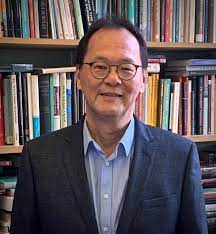
The Bilingualism of Ruth with Timothy Lim: Ruth 2:21-23

The narrator of the book of Ruth preserves small but telling mistakes in the Hebrew uttered by the character Ruth, who was a Moabite immigrant to Israel. How are these clues to the narrator’s intentions? Dr. Timothy Lim is Professor of Hebrew Bible & Second Temple Judaism at The University of Edinburgh. He works broadly in the Hebrew Bible, ancient Judaism, and the origins of Christianity, while concentrating in the biblical canon and the Dead Sea Scrolls. He has published The Earliest Commentary on the Prophecy of Habakkuk, among other things.

To hear the podcast click here and scroll down to the podcast, published July 25, 2023.

“Ruth and Naomi: the vulnerable and marginalized” with Havilah Dharamraj

To hear the podcast (17 minutes) click here.

“Reading Ruth in South Asia” is the theme of a recent lecture at the Lanier Theological Library in Houston, TX (Winter 2023). David Capes, the Director of the library, sat down to talk with our lecturer, Dr. Havilah Dharamraj, on the Stone Chapel Podcast. 

The lecture was co-sponsored by Langham Partnership.

Who is Havilah Dharamraj?  Dr. Dharamraj has her PhD from the University of Durham. She is an Old Testament scholar and academic dean. In addition, she is the head of the department of Old Testament at the South Asia Institute of Advanced Christian Studies (SAIACS) in Bangalore, India. 

She is a Langham scholar whose reputation far and wide is extraordinary.  She is married and has two grown children.

Books by Dr. Dharamraj

Havilah is the author of two important books, the first Altogether Lovely: A Thematic and Intertextual Reading of the Song of Song (Fortress Press, 2018). It is part of a South Asian series in biblical theology. 

The second is Ruth: A Pastoral and Contextual Commentary (Langham Publishing, 2019). It is part of the Asia Bible Commentary. 

Here is what a leading Old Testament scholar has to say about the book:

“This a delightful commentary that deserves a wide readership. The authors combine solid exegesis with a warm and very readable style. Their exploration of the book of Ruth with Asian eyes reminds us Westerners how much closer to the world of the Bible others may be. The illustrative anecdotes from their own Indian world give this commentary a quality that is found in none other.”

Daniel I. Block, DPhil
Wheaton College, Wheaton, Illinois, USA

Reading Ruth and Naomi

In this conversation Dr. Dharamraj uncovers the message Ruth has for contemporary audiences.  Western audiences can hardly grasp the heart of it because western culture is so far removed from that of Naomi’s and Ruth’s time. But in South Asia, the plight of the widows, the childless, and women remains bleak.  

Ruth speaks in remarkable ways to our disposition toward the least of these and the vulnerable.  

To view the lecture featuring Dr. Dharamraj, go to our YouTube channel or click here. 

If you’d like to watch the panel discussion from the lecture weekend, go to our YouTube channel or click here. 

To learn more about Langham Partnership US click here.

If you’d like a transcript of this podcast, click here.

Want more Stone Chapel Podcasts? click here.

For upcoming lectures at Lanier Theological Library, click here.

Hidden Hebrew Wordplays in Ruth with James Frohlich

Dr. James Frohlich is Adjunct Professor of Old Testament, Dallas Theological Seminary-Houston, and the author of The Relationship between MT and LXX in Jeremiah 39(46):1-41(48):3 and 52 (Forschungen Zum Alten Testament 2.reihe). Today’s topic: The author of Ruth weaves some interesting Hebrew wordplays through the narrative which are frequently lost in translation, especially relating to “leaving,” “clinging,” and the protective covering of “wings.”

To hear the podcast click here.

Ruth: Boaz’s Generosity with Catherine McDowell

Dr. Catherine McDowell is Associate Professor of Old Testament at Gordon-Conwell Theological Seminary, having previously taught at Wheaton College. She also serves part-time as a professor of Hebrew and Old Testament at Séminaire Théologique Mondelus in Milot, Haiti. Among other things, she has authored, The Image of God in the Garden of Eden: The Creation of Humankind in Genesis 2:5-3:24 in Light of the mīs pî, pīt pî, and wpt-r Rituals of Mesopotamia and Ancient Egypt. Today’s topic: Though some English translations have failed to convey this, the author of Ruth 3:17 was using word order to emphasize both Boaz’s excessive generosity and God’s care for the poor and marginalized.

To hear the podcast (8 minutes) click here.

Men of Valor

In this episode of “Exegetically Speaking” . . .

Dr. Aubrey Buster, Assistant Professor in Old Testament, ponders how a Hebrew expression can have different meanings in different books and contexts. She uses an example where “man of valor” can describe the notorious Jephthah in Judges and also the upright Boaz in the book of Ruth.Unknown-3

You can copy and paste the following URL into your browser:

https://exegeticallyspeaking.libsyn.com/men-of-calor

or click here.

The podcast lasts approximately seven minutes.