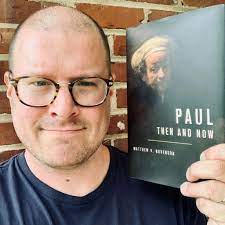
Son of David/Son of God with Matthew Novenson

The Greek sentence that opens Paul’s letter to the Romans includes carefully worded claims about Paul’s gospel. Crucially, Paul identifies some of what he means when he refers to Jesus as Christ/Messiah: He is a descendent of David and the Son of God. He is the latter not only as a result of the resurrection but in a special way through that event.

Dr. Matthew V. Novenson is Professor of Biblical Criticism and Biblical Antiquities at the University of Edinburgh. Among recent publications are (author) Christ Among the Messiahs; Paul, Then and Now; and (co-editor) The Oxford Handbook of Pauline Studies.

To hear the podcast click here.

The Romans Road with N. T. Wright

Tom Wright

N. T. (“Tom”) Wright, Senior Research Fellow at Wycliffe Hall, Oxford University, joins David Capes on “The Stone Chapel Podcast” to talk about his June 2022 lecture: “The Romans Road: Through the Dark Valley.”  

After recounting a bit of his early life, Wright describes what many evangelical Christians know as “The Romans Road.”  It is a way of sharing key verses from Paul’s letter to the Romans to help people find salvation.  But Wright thinks “salvation” for Paul means something different than what moderns mean by it, that is, going to heaven when we die.

To read Romans well and in context means that we continue to Romans 8.  For Wright the story of salvation is a truly human story which includes going through the dark valley.

To hear the podcast (20 minutes) click here.

Son-of-God-in-power, Romans 1:3-4 with Matthew Bates

Dr. Matthew Bates, Quincy University

Dr. Matthew Bates is Associate Professor of Theology at Quincy University. He recalls how, having majored in physics as an undergraduate, he learned beginning Greek independently before jumping into second-year Greek in seminary. Among his several publications are The Birth of the Trinity (Oxford, 2015) and Salvation by Allegiance Alone(Baker, 2017). In this episode he reveals how Paul’s choice of verbiage in an important summary of the gospel indicates his conceptions of Christ’s nature and history, especially both his divine pre-existence and his exaltation.

To listen to the podcast click here.

“Exegetically Speaking” is a weekly podcast of the friends and faculty of Wheaton College, IL and The Lanier Theological Library. Hosted by Dr. David Capes, it features language experts who discuss the importance of learning the biblical languages—Hebrew, Aramaic, and Greek—and show how reading the Bible in the original languages “pays off.” Each podcast lasts between seven and eleven minutes and covers a different topic for those who want to read the Bible for all it is worth.

If you’re interested in going deeper, learn more about Wheaton’s undergraduate degree in Classical Languages (Greek, Hebrew, and Latin) and our MA in Biblical Exegesis

You can hear Exegetically Speaking on SpotifyStitcherApple Podcasts, and YouTube. If you have questions or comments, please contact us at exegetically.speaking@wheaton.edu. And keep listening. 

The Right Kind of Boasting

In this episode of “Exegetically Speaking” . . .

Dr. Josh Moody, Senior Pastor at College Church (Wheaton, IL), considers what we should and should not boast in according to the book of Romans. Josh Moody

You can copy and paste the following URL to your browser:

https://exegeticallyspeaking.libsyn.com/from-text-to-sermon-0

or click here.

This podcasts last approximately 7 minutes.

Why no hell fire and brimstone?

In writing Romans, before Paul gets to the good news of the gospel (Romans 3 and following), he lays out the bad news: the wrath of God is breaking in from heaven.  For Paul God’s wrath is a present reality not some distant, future threat. We are living in “the present, evil age” (Gal 1:4), where the proliferation of idolatries, perversions and corruption are the ambient human condition (Romans 1).  It’s just the way things are even as we know things are not the way they are supposed to be.  Evangelicals use “the Roman road” to highlight the threat of hell, but Paul doesn’t do that.  The bad news is not the threat of fire and brimstone in some afterlife; it is the fact that God’s wrath is already evident in the world in what is effectively God’s hands-off policy.  God has stepped back and given us up to idolatry, disillusionment, strife, sexual sins, fractured families, and wicked minds.  For the apostle, sin and depravity may be the cause of God’s fury, but they are also the effect.  The presence and spread of human vices throughout the earth make life miserable and wretched. Perhaps we can say it this way: we are not only punished for our sins, we are punished by our sins.

hell fire and brimstone

If salvation for Paul consists primarily of God’s invading presence, then divine wrath consists ultimately of God’s silence and absence in the midst of a counterfeit world.  God doesn’t step in and smash us with his powerful right arm; he steps back and says, in effect, “if that is what you want, that is what you will get.” That is heaven’s wrath.  Now we are not saying that Paul completely ignores any threat of future judgment (e.g., 2 Thess 1:5-12); what we are saying is that the threat of fire and brimstone is not the only way to frame the human plight.

Fortunately, Paul doesn’t stop with the bad news; he has good news too.