No Inn in Which to Have No Room, with Ben Witherington III

Dr. Ben Witherington III argues passionately against burnishing the nativity stories of Luke and Matthew with unfounded speculation and mistranslations. He gives particular attention to the story of Jesus’ birth in Luke 2:7. Prof. Witherington is the Jean R. Amos Professor of New Testament for Doctoral Studies at Asbury Theological Seminary and is an emeritus professor of New Testament at St. Andrews University, Scotland. He has published widely including commentaries on every book of the New Testament. Two of his books won the Christianity Today annual top biblical studies book award: The Jesus Quest: The Third Search for the Jew of Nazareth and The Paul Quest: The Renewed Search for the Jew of Tarsus. His Biblical Theology; The Convergence of the Canon (Cambridge) won the Prose Prize National Book of the Year award in 2020 for books in religion and philosophy.

To hear the podcast (12 min) click here.

Mary’s Voice: Advent Readings with Amy Orr-Ewing

Amy Orr-Ewing is on a book tour across the USA regarding her new book, Mary’s Voice: Advent Reflections to Contemplate the Coming of Christ. She joined us at the Lanier Theological Library during the lecture weekend featuring Ed Stetzer (10-12 November 2023). 

While here, she joined David Capes to speak to a group of scholars and friends about her book. We created a podcast for the Stone Chapel Podcasts from the first half hour of the conversation.

Who Is Amy Orr-Ewing? 

Amy is a British theologian, speaker, and author who lives with her husband, an Anglican minister, not far from London.  She did her DPhil at the University of Oxford in theology at Christ’s College

Amy lectures all over the world and writes on the trustworthiness of Scripture, the problem of suffering, and other topics. 

Mark Lanier heard her speak at the Parliamentary Prayer Breakfast in London in 2023 and wanted her to come and speak at the library.  She is scheduled to return in September 2024 as a featured lecturer.

Mary’s Voice

Mary’s Voice is a Christmas devotional for the Advent Season.  Dr. Orr-Ewing wanted to amplify Mary, the mother of Jesus, as a key witness to the incarnation. 

Too often Protestants ignore Mary because some others appear to elevate her too highly.   The net effect is that she is side-lined. 

But women are key witnesses to both the incarnation and the resurrection, two key doctrines of the Christian faith.  In fact, without these women as witnesses, we’d know little of them.  Amy wants us to hear afresh the voice of Mary. 

The book includes elegant prose and insightful commentary.  It also includes model prayers and beautiful art depicting aspects of the incarnation. You will want this to be your next Advent devotional. 

More Resources

To see a video of a panel discussion featuring Amy, Timothy Dalrymple, Nicole Martin, and Ed Stetzer click here.

For Amy’s  website click here.

Here’s the link for more books by Amy Orr-Ewing 

Want more Stone Chapel Podcasts on some great topics? Just click here.

What’s more, you can get information on upcoming lectures at Lanier Theological Library by clicking here.

To hear the podcast click here.

Podcast: Xmas–Is it taking Christ out of Christmas?

We have a new podcast up, a special Christmas edition.  It’s entitled: “Xmas–Is it taking Christ out of Christmas?”  Here is a link to the website.  Each podcast is about 7 minutes in length.  Take a few minutes and catch up on other episodes while you are there.

http://exegeticallyspeaking.libsyn.com/website

Xmas: Is It Taking Christ out of Christmas?

I remember my fourth grade teacher, Mrs. Potts, opening a vein when anyone wrote “Xmas” instead of “Christmas.”  She felt there was a war on Christmas  and that people who abbreviated the name of the holiday were trying to take Christ out of Christmas.  I suppose that is true for some people, but when you look into the real story of “Xmas” you realize that something else is at work.

The story begins with the Ten Commandments.  One of those commandments says, “Do not take the name of the LORD in vain.”  The name by the way is not “LORD,” that was a respectful translation or substitute for the name.  In Hebrew THE NAME is four letters, yodh-he-vav-he. The technical term for the name is the tetragrammaton (literally, “the four letters”).  Scholars today think the name may have been pronounced—when it was pronounced—Yahweh or Yahveh.  But we aren’t sure.  This was the covenant name of God, the name revealed to Moses and Israel at Mt. Sinai. nomina_sacra
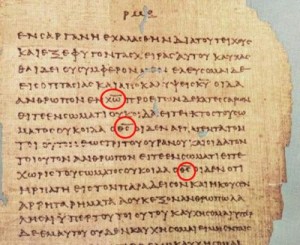
Under the influence of the commandment about the misuse of God’s name, the faithful spoke it less and less.  By the time of Jesus speaking the name was considered blasphemous in almost every circumstance. The rabbis made their mark by building a hedge about the law. If you never spoke God’s name, you could never be guilty of taking the name in vain. It was a way of safeguarding the name.  Even when reading Scripture in the synagogue, a substitute word was used.  In Aramaic-speaking synagogues the readers said “Adonai.”  In Greek-speaking synagogues they said “kyrios.”  Both mean something like “Lord” or “Master.”

The Dead Sea Scrolls provide good evidence for how the name of God was written in the centuries and decades leading up to the New Testament era.  In many of the biblical scrolls the name of God is written in paleo-Hebrew script.  That would be like shifting to a Gothic font when writing the name of God.  In other scrolls the name is not written at all; it is represented by four, thick dots written in the center of the line. In yet other scrolls where the name of God should be there is a blank in the line just large enough for the tetragrammaton.  Scholars theorize that the blank was left by a junior scribe and would have been filled in later by a senior scribe who had permission to write the name. Where there is a blank in the line, we think the senior scholar never got around to writing the divine name in the blank. These were some of the ways the faithful showed respect for the name of God.

Early Christians developed their own way of signaling respect for the names and titles associated with God the Father, God the Son, and God the Holy Spirit.  Copying the New Testament books in Greek, they abbreviated the names (usually first letter and last letter) and placed a line above those letters. You can see this in the picture.  Scholars refer to these as nomina sacra (Latin for “sacred names”).  Copyists continued to write sacred names this way for centuries.  It remains a common practice still among artists who create the icons used in the eastern churches.  Many names and titles were written this way including “God,” “Father,” “Jesus,” “Son of God,” “Son of Man,” “Christ,” “Lord,” “Holy Spirit.” For our purposes note the nomen sacrum for “Christ;” it was written XC. Now remember these are letters from the Greek alphabet not our Latinized version. It is not “X” (eks) the 24th letter of our English alphabet but the Greek letter “Chi,” the first letter of the title “Christ.”

Earliest versions of writing Christmas as “Xmas” in English go back to the Anglo-Saxon Chronicle (about 1100).  This predates the rise of secularism by over 600 years.  The Oxford English Dictionary cites the use of “X-“ for “Christ” as early as 1485.  In one manuscript (1551) Christmas is written as “X’temmas.”  English writers from Lord Byron (1811) to Samuel Coleridge (1801) to Lewis Carroll (1864) used the spelling we are familiar with today, “Xmas.”

The origin of “Xmas” does not lie in secularists who are trying to take Christ out of Christmas, but in ancient scribal practices adopted to safeguard the divine name and signal respect for it.  The “X” in “Xmas” is not the English letter (eks) as in “X marks the spot,” but it is the initial Greek letter “Chi” (X), the first letter of the title “Christ.”  No doubt some people today use the abbreviated form to disregard the Christian focus of the holy-day, but the background tells a different story, a story of faithful men and women showing the deep respect they have for Jesus at this time of year.

Merry Christmas or should I say “Merry Xmas”!

Xmas: Is it taking Christ out of Christmas?

I remember my fourth grade teacher, Mrs. Potts, opening a vein when anyone wrote “Xmas” instead of “Christmas.”  She felt there was a war on Christmas  and that people who abbreviated the name of the holiday were trying to take Christ out of Christmas.  I suppose that is true for some people, but when you look into the real story of “Xmas” you realize that something else is at work.

The story begins with the Ten Commandments.  One of those commandments says, “Do not take the name of the LORD in vain.”  The name by the way is not “LORD,” that was a respectful translation or substitute for the name.  In Hebrew THE NAME is four letters, yodh-he-vav-he. The technical term for the name is the tetragrammaton (literally, “the four letters”).  Scholars today think the name may have been pronounced—when it was pronounced—Yahweh or Yahveh.  But we aren’t sure.  This was the covenant name of God, the name revealed to Moses and Israel at Mt. Sinai. nomina_sacra

Under the influence of the commandment about the misuse of God’s name, the faithful spoke it less and less.  By the time of Jesus speaking the name was considered blasphemous in almost every circumstance. The rabbis made their mark by building a hedge about the law. If you never spoke God’s name, you could never be guilty of taking the name in vain. It was a way of safeguarding the name.  Even when reading Scripture in the synagogue, a substitute word was used.  In Aramaic-speaking synagogues the readers said “Adonai.”  In Greek-speaking synagogues they said “kyrios.”  Both mean something like “Lord” or “Master.”

The Dead Sea Scrolls provide good evidence for how the name of God was written in the centuries and decades leading up to the New Testament era.  In many of the biblical scrolls the name of God is written in paleo-Hebrew script.  That would be like shifting to a Gothic font when writing the name of God.  In other scrolls the name is not written at all; it is represented by four, thick dots written in the center of the line. In yet other scrolls where the name of God should be there is a blank in the line just large enough for the tetragrammaton.  Scholars theorize that the blank was left by a junior scribe and would have been filled in later by a senior scribe who had permission to write the name. Where there is a blank in the line, we think the senior scholar never got around to writing the divine name in the blank. These were some of the ways the faithful showed respect for the name of God.

Early Christians developed their own way of signaling respect for the names and titles associated with God the Father, God the Son, and God the Holy Spirit.  Copying the New Testament books in Greek, they abbreviated the names (usually first letter and last letter) and placed a line above those letters. You can see this in the picture.  Scholars refer to these as nomina sacra (Latin for “sacred names”).  Copyists continued to write sacred names this way for centuries.  It remains a common practice still among artists who create the icons used in the eastern churches.  Many names and titles were written this way including “God,” “Father,” “Jesus,” “Son of God,” “Son of Man,” “Christ,” “Lord,” “Holy Spirit.” For our purposes note the nomen sacrum for “Christ;” it was written XC. Now remember these are letters from the Greek alphabet not our Latinized version. It is not “X” (eks) the 24th letter of our English alphabet but the Greek letter “Chi,” the first letter of the title “Christ.”

Earliest versions of writing Christmas as “Xmas” in English go back to the Anglo-Saxon Chronicle (about 1100).  This predates the rise of secularism by over 600 years.  The Oxford English Dictionary cites the use of “X-“ for “Christ” as early as 1485.  In one manuscript (1551) Christmas is written as “X’temmas.”  English writers from Lord Byron (1811) to Samuel Coleridge (1801) to Lewis Carroll (1864) used the spelling we are familiar with today, “Xmas.”

The origin of “Xmas” does not lie in secularists who are trying to take Christ out of Christmas, but in ancient scribal practices adopted to safeguard the divine name and signal respect for it.  The “X” in “Xmas” is not the English letter (eks) as in “X marks the spot,” but it is the initial Greek letter “Chi” (X), the first letter of the title “Christ.”  No doubt some people today use the abbreviated form to disregard the Christian focus of the holy-day, but the background tells a different story, a story of faithful men and women showing the deep respect they have for Jesus at this time of year.

Merry Christmas or should I say “Merry Xmas”!