
How We Got the New Testament

To hear the podcast (20 min.) click here.

One of the questions I often get is “How did we get our Bible?”  As you’re going to hear on this podcast, there is not a quick, easy answer. 

It’s an important historical question that had a few questions marks around it.  Dr. Lee McDonald has given a lifetime to the question and has authored more than a dozen books on the topic.  You can find a link to some of those down below.

Dr. McDonald joined David Capes on the Stone Chapel Podcasts to talk about this question.

Who Is Lee McDonald?

Lee McDonald earned his PhD at the University of Edinburgh.  Prior to that he earned his masters at Harvard. 

Today he is retired.  But he spent many years as professor of New Testament Studies and President of Acadia Divinity College in Nova Scotia. 

He has written a number of books on the canon of the Bible.  See the notes below for some of those.  In retirement he lives in southern California. 

How We Got Our New Testament

McDonald is interested in the question of how we got our Bible.  But this podcast deals only with part two of the Bible, the New Testament. 

The issues are challenging.  We have minimal historical sources that discuss the canon.  The presence of manuscripts themselves help us somewhat. 

Canon is a technical term for the list of inspired books referred to today as the New Testament.  There are historical forces and factors that led to the development of the canon. 

Capes and McDonald outline a few of these in the podcast.   But there are also theological factors and concerns at the same time.  Geographically, the church was scattered.  So, practices in Ethiopia were different than those in Italy. 

Early Christians were a very bookish people.  They wrote a lot of books.  I suppose you could say they also read a lot of books. Some of those books were included in the canon, but many were excluded.  In this podcast Capes and McDonald discuss the criteria for apostolic authorship. 

Resources

Click here for a transcript of today’s podcast.

A key book on the question which he wrote with interested lay people in mind:

Formation of the Bible: The Story of the Church’s Canon (Hendrickson, 2012).

A bit more technical is:

The Biblical Canon: Its Origin, Transmission, and Authority (Baker Academic, 2006)

To see a lecture by Dr. Lee McDonald at the Lanier Theological Library click here.

More Resources

Want more Stone Chapel Podcasts on some great topics? Just click here.

You can get information on upcoming lectures at Lanier Theological Library by clicking here
The Dead Sea Scrolls (Part Two) with Timothy Lim

To hear the podcast (22 minutes) click here.

Recently, David Capes was in Edinburgh, Scotland, and had the chance to sit down and talk with Dr. Timothy Lim about the Dead Sea Scrolls. 

This discovery was one of the most important archaeological discoveries of the 20th century.

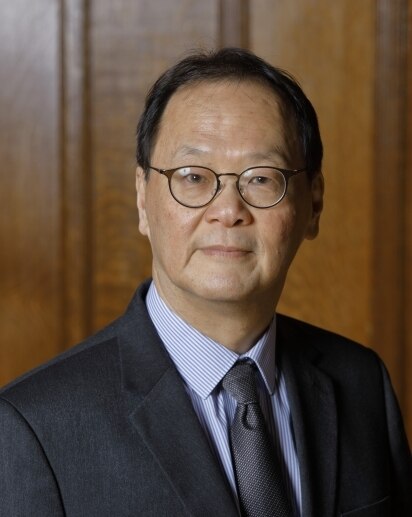
Who Is Timothy Lim?

Timothy Lim is Professor of Hebrew Bible and Second Temple Judaism at the University of Edinburgh.  Born in Canada, Timothy and his family made their home in Scotland during his illustrious career. 

He is recognized as one of the world’s leading authorities on the Dead Sea Scrolls.

He loves running, playing tennis, working out, AND he is good guitar player.

What Do the Dead Sea Scrolls Tell Us About the Shape of the Cannon?

One of the many contributions the Dead Sea Scrolls have made is that they give us some insight into the books that made up authoritative scripture.

We’d probably like to think of the Bible as containing the same books, in the same order, and using all the same words for all time.

In fact, the Dead Sea Scrolls demonstrate the fluidity of the biblical text at the time of the turn of the millennium from BC to AD, or if you prefer BCE to CE.

It may be good to remember that the Dead Sea Scrolls were the library of a Jewish community contemporaneous to the time of John the Baptizer, Jesus, Peter and Paul.

What Do the Dead Sea Scrolls Tell Us About Biblical Interpretation?

The people of the scrolls had a particular view of the world and that came out in the way they interpreted their biblical books.

Among the books recovered have been biblical commentaries that go by the title pesharim (Hebrew plural). Dr. Lim has done a great deal to illuminate this kind of commentary (pesher is the Hebrew singular). 

It is both a method or approach to Scripture and the results of that method. We find a number of places in the New Testament where writers employed a similar method (though not altogether the same).

To hear the podcast (22 minutes) click here.

Books by Dr. Timothy Lim

Among his many books are:

The Dead Sea Scrolls: A Very Short Introduction, 2nd edition (Oxford University Press, 2017)

The Formation of the Jewish Canon (Yale University Press, 2012)

The Oxford Handbook of the Dead Sea Scrolls (with John Collins, Oxford University Press, 2012)

For a transcript of this podcast, click here.

More resources

Want more Stone Chapel Podcasts on some great topics. Just click here.

What’s more, you can get information on upcoming lectures at Lanier Theological Library. Just click here.

The Dead Sea Scrolls (Part One) with Timothy Lim

To hear the podcast (18 minutes) click here.

Recently, David Capes was in Edinburgh, Scotland, and had the chance to sit down and talk with Dr. Timothy Lim about the Dead Sea Scrolls. 

This discovery was one of the most important archaeological discoveries of the 20th century.

Who Is Timothy Lim?

Timothy Lim is Professor of Hebrew Bible and Second Temple Judaism at the University of Edinburgh.  Born in Canada, Timothy and his family made their home in Scotland during his illustrious career. 

He is recognized as one of the world’s leading authorities on the Dead Sea Scrolls.

He loves running, playing tennis, working out, AND he is good guitar player.

What Are the Dead Sea Scrolls?

About seventy years ago, the first of eleven caves was found containing scrolls from the first century BC to the first century AD. 

This is about the time the Jesus movement started. Today, and this is controversial, a 12th cave appears to have been found. More about this on another podcast.

These scrolls are significant in many ways because they give us a window into that period like no other. 

In all, between 800-1000 manuscripts have been discovered.  About twenty-five of those are relatively intact. 

All the rest are fragments.  Scholars have been piecing them together and exploring their significance since the 1950s.

Qumran is the area where these scrolls were found. So, they are sometimes referred to as the Qumran scrolls. 

Both biblical (Old Testament) and non-biblical manuscripts were discovered there. There are many documents we never knew existed. 

Every book of the Hebrew Bible was found except for the book of Esther. There are theories about that. 

In part two of this podcast we explore more about the Dead Sea Scrolls.

Books by Dr. Timothy Lim

Among his many books are:

The Dead Sea Scrolls: A Very Short Introduction, 2nd edition (Oxford University Press, 2017)

The Formation of the Jewish Canon (Yale University Press, 2012)

The Oxford Handbook of the Dead Sea Scrolls (with John Collins, Oxford University Press, 2012)

For a transcript of this podcast, click here.

To hear the podcast (18 minutes) click here.

More resources

Want more Stone Chapel Podcasts on some great topics. Just click here.

What’s more, you can get information on upcoming lectures at Lanier Theological Library. Just click here.