Thomas Merton may be one of the best known Christian mystics of the 20th century. He was a Trappist monk who experienced life in period few of us know or remember. He was born in 1915 and died way too soon, by electricution, in 1968, in Thailand. He was 53 years old.
Despite his shortened life Merton authored about 70 books. His words and poetry have had an enduring influence on Christians and others who are delving deeply into the contemplative life.
I came across the prayer below the other day. I thought I’d share it with you because we are all on a difficult, spiritual journey and knowing and doing God’s will seems so elusive. Read it as Merton wrote it, as a contemplative prayer. I do not know the attribution, that is, where it first appeared in print. If you can point me that direction, I’d be grateful.
My Lord God,
I have no idea where I am going.
I do not see the road ahead of me.
I cannot know for certain where it will end.
Nor do I really know myself,
and the fact that I think that I am following Your will
does not mean that I am actually doing so.
But I believe that the desire to please You
does in fact please You.
And I hope that I have that desire
in all that I am doing.
And I know that if I do this,
You will lead me by the right road
although I may know nothing about it.
Therefore will I trust You always,
though I may seem to be lost
and in the shadow of death,
I will not fear, for You are ever with me,
and will never leave me
to face my perils alone.
One of the most significant movements now in missions and missiology is the orality movement. Orality is the recognition that not all people can read or prefer to read, most of us learn by what we hear. How often have you turned to watch a YouTube video of how to fix something rather than turning to the written manual? And you’re a literate person, right? Or else you couldn’t read this blog. The orality movement recognizes that most learning throughout most of history has been based on what was heard, said, and—we might add—seen.
The International Orality Network is a network of scholars, church leaders, missionaries, evangelists, and business leaders who are rediscovering the power and truth of oral learning and story-telling. It is truly changing the way we do business, teach, train, and do missions around the world.
Those of us from the text-based world at one time conducted missions this way. A missionary would arrive in an area of unreached people. He or she would spend time with people and learn their language. Then two things had to happen: first, the language would have to be committed to writing; and second, the Scriptures would have to be translated into the target language. Then the people would have to be taught how to read before they could read the Scriptures. Often, because they were in an oral culture, the only thing they had to read or could read were the Scriptures. Now there is nothing wrong with this strategy; it is a good process. It has helped to spread the Gospel in many places in the world. But what if we could shorten the process by recognizing the power of storytelling and orality. Then the missionary, after learning the language, could selectively begin to tell Bible stories and teach others how to tell those same stories. As people in the orality movement say, this method is “simple and reproducible.”
You might think this would work just fine in illiterate cultures but what about cultures that are highly literate like our own. Good question. The fact is that many people who can read and write prefer to learn in ways other than by reading a text. These are called oral preference learners. They may be living next door or in your own house. I don’t know the exact numbers but there is a larger percentage of college graduates who never read a book after college (I’m not sure they read a book in college). And the Bible is a big book. People may read short items: webpages, blogs, newspaper articles, but getting them interested in a book with over 780,000 words, not likely to happen.
Orality offers us a significant step forward in sharing the gospel and living the gospel. In the great commission Jesus instructed his followers to go, make disciples through baptizing and teaching others all that Jesus had taught them. And what was Jesus’ preferred teaching method? (trick question) . . . orality. Sunday school teachers, small group leaders, pastors, educators, missionaries, and heads of charitable organizations across the world are learning the power of orality. Pastors are changing their preaching to contain more orality and it is transforming their preaching. An orality training event may be coming to your city soon. If so, go and take part. It is fun and exciting to HEAR what God is up to.
I recently had the privilege of teaching a class for Mark Lanier at Champions Forest Baptist Church. My topic was “According to Mark” and I spent most of the time on the first 14-15 verses of the Gospel. It sets the tone for how to read the rest of the story. Thanks to Mark Lanier for the opportunity.
It’s hard to believe it has been five years since The Voice translation launched. At the time there was a furor over how the team chose to translate the Greek word “Christos.” As a result Martin Marty invited me to write a post for “Sightings.” I’ve reproduced some of it here for readers who don’t have access or know of his site.
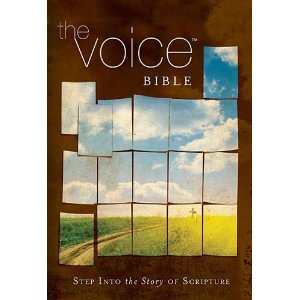
One of the original covers to THE VOICE Bible.
Martin E. Marty’s article “Annenberg Poll on Religion in the Media” brought to our attention a recent survey: “Most Americans Say Media Coverage of Religion Too Sensationalized.” I saw that side of the media firsthand. On April 17 I was interviewed by Carol Costello on CNN regarding a new Bible translation I had contributed to called The Voice Bible. The interview and subsequent articles falsely positioned The Voice as a new Bible translation which leaves out Jesus Christ, angels, and apostles. The title to CNN’s online article says it all: “Christ Missing from New Bible.” Note: no quotation marks.
CNN’s interest was prompted by an article the day before in USA Today entitled “‘The Voice’: New Bible translation focuses on dialogue.” The USA Today article was itself a heavily truncated version of the original story written by Bob Smietana in Nashville’s paper, The Tennessean entitled “Bible gets new voice.”
Smietana’s original article did a fair job of characterizing the project, but as it passed up the media food chain, a significant part of the story was lost, distorted, and sensationalized. By the time CNN covered it, The Voicebecame a new Bible translation which leaves out Jesus, angels, and the apostles. As one angry fellow said to me: “A Bible without Jesus and the angels! What the heck kind of Bible is that?” Good question.
CNN’s (mis)characterization of the translation was based on a half-truth. The word “Christ” is not found in the translation because “Christ” is not a translation at all; it is a transliteration of the Greek word Christos(which means “anointed one”). We translated every occurrence of Christos as “the Anointed” or “the Anointed One.” So Jesus is not missing—as CNN’s coverage insinuates—he is front and center in this new translation. The translation team did this to clear up a fundamental misunderstanding. Most in the Bible-reading public take the phrase “Jesus Christ” as his name: “Jesus,” his first name and “Christ” his last name. In fact, “Christ” is an honorific title like “Son of God,” “Lord,” and “Savior.” But in the western tradition Christos was the only title not translated into the new language of the church. In the Latin Christos was rendered “Christus,” and in the English Bible tradition it became “Christ.” Our translation decision was intentional: we hoped to recover something of the titular sense of the term in which Jesus the Christos is God’s agent, descended from David’s royal line, who is chosen (“anointed”) and destined to liberate the cosmos from sin, death, oppression, and corruption. We also translated other key terms which happen to be transliterations in all English Bible editions. Words like “apostle” (Greek, apostolos), “baptism” (Greek, baptisma), and “angel” (Greek, angelos) we translated “emissary,” “washing,” and “heavenly messenger” respectively.
As the blogosphere and airwaves heated up over the media coverage, a number of scholars commented on the sensationalized portrayal of The Voice. Larry Hurtado, retired Professor of New Testament from the University of Edinburgh, wrote an essay on his blog entitled “On Translation and Hysteria,” which addressed the media’s mischaracterization. On his blog, “Storied Theology,” J. Daniel Kirk showed how CNN was baiting the audience with inaccurate information to drive a bit of Internet traffic. Darrell Bock, Kristi Swenson, Edward Fudge, and Greg Garrett also chimed in to set the record straight.
The bottom line is this: both CNN and USA Today misrepresented the project. They either did so intentionally (they wanted to see how Christians might react), out of ignorance (they did not know any better), or out of apathy (they did not care enough to get the story right). Likely it was some combination of the three. As the Annenberg study has shown, those who report on religion are not very knowledgeable of it. And as Martin E. Marty has suggested, those who know enough and care enough to report on religion accurately will most often be met with yawns.
Recently two friends and colleagues of mine, Dr. Craig Keener (Asbury Seminary) and Dr. John Walton (Wheaton College) were recognized for their work with the NIV Cultural Backgrounds Study Bible. Craig worked on the comments and sidebars for the New Testament; John authored the comments and sidebars on the Old Testament. Here is a link to one of the announcements:
Keener and Walton, or if it we put it in the order of the testaments, Walton and Keener are at the top of their respective fields, and they have pulled together an impressive bit of scholarship to help modern readers understand something of the cultural context in which the 66 books of the Christian Scriptures were written. We do the writers of the Bible a disservice if we insist on reading it against our culture, values and standards. If we want to read the most important book in history well, we’d do well to pay close attention to the language, habits, customs and culture of the peoples of the Book.
Dr. John Walton, Wheaton College
Walton and Keener received the top award in the category of Religion: Christianity in the International Book Awards, announced on May 22nd, by the American Book Fest.
“We understand and apply the Bible much better when we understand the concrete, real-life circumstances to which its words were first addressed,” Dr. Keener said. “I am grateful that this new award, like the previous one, draws attention to this resource to help people access this information.”
The NIV Cultural Backgrounds Study Bible released August 2016 and has sold more than 56,000 copies. The book is available for purchase on Amazon for less than $40.00. N. T. Wright said he wished somebody had put this Bible in his hands 50 years ago.




 A Word in Edgewise
You must be logged in to post a comment.