Page 57 of 126

Context is King

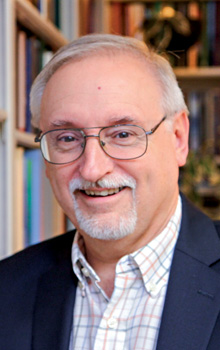
Dr. John Walton, Professor of Old Testament at Wheaton College Graduate School, and I recently had a chat on Exegetically Speaking. He lays out the importance of knowing the context of a passage to understand it.  After discussing four kinds of context for exegesis, he focuses on the historical context.  As a test case, he takes us to Daniel 7:1 to understand what is happening historically at the time of Daniel’s fantastic vision. 

To hear the 7 minute podcast, you can cut and paste the following URL to your browser:

https://exegeticallyspeaking.libsyn.com/context-is-everything-historical-context-daniel-71

or click here.

“Exegetically Speaking” is a weekly podcast of the friends and faculty of Wheaton College, IL and The Lanier Theological Library. Hosted by Dr. David Capes, it features language experts who discuss the importance of learning the biblical languages—Hebrew, Aramaic, and Greek—and show how reading the Bible in the original languages “pays off.” Each podcast lasts between seven and eleven minutes and covers a different topic for those who want to read the Bible for all it is worth.

If you’re interested in going deeper, learn more about Wheaton’s undergraduate degree in Classical Languages (Greek, Hebrew, and Latin) and our MA in Biblical Exegesis

You can hear Exegetically Speaking on SpotifyStitcherApple Podcasts, and YouTube. If you have questions or comments, please contact us at exegetically.speaking@wheaton.edu. And keep listening. 

Mr. Greek

Bill Mounce

Dr. Bill Mounce (https://www.billmounce.com/about), Mr. Greek himself, recently stopped by the Lanier Library with his sweet wife, Robin. I had the chance to interview him briefly for “Exegetically Speaking,” Dr. Mounce is the the founder and President of BiblicalTraining.org. He also serves on the Committee for Bible Translation (responsible for the NIV translation of the Bible), is author of Basics of Biblical Greek and other works, and was formerly a professor at Gordon-Conwell Theological Seminary and Azusa Pacific University. In this episode, he joins me to talk about his own pilgrimage as a student of Greek and the vision and work of BiblicalTraining.org.

To listen to the podcast, click here.

“Exegetically Speaking” is a weekly podcast of the friends and faculty of Wheaton College, IL and The Lanier Theological Library. Hosted by Dr. David Capes, it features language experts who discuss the importance of learning the biblical languages—Hebrew, Aramaic, and Greek—and show how reading the Bible in the original languages “pays off.” Each podcast lasts between seven and eleven minutes and covers a different topic for those who want to read the Bible for all it is worth.

If you’re interested in going deeper, learn more about Wheaton’s undergraduate degree in Classical Languages (Greek, Hebrew, and Latin) and our MA in Biblical Exegesis

You can hear Exegetically Speaking on SpotifyStitcherApple Podcasts, and YouTube. If you have questions or comments, please contact us at exegetically.speaking@wheaton.edu. And keep listening. 

Pablo Seguel: The Architecture of Language

A friend and former student of mine, Pablo Seguel, recorded an episode of Exegetically Speaking with me a while back in order to talk about his experiences as a architect in Chili helped him understand biblical languages. He reminds us that there is architecture to language just as there is architecture in erecting a strong building.

To listen to this 7 minute podcast please cut and paste the following URL to your browser:

http://exegeticallyspeaking.libsyn.com/the-architecture-of-language

or click here.

“Exegetically Speaking” is a weekly podcast of the friends and faculty of Wheaton College, IL and The Lanier Theological Library. Hosted by Dr. David Capes, it features language experts who discuss the importance of learning the biblical languages—Hebrew, Aramaic, and Greek—and show how reading the Bible in the original languages “pays off.” Each podcast lasts between seven and eleven minutes and covers a different topic for those who want to read the Bible for all it is worth.

If you’re interested in going deeper, learn more about Wheaton’s undergraduate degree in Classical Languages (Greek, Hebrew, and Latin) and our MA in Biblical Exegesis

You can hear Exegetically Speaking on SpotifyStitcherApple Podcasts, and YouTube. If you have questions or comments, please contact us at exegetically.speaking@wheaton.edu. And keep listening. 

John Walton: “Context Is Everything”

Recently, Dr. John Walton, Professor of Old Testament at Wheaton College Graduate School, joined me on Exegetically Speaking to lay out the importance of knowing the context of a passage to understand it. After discussing four kinds of context for exegesis, he focuses on the linguistic context. As a test case, he takes us to 1 Samuel 13:14: “the LORD sought out a man after his own heart [David].” What does that mean? Where does it come from? It might not mean what we always thought.

Dr. John Walton

To hear the 7 minute podcast cut and paste the following URL to your browser:

http://exegeticallyspeaking.libsyn.com/context-is-everything-linguistic-context-1-samuel-1314

Or click here.

James A. Sanders (1927-2020)

I share with you an email from a friend and colleague, Dr. Craig Evans, regarding the passing of another great scholar from our midst, Dr. James A. Sanders. Though I did not know him, I did follow, appreciate, and benefit from his many works. J

3 October 2020

Dear SCT Colleagues:

I pass on to you sad news. As some of you may have already heard, James A. Sanders, born 28 November 1927, passed away yesterday morning, 1 October 2020. Jim was nearing his 93rdbirthday. I met Jim in Claremont, California, at the beginning of the fall semester in 1977. It was the beginning of my doctoral studies. Jim was 49 and I was 25. Jim was always a handsome, youthful fellow. In fact, he could have passed for Dick Clark’s brother! Jim had just moved from Union Seminary in New York to the Claremont School of Theology, to launch the newly built Ancient Biblical Manuscript Center (ABMC), which housed in its climate-controlled vault thousands of images of biblical manuscripts, including microfilm and microfiche images of the Dead Sea Scrolls. Jim served as ABMC President until 2004. While at Union Jim’s colleagues included the likes of J. Louis Martyn and Raymond E. Brown.

Although Jim was not my doctoral supervisor (Bill Brownlee was), he played an important mentoring role while I was at Claremont and throughout my career. He and I founded in 1989 and then co-chaired the SBL program unit Scripture in Early Judaism and Christianity. This in turned led to the founding of the Studies in Scripture in Early Judaism and Christianity (SSEJC) series published by Sheffield Academic Press, then later Continuum, and now Bloomsbury T&T Clark. To date, we have published 21 volumes in the SSEJC series and two more volumes are in the works. As you may know, Jim served as the President of the Society of Biblical Literature in 1979. Jim’s best known work is Torah and Canon (1972). Jim was also well known for his The Psalms Scroll of Qumrân Cave 11 (DJD 4; Oxford: Clarendon Press, 1965), whose conclusions were confirmed many years later by Peter Flint’s work on all of Qumran’s Psalms scrolls.

Jim and I co-authored Luke and Scripture (Fortress Press, 1993) and co-edited several books, mostly in the SSEJC series. We presented together at several conferences, at SBL and elsewhere. I had the opportunity to edit, along with Shemaryahu Talmon (1920-2010), a Festschrift in honor of Jim, on the occasion of his 70th birthday. The 700-page book is called The Quest for Context and Meaning (BIS 28; Leiden: Brill, 1997). Contributors included Reginald Fuller and W. D. Davies. In recent years I helped Jim assemble his studies in two volumes: Scripture in Its Historical Contexts. Volume I: Text, Canon, and Qumran(FAT 118; Tübingen: Mohr Siebeck, 2018), and Scripture in Its Historical Contexts. Volume II: Exegesis, Hermeneutics, and Theology (FAT 126; Tübingen: Mohr Siebeck, 2019). Jim was awarded an honorary doctorate at Acadia University, where coincidentally I found myself on the faculty many years later. In fact, while at Acadia Divinity College I became friends with Jim Perkin, former President of Acadia University and himself a New Testament scholar, who had nominated Jim for the award.

Jim Sanders was a prince of a fellow. His wife Dora, whom Jim loved very much, died in June of 2016, at the age of 88. Dora danced, played the piano, the violin, and the organ. Dora participated in the American Dance Festival every summer from 1949 to 2004. She and Jim were quite the pair: Jim from Memphis, Tennessee, and Dora from New Jersey (and, spiritually, from New York). Jim and Dora had one child, a son, Robin David Sanders Sr., and two grandsons Robin David Sanders Jr, and Alexander Jonathan Sanders. It was Alex who in 2017 invited me and Ginny to fly out to California to attend Jim’s 90th birthday party. Although that visit was not possible, we did have opportunities to see Jim on other occasions in California and lunch with him. (Often when I flew to California in summers to teach at Fuller Seminary in Pasadena, I had the chance to visit Jim.)

Jim was one of the best biblical scholars of our era. Of all my professors at Claremont (and they were all good), it was Jim Sanders who could bring together the exegetical and textual minutiae and the big picture. It was he who taught me what textual criticism really was and what biblical criticism was and wasn’t and how it could edify the Church. For Jim faith and scholarship were never at odds but were always complimentary. Some of my former and current grad students have complimented me by making that observation. Well, now you know where I got it. Jim will be sorely missed but his legacy will be a lasting one.

Best,

CAE

Craig A. Evans, Ph.D., D.Habil.

John Bisagno Distinguished Professor of Christian Origins

Houston Theological Seminary

Houston Baptist University