
Study in Jerusalem: Online and In the Land
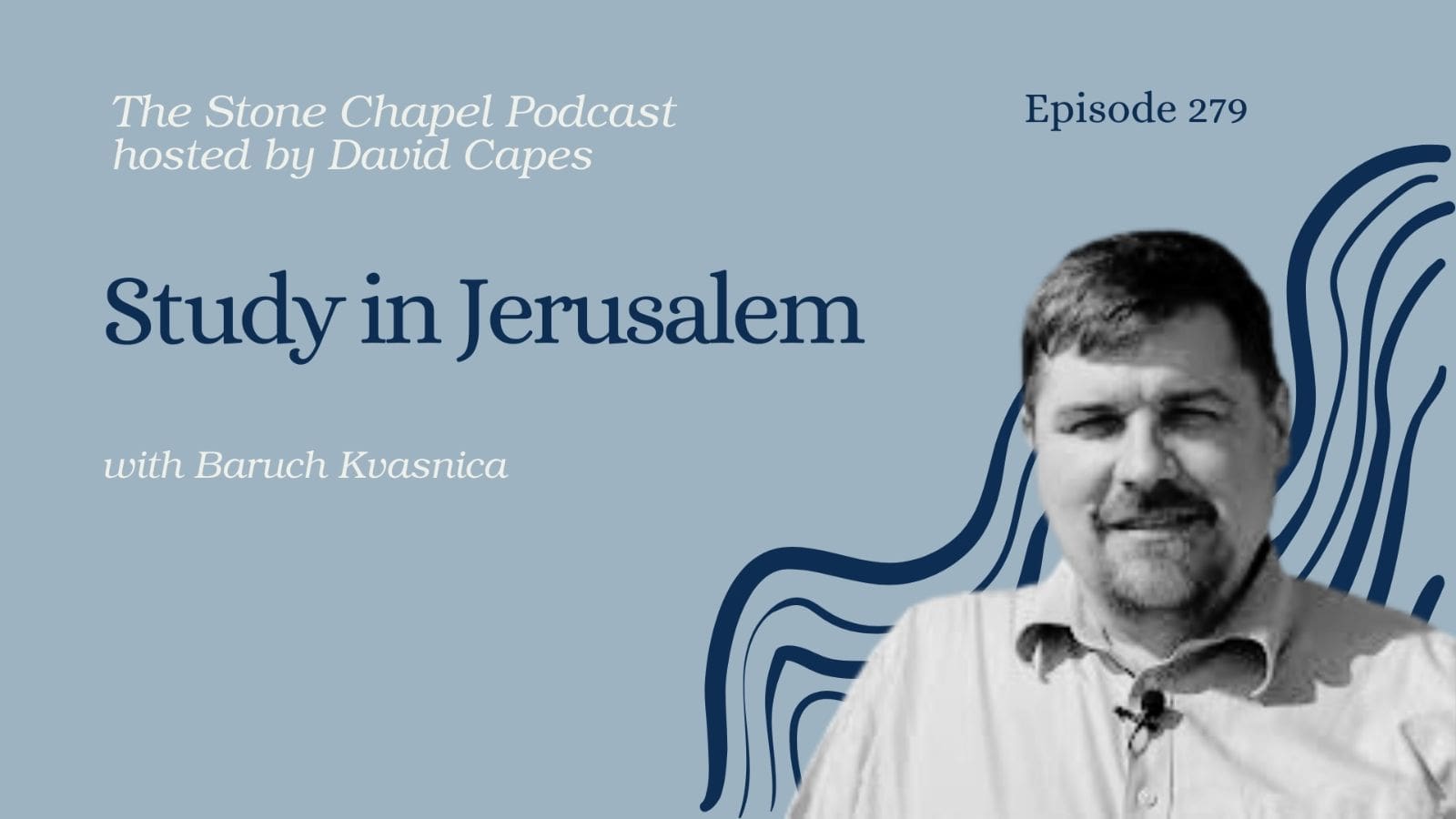
Baruch Kvasnica
My name is Baruch Brian Kvasnica, and I’m president of Jerusalem Seminary.
David Capes
Dr. Kvasnica, good to see you, Baruch.
Baruch Kvasnica
Good to be here.
David Capes
Thanks for being with us. We’re here together face to face, which is always good. Now you’re president of Jerusalem Seminary. We’re going to find out more about that in a minute, but I want to find out about you now. For those who don’t know you, who is Baruch Kvasnica?
Baruch Kvasnica
I was born in Michigan and raised mainly in Michigan, as well as the Philippines and Papua New Guinea, where I graduated as a Wycliffe MK. I loved my time there as a kid, growing up with a broader mission than just a local church, but also the whole world. I went from Ukarumpa High School in Papua, New Guinea, to Houghton University in Western New York. Knowing that I had Jewish heritage, that idea expanded in college, getting to know a person who was born and raised in Israel. And that piqued my interest.
I really wanted to study early Christianity in the land of the Bible. I went there in the summer of 1994, and I couldn’t believe how much I didn’t know. I thought I knew my Bible well, and then I went to the land. It showed all these places where I had gaps that I hadn’t focused on, or I didn’t understand, or hadn’t paid attention. And I just ate that up. I jumped on an Anglican priest course at Tantur with Jim Fleming and Kenneth Bailey. And I couldn’t believe that. It was amazing. I studied under Petra Heldt at Hebrew University on Eastern Christianity. As a history and religion major, I thought I knew my history of Christianity, but I didn’t know it very well.
David Capes
Now you’d already graduated from Houghton?
Baruch Kvasnica
No, this was between my junior and senior year. I was there just for nine weeks during my summer break. I went back to Houghton and became pastor of a little country church, as well as finishing up my honors project on John Wesley’s Religious Epistemology. I applied to different seminaries, and I got a full-ride offer to an Ivy League school. But I decided not to take it because my life was influenced so powerfully by those nine weeks in the summer of 1994. I went back [to Israel] after Houghton and started studying religious studies, comparative religions between early Judaism and early Christianity.
David Capes
Where were you studying at that point?
Baruch Kvasnica
At Hebrew University of Jerusalem. The Harvard of Israel.
David Capes
Our good friend, Emmanuel Tov, teaches there. He’s great.
Baruch Kvasnica
Yes, he’s been my neighbor down the street for the past 10 years.
David Capes
So, are you married?
Baruch Kvasnica
I’ve been married very, very happily for 24 years to Shoshi, my wife. She was born and raised there in Israel. She’s a messianic Jewish gal.
David Capes
So, how’d you get the name Baruch?
Baruch Kvasnica
Baruch has been my name for the past 15 years. I was walking one day in 1998 with my dad, and he said, if I ever immigrate to Israel, I think I’d be Baruch instead of Bob. And then when I became a permanent resident there, I said, hey, this is a good opportunity for me to recognize my latent Jewish heritage. I’m still a believer. I’m a Christian. I’m the same person, but I’ve seen a lot of Jewish believers assimilate to the point that their Jewishness is no longer realized. Statistically, two to three generations after a person becomes a believer, their children don’t understand themselves as being Jewish anymore.
David Capes
Though by heritage and by blood, they are.
Baruch Kvasnica
Yes, so I thought this is a way to reaffirm what my dad felt, and who my grandfather was. I feel like I’m blessed. My wife and I have seven children, and we’re so thankful. We’re living in the land which is a blessing and a challenge. Baruch means “blessed, blessing.”
David Capes
You’re president of Jerusalem Seminary. Tell us a little bit about it. What is its mission?
Baruch Kvasnica
When I went first in 1994, I couldn’t find a place where I could do a Master’s of Divinity in English. I needed that to be ordained. I looked for different ways to do that. I couldn’t find an easy way to do it. Later on, I could do it online. But I didn’t really want to do it online. I wanted to do it in person, if possible, or some component in person.
So, I thought, there’s not a seminary in the land of the Bible. Why not create one? That’s the short story. The longer story is that my life was so transformed by being in the land and learning Hebrew, and not just Greek. I learned Greek too, and that’s awesome, but knowing both Greek and Hebrew really impacted my faith. It rooted me in the land and history of the people of Israel, that strengthened my faith. It challenged it a little bit too. And I thought, God, this is so amazing. I want to share this with other people. I started guiding and teaching pastors and academics and lay people. In 1998 I saw that it was
also beneficial for them. I started training Bible translators in Hebrew.
I saw the impact that Hebrew in the land had, both in my life and for others. I thought, wow, everyone going into ministry should have the opportunity to spend some amount of time with the right people in the land of the Bible. And so that’s really the driving passion of why Jerusalem Seminary exists, to give that opportunity that I had, that I hope many, many thousands of others can have in the coming years.
David Capes
Now, are you an online seminary, or are you residential? How does that work?
Baruch Kvasnica
We started in 2018.
David Capes
Okay, so at this point you’re only seven years old.
Baruch Kvasnica
Yes, and this is just before the pandemic. Our first school of Hebrew was founded in 2018, and this was geared towards Israelis, to have them learning Biblical Hebrew in a lived or communicative manner. Israelis know a little bit of biblical Hebrew, because modern Hebrew is not too different. The first 1,000 words are about 88% the same vocabulary. But beyond that, the poetry and a lot of the syntax is different.
We wanted to train them, and not just teach them Biblical Hebrew, but teach them how to teach in this lived, expressive, spoken way. They became the core of our teachers, both residentially, abroad and online. What we’re doing still is training Israelis to learn how to teach Biblical Hebrew, and they do that by going to Mongolia, Nigeria, Togo, Myanmar, Grand Rapids. Two by two, we send these Israelis, these Messianic Jews who know Biblical Hebrew inside and out and express that. All of the learning is done in that manner. That’s our School of Hebrews, founded in 2018.
In 2021 we started the School the Bible, which started right in the midst of the pandemic. We started that completely online. We were able to have some short-term courses come in 2022 and 2023. And we’re looking to expand that. But our School of the Bible, started in 2021, and this is more on a BA level, more for enrichment. This fall, just a month or two ago, we started our School of Graduate Studies, and this is our first degree, a MA in Biblical studies.
David Capes
In these other programs, you don’t earn a degree. They are more of a certificate program. But the graduate studies, you’re offering the full degree.
Baruch Kvasnica
Yes, that’s right. But our certificates are not lightweight, meaning that almost half of our students are Bible translators. Because I’ve been training Bible translators in the land of the Bible for about 15-20, years. They know about us, and they know, by God’s grace and for His glory, how incredible our School of Hebrew is. They are coming to learn online and in person in August. For example, every August for the past eight years, and diaspora Hebrew month-long intensives, we call them. So even though they’re certificates, they’re actually very serious.
David Capes
Yes, they can be. This is fascinating! All right, so if people have heard something today and they want to connect with you, how would they get connected with Jerusalem Seminary and you as President?
Baruch Kvasnica
Well, jerusalemseminary.org is our website, and that has our course catalog.
David Capes
jerusalemseminary.org.
Baruch Kvasnica
Yes. They can see the course catalog and can register for both individual classes. They can take them for credit. They can take them for audit. There are also certificate programs. And there’s also the new MA in Biblical Studies that requires them to be in the country twice. So, everything can be done online, except for two residential intensives in the land.
David Capes
Are those one week, or two weeks?
Baruch Kvasnica
Two weeks.
David Capes
Two weeks each. Do you have residences that they can occupy?
Baruch Kvasnica
Yes, as soon as we received money, that was given from here in Houston, back in 2017. As soon as I knew about this seed money, I immediately thought of the building that we’re in. It’s the Alliance Center. It’s where a number of institutions have been born, and it has eight dorm rooms. It has a beautiful chapel, it has classrooms, has offices. It’s right downtown in central Jerusalem.
David Capes
Oh, wow. So, this is not tin he Old City.
Baruch Kvasnica
It’s about a seven-minute walk from the Old City. On Prophet Street. It’s even biblical!
David Capes
Nevi’im the prophets! So, people can get to know the city of Jerusalem. Do they go up to the Galilee, over to the Dead Sea, and Jericho? Places like that.
Baruch Kvasnica
Yes, we often start our short-term courses down in the Negev just like the patriarchs and the wanderings in the wilderness and the manna. And then we move up to the Galilee at some point for a couple days or so and see the coast. Then focus at least half the time in Jerusalem. So yes, it’s definitely an active field trip and lecture combination for our short-term courses.
David Capes
How has the war affected you and your institution?
Baruch Kvasnica
It’s been a long journey. Not only the war, but COVID was tough for everyone. Israel tried to be really tough.
David Capes
Everything was shut down.
Baruch Kvasnica
Yes. Then the war has persisted in bringing challenges. It’s been a very difficult psychological challenge. We’ve had staff that have been involved in serving. They’ve been pulled out for reserves because about 75% of our staff are local, so that makes us a little unique too. There’s a number of institutions in the land. God is building us in such a way that we can be there, long term. We pray, so that we can have a lasting effect.
Some of my children are needing to serve because that’s required by law, boys and girls. That clipped our wings as far as bringing students in the land, but we’re looking forward to a new era. Now that there’s greater peace, we have a number of seminaries and Bible colleges interested in coming back to the land. Having short-term courses or a semester abroad or a year-long program. We’re looking forward to the future.
David Capes
I know some of the people who teach for you, but for our listeners, tell us a few people that teach for you. If I were to come and study, besides working with you and learning Hebrew, who could I study with?
Baruch Kvasnica
We have Dr. Gerald McDermott, who’s been with us from the beginning, Dr. Petra Heldt, who was my first teacher in Hebrew University in 1994 and she is amazing. We’re trying to get her to write a book. We have Randall Buth, who’s doing some of the lecturing for the gospels course. We have Dr. Halver Ronning, who has been here. Nick Aaronson is coming on board. Walter Kaiser is on our Advisory Council.
David Capes
What does the future look like over the next three to five years?
Baruch Kvasnica
We are looking forward to having hundreds of students come each year. Our goal is 1,000 a year in about 5-10 years, but looking for hundreds to come and be in the land or online. We have about 250 students now, each year, but only about 20% of them are in the country. We want to just expand that from 250-1,000.
David Capes
Your students are from different countries?
Baruch Kvasnica
Yes. This semester, I think we have 14 different countries. Last semester, we had 85 from 21 countries. This is mainly because we have so many Bible translators. But the wonderful thing about Bible translators is, often, they’re not just translating Bible. They’re also preaching, yeah. So we get two for one, preachers and Bible translators at the same time,
David Capes
All right, once again, for those who want to be in touch with you. Maybe they feel like they want to donate some money, or maybe they feel they’d like to study in the land. I’d like to go over there for two weeks and have some time or take a short-term course or be involved in a program of study. How would they do that?
Baruch Kvasnica
They can connect us with us at jerusalemseminary.org. They can write, email, call. If they’d like to donate, there’s a “Give” page. I totally believe that this is God’s doing. That the Kingdom needs to advance in the land of the Bible. Meaning that pastors can be rejuvenated. Seminarians can be rooted in the land and will have a much more fruitful ministry by being connected to the land and language of the Bible. If people would want to join what God is doing at Jerusalem Seminary, feel free to check us out at jerusalemseminary.org.
David Capes
That sounds great. Dr. Kvasnica, thanks for being with us today on “The Stone Chapel Podcast.”
Baruch Kvasnica
Thank you very much. My pleasure.
12
 A Word in Edgewise
You must be logged in to post a comment.