The Dead Sea Scrolls (Part One) with Timothy Lim

To hear the podcast (18 minutes) click here.

Recently, David Capes was in Edinburgh, Scotland, and had the chance to sit down and talk with Dr. Timothy Lim about the Dead Sea Scrolls. 

This discovery was one of the most important archaeological discoveries of the 20th century.

Who Is Timothy Lim?

Timothy Lim is Professor of Hebrew Bible and Second Temple Judaism at the University of Edinburgh.  Born in Canada, Timothy and his family made their home in Scotland during his illustrious career. 

He is recognized as one of the world’s leading authorities on the Dead Sea Scrolls.

He loves running, playing tennis, working out, AND he is good guitar player.

What Are the Dead Sea Scrolls?

About seventy years ago, the first of eleven caves was found containing scrolls from the first century BC to the first century AD. 

This is about the time the Jesus movement started. Today, and this is controversial, a 12th cave appears to have been found. More about this on another podcast.

These scrolls are significant in many ways because they give us a window into that period like no other. 

In all, between 800-1000 manuscripts have been discovered.  About twenty-five of those are relatively intact. 

All the rest are fragments.  Scholars have been piecing them together and exploring their significance since the 1950s.

Qumran is the area where these scrolls were found. So, they are sometimes referred to as the Qumran scrolls. 

Both biblical (Old Testament) and non-biblical manuscripts were discovered there. There are many documents we never knew existed. 

Every book of the Hebrew Bible was found except for the book of Esther. There are theories about that. 

In part two of this podcast we explore more about the Dead Sea Scrolls.

Books by Dr. Timothy Lim

Among his many books are:

The Dead Sea Scrolls: A Very Short Introduction, 2nd edition (Oxford University Press, 2017)

The Formation of the Jewish Canon (Yale University Press, 2012)

The Oxford Handbook of the Dead Sea Scrolls (with John Collins, Oxford University Press, 2012)

For a transcript of this podcast, click here.

To hear the podcast (18 minutes) click here.

More resources

Want more Stone Chapel Podcasts on some great topics. Just click here.

What’s more, you can get information on upcoming lectures at Lanier Theological Library. Just click here.

Marriage Relations according to Aristotle and Paul with Lynn Cohick

In his teaching about family relations (e.g. Eph. 5:21–6:9), Paul is echoing descriptions of a household that had been formalized by Aristotle, but in so doing Paul turns Aristotle’s teaching on its head. Dr. Lynn Cohick is Distinguished Professor of New Testament and Director of Houston Theological Seminary at Houston Christian University. Among her many publications are The Letter to the Ephesians (NICNT) and (with Amy Brown Hughes) Christian Women in the Patristic World: Their Influence, Authority, and Legacy in the Second through Fifth Centuries.

To hear the podcast (10 minutes) click here.

“Exegetically Speaking” is a weekly podcast of the friends and faculty of Wheaton College, IL and The Lanier Theological Library. Hosted by Dr. David Capes, it features language experts who discuss the importance of learning the biblical languages—Hebrew, Aramaic, and Greek—and show how reading the Bible in the original languages “pays off.” Each podcast lasts between seven and eleven minutes and covers a different topic for those who want to read the Bible for all it is worth.

If you’re interested in going deeper, learn more about Wheaton’s undergraduate degree in Classical Languages (Greek, Hebrew, and Latin) and our MA in Biblical Exegesis

You can hear Exegetically Speaking on SpotifyStitcherApple Podcasts, and YouTube. If you have questions or comments, please contact us at exegetically.speaking@wheaton.edu. And keep listening. 

Announcing the Gospel in Fecund Language with Joseph Dodson: Col 2:15

The grammar, metaphors, background, and possible referents of the Greek wording of Colossians 2:15 make for rich challenges and possibilities for interpretation, translation, and application. As Dr. Joseph Dodson explains in this episode, choosing between options may not always be correct. Dodson is the Dr. Craig L. Blomberg Chair of New Testament at Denver Seminary. In addition to other publications, he co-edited, Paul and the Giants of Philosophy: Reading the Apostle in Greco-Roman Context, and is working on commentaries on Romans (Brill) and Colossians-Philemon (Holman).

To hear the podcast click here and scroll down to the podcast that published July 31, 2023.

“Exegetically Speaking” is a weekly podcast of the friends and faculty of Wheaton College, IL and The Lanier Theological Library. Hosted by Dr. David Capes, it features language experts who discuss the importance of learning the biblical languages—Hebrew, Aramaic, and Greek—and show how reading the Bible in the original languages “pays off.” Each podcast lasts between seven and eleven minutes and covers a different topic for those who want to read the Bible for all it is worth. Click on the ⓘ symbol below for each episode to read the description.

If you’re interested in going deeper, learn more about Wheaton’s undergraduate degree in Classical Languages (Greek, Hebrew, and Latin) and our MA in Biblical Exegesis

You can also hear Exegetically Speaking on SpotifyStitcherApple Podcasts, and YouTube. If you have questions or comments, please contact us at exegetically.speaking@wheaton.edu. And keep listening. 

Making a Car out of Spare Parts with Mark Lanier: Acts 15

At a crossroads in the nascent Christian mission the “apostles and elders” conferred to discern where the Spirit of God and the Scriptures were leading them. The question: What is required of the Gentiles for salvation? James cited Amos 9 which foretold the restoration of David’s “fallen tent” so that the “remnant” of humankind would seek the Lord. As Mark Lanier explains, it is that word “remnant” that ties into a major OT theme. Mark Lanier is a practicing attorney, a teacher in his local church in Houston, Texas, and the founder of the Lanier Theological Library (co-sponsor of this podcast) among other projects in service of the church. In earlier episodes he talked about the library and about the word Behold! in Matthew’s Gospel.

To hear the podcast click here and look down the list of our latest podcasts.

Exegetically Speaking” is a weekly podcast of the friends and faculty of Wheaton College, IL and The Lanier Theological Library. Hosted by Dr. David Capes, it features language experts who discuss the importance of learning the biblical languages—Hebrew, Aramaic, and Greek—and show how reading the Bible in the original languages “pays off.” Each podcast lasts between seven and eleven minutes and covers a different topic for those who want to read the Bible for all it is worth. Click on the ⓘ symbol below for each episode to read the description.

If you’re interested in going deeper, learn more about Wheaton’s undergraduate degree in Classical Languages (Greek, Hebrew, and Latin) and our MA in Biblical Exegesis

You can also hear Exegetically Speaking on SpotifyStitcherApple Podcasts, and YouTube. If you have questions or comments, please contact us at exegetically.speaking@wheaton.edu. And keep listening. 

Son of David/Son of God with Matthew Novenson

The Greek sentence that opens Paul’s letter to the Romans includes carefully worded claims about Paul’s gospel. Crucially, Paul identifies some of what he means when he refers to Jesus as Christ/Messiah: He is a descendent of David and the Son of God. He is the latter not only as a result of the resurrection but in a special way through that event.

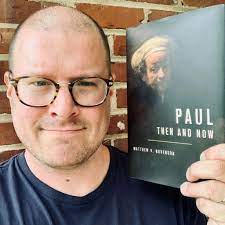
Dr. Matthew V. Novenson is Professor of Biblical Criticism and Biblical Antiquities at the University of Edinburgh. Among recent publications are (author) Christ Among the Messiahs; Paul, Then and Now; and (co-editor) The Oxford Handbook of Pauline Studies.

To hear the podcast click here.