Page 2 of 3

Formatting the Word of God with Dan Wallace

In May 2023 Dan Wallace lectured at the Lanier Theological Library. His topic was “Formatting the Word of God.”  Before the lecture, he sat down to talk with David Capes for “The Stone Chapel Podcasts.”

Who is Dan Wallace? 

Dan Wallace is the CEO and executive director of the Center for the Study of New Testament Manuscripts (CSNTM) in Plano, Texas.

Formatting the Word of God

From the beginning, people who hand copied the New Testament manuscripts put into the manuscripts features which made the reading of Scripture easier.  But these features led to certain interpretations.

The Bible has certain formatting to it. It has to. Every literary product has to. For example, how wide should the margins be for a text? How wide should the text be? Is it going to be on a three-foot papyrus roll? So, there’s some formatting.

Certain features, for example, make it easier to read in public.  Other features of copying indicate respect for and devotion to Christ. 

Dan’s lecture will be rich in imagery drawn from the thousands of photographs of these amazing manuscripts that this organization has taken over the last decades. (You can find a link to it below. It was a little over one hour long.)

Still thousands of manuscripts remain unphotographed.  But his organization has discovered many other manuscripts not previously catalogued. 

Even the form of the book itself—the codex not scrolls or rolls—has a certain interpretive significance. 

The Center for the Study of New Testament Manuscripts

Because these manuscripts and inks are organic, over time they will decay, fade, and become unreadable.  That’s one reason Dan started the Center for the Study of New Testament Manuscripts: to preserve these valuable artifacts. 

But there is another reason.  The goal of the center is to make high quality, digital images available to all people.  If the staff  meet their goal, then in the future anyone in the world with an internet connection will be able to view images of available manuscripts. 

Formatting Today

Modern Bibles continue the interpretive features.  Chapters, verses, columns, italicizing, page numbers, cross-referencing, and interpretive notes are employed by publishers and these guide readers to interpret the texts. 

For the website of the CSNTM, go to www.csntm.org

To hear the complete lecture click here.

To hear Dan Wallace’s previous podcast on the history and mission of the CSNTM click here.

Would you like a transcript of this podcast? Click here.

More resources

Want more Stone Chapel Podcasts on some great topics. Just click here.

What’s more, you can get information on upcoming lectures at Lanier Theological Library. Just click here.

To hear the podcast (22 minutes) click here.

Broken Planet with Sharon Dirckx

Dr. Sharon Dirckx

Broken Planet is the title of a new book by Sharon Dirckx (PhD, Cambridge) with InterVarsity Press (2023). The subtitle describes the question she hopes to address: If There’s a God, Then Why Are There Natural Disasters and Diseases?  She joins David Capes on The Stone Chapel Podcast to talk about her most recent book.

To hear the podcast (approx 20 minutes) click here.

Who is Sharon Dirckx, author of Broken Planet?

Sharon Dirckx is a freelance speaker and author who occasionally teaches courses for OCCA, The Oxford Centre for Christian Apologetics.  She has been with us before on this podcast and has lectured at the Lanier Theological Library in Houston in November 2022. Links to those episodes and to her other books are below.

While her PhD from Cambridge is in brain imaging, Dr. Dirckx has turned her attention to our broken planet. She and her husband live in Oxford, UK.

Are we living on a Broken Planet

A great deal of suffering is caused by natural disasters: tsunamis, earthquakes, floods, hurricanes, pandemics, and other catastrophes. How do we account for such disasters if there is a God who is all powerful?  Is our planet broken or is this the best of all possible worlds as some regard it?

It is one thing to make a case for the origin and impact of moral evil or “man’s inhumanity to man.”  But it’s quite another to talk about the planet itself as being our home and our nemesis.

Dirckx mixes her own style of apologetic argument with stories of people who suffered and survived to create a compelling book. This podcast captures a bit of her book and aims to help readers deal with those tragedies not caused by humans.

Click here to watch Sharon Dirckx’s lecture at the Lanier Theological library, on her second book, Am I Just My Brain.

Watch a short video here of Sharon discussing the topic, Can you be a credible scientist and believe in God.

For Sharon’s Podcast’s on her book, Am I Just My Brain, click here.

In the Form of (a) God, Pt 2

With Andrew Perriman

To hear the podcast click here.

This discussion is more technical than most we get into, but hang in there and think a few new thoughts today.

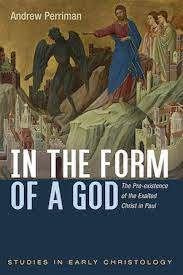
In the Form of a God is a new book by Dr. Andrew Perriman.  It is part of series edited by Mike Bird, David Capes, and Scott Harrower called Studies in Early Christology (Cascade). 

Perriman  joined David Capes by Zoom from his home in London for two episodes of “The Stone Chapel Podcasts.”  Here is part 2.  If you haven’t heard part 1, go back and listen to that episode here.

Who is Andrew Perriman?

Andrew Perriman is a researcher and writer on topics related to eschatology and Christology. He is Associate Research Professor, London School of Theology, and spends part of his time in pastoral work around the world.

He also works with a mission organization, Communitas.  As he says, he inhabits two worlds.

Details about “In the Form of A God”

The subtitle of the book narrows the subject of the book The Preexistence of the Exalted Christ in Paul.

Many scholars believe that Paul, our earliest Christian theologian, already held to the notion that before Jesus was “born of a woman” (Gal 4:4-6), he existed in heaven as a divine being “in the form of God” or as Perriman prefers “in the form of a god” (Phil 2:6). 

His book asks the question: did Paul believe in the pre-existence of Christ?  And if so, to what extent?

The Philippian Hymn (Phil 2:6-11)

Perriman has an interpretation of Phil 2:6-7 that is at variance from many scholars. First, he does not regard it as a hymn. He considers it an encomium, that is, rhetoric designed to praise a human being. 

Second, he thinks it unlikely that Paul wrote it.  Rather, Paul approves of it because he incorporates it into his letter.

Third, he focuses upon the phrase “in the form of (a) god” to demonstrate that the backdrop of this passage—at least the first verses of it—comes from a pagan background that is accustomed to god’s appearing in human form. 

Jesus appeared in his ministry as a godlike figure.  It is generally agreed that morphe, that is, “form” refers to an outward appearance not the essence of a person or thing.

Seize the Opportunity

The other key word in this passage is harpagmos, which Perriman regards as an opportunity to be seized. Perriman follows the case made by Roy Hoover in 1971 (see details below). He believes, the most likely reference goes back to Jesus’ temptation in the wilderness. The godlike man was presented with an opportunity to have the kingdoms of the world, and he turned it down.

Essentially, the passage (Phil 2:6-11) poses the question: how should a Gentile, a pagan understand Jesus? 

The second half of the hymn or encomium is thoroughly Jewish because ultimately everything, every creature will bow down to the Jewish God, Creator of the heavens and earth. This is a strong allusion to a passage from Isaiah 45.

Finally

In the end Perriman regards this passage not so much as a hymn with a preexistence Christology. Rather it is rhetoric designed to make Jesus an example of humility and wisdom, a person worthy of imitation.

Agree or disagree? Leave a comment below.

See Roy Hoover, “The Harpagmos Enigma: A Philological Solution,” Harvard Theological Review 64 (1971) 95-11.

Here are more resources for you.

Check out more Stone Chapel Podcasts on some great topics here.

What’s more, you can get information on upcoming lectures at Lanier Theological Library. Just click here.

The Akedah and Job with John Walton

The Akedah refers to the binding of Isaac (Genesis 22). How does Gen. 22:12 in its context of God’s promises to Abraham answer the question of why God asked Abraham to sacrifice Isaac? Hint: There are parallels with Job. Dr. John Walton, Professor of Old Testament at Wheaton Graduate School, is a frequent contributor to this podcast. His many publications concentrate especially in the backgrounds, language, and thought of the Old Testament world.

To hear the podcast (9 min.) click here.

“Exegetically Speaking” is a weekly podcast of the friends and faculty of Wheaton College, IL and The Lanier Theological Library. Hosted by Dr. David Capes, it features language experts who discuss the importance of learning the biblical languages—Hebrew, Aramaic, and Greek—and show how reading the Bible in the original languages “pays off.” Each podcast lasts between seven and eleven minutes and covers a different topic for those who want to read the Bible for all it is worth.

If you’re interested in going deeper, learn more about Wheaton’s undergraduate degree in Classical Languages (Greek, Hebrew, and Latin) and our MA in Biblical Exegesis

You can hear Exegetically Speaking on SpotifyStitcherApple Podcasts, and YouTube. If you have questions or comments, please contact us at exegetically.speaking@wheaton.edu. And keep listening. 

Does Everyone Speak in Tongues?

Christopher Hays

It is possible for a small Greek word to lift a great weight of misunderstanding from one’s heart. In 1 Cor. 12:30 Paul’s question about the gift of tongues is marked as rhetorical, expecting a negative answer, by just such a word. Christopher M. Hays is the president of Scholar Leaders. Among his publications are When the Son of Man Didn’t Come: A Constructive Proposal on the Delay of the Parousia and Renouncing Everything: Money and Discipleship in Luke.

To hear the Exegetically Speaking Podcast (10 minutes) click here.

“Exegetically Speaking” is a weekly podcast of the friends and faculty of Wheaton College, IL and The Lanier Theological Library. Hosted by Dr. David Capes, it features language experts who discuss the importance of learning the biblical languages—Hebrew, Aramaic, and Greek—and show how reading the Bible in the original languages “pays off.” Each podcast lasts between seven and eleven minutes and covers a different topic for those who want to read the Bible for all it is worth.

If you’re interested in going deeper, learn more about Wheaton’s undergraduate degree in Classical Languages (Greek, Hebrew, and Latin) and our MA in Biblical Exegesis

You can hear Exegetically Speaking on SpotifyStitcherApple Podcasts, and YouTube. If you have questions or comments, please contact us at exegetically.speaking@wheaton.edu. And keep listening.