With Andrew Perriman
To hear the podcast click here.
This discussion is more technical than most we get into, but hang in there and think a few new thoughts today.
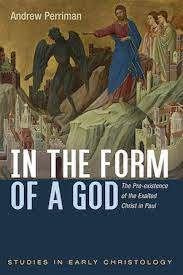
In the Form of a God is a new book by Dr. Andrew Perriman. It is part of series edited by Mike Bird, David Capes, and Scott Harrower called Studies in Early Christology (Cascade).
Perriman joined David Capes by Zoom from his home in London for two episodes of “The Stone Chapel Podcasts.” Here is part 2. If you haven’t heard part 1, go back and listen to that episode here.
Who is Andrew Perriman?
Andrew Perriman is a researcher and writer on topics related to eschatology and Christology. He is Associate Research Professor, London School of Theology, and spends part of his time in pastoral work around the world.
He also works with a mission organization, Communitas. As he says, he inhabits two worlds.
Details about “In the Form of A God”
The subtitle of the book narrows the subject of the book The Preexistence of the Exalted Christ in Paul.
Many scholars believe that Paul, our earliest Christian theologian, already held to the notion that before Jesus was “born of a woman” (Gal 4:4-6), he existed in heaven as a divine being “in the form of God” or as Perriman prefers “in the form of a god” (Phil 2:6).
His book asks the question: did Paul believe in the pre-existence of Christ? And if so, to what extent?
The Philippian Hymn (Phil 2:6-11)
Perriman has an interpretation of Phil 2:6-7 that is at variance from many scholars. First, he does not regard it as a hymn. He considers it an encomium, that is, rhetoric designed to praise a human being.
Second, he thinks it unlikely that Paul wrote it. Rather, Paul approves of it because he incorporates it into his letter.
Third, he focuses upon the phrase “in the form of (a) god” to demonstrate that the backdrop of this passage—at least the first verses of it—comes from a pagan background that is accustomed to god’s appearing in human form.
Jesus appeared in his ministry as a godlike figure. It is generally agreed that morphe, that is, “form” refers to an outward appearance not the essence of a person or thing.
Seize the Opportunity
The other key word in this passage is harpagmos, which Perriman regards as an opportunity to be seized. Perriman follows the case made by Roy Hoover in 1971 (see details below). He believes, the most likely reference goes back to Jesus’ temptation in the wilderness. The godlike man was presented with an opportunity to have the kingdoms of the world, and he turned it down.
Essentially, the passage (Phil 2:6-11) poses the question: how should a Gentile, a pagan understand Jesus?
The second half of the hymn or encomium is thoroughly Jewish because ultimately everything, every creature will bow down to the Jewish God, Creator of the heavens and earth. This is a strong allusion to a passage from Isaiah 45.
Finally
In the end Perriman regards this passage not so much as a hymn with a preexistence Christology. Rather it is rhetoric designed to make Jesus an example of humility and wisdom, a person worthy of imitation.
Agree or disagree? Leave a comment below.
See Roy Hoover, “The Harpagmos Enigma: A Philological Solution,” Harvard Theological Review 64 (1971) 95-11.
Here are more resources for you.
Check out more Stone Chapel Podcasts on some great topics here.
What’s more, you can get information on upcoming lectures at Lanier Theological Library. Just click here.





 A Word in Edgewise
You must be logged in to post a comment.