
 by
by 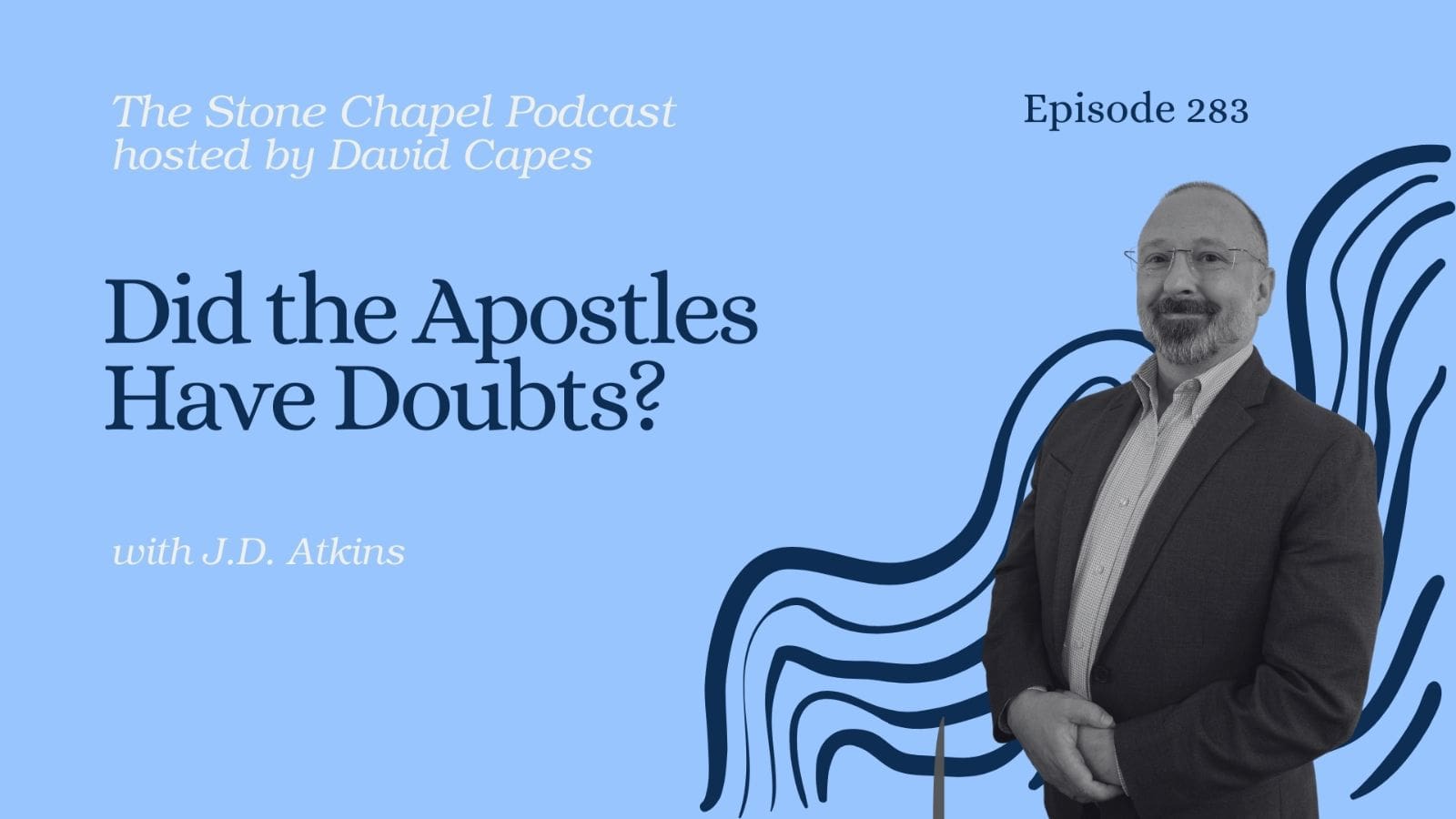
Here is my conversation with Dr. J. D. Atkins. You can listen to the podcast here.
This transcript has been edited for clarity and space.
J.D. Atkins
Hello. My name is J.D. Atkins. I am Associate Professor of New Testament, Language and Literature at Tyndale Theological Seminary in the Netherlands, and I’m also the Chair of the Department of Biblical and Exegetical Studies.
David Capes
Dr. J.D. Atkins, J.D. good to see you. We’re glad that you’re here. You and your wife and son have been here to study and hopefully write some, think some, and read a bit.
J.D. Atkins
Thank you, David. It’s been a pleasure and really a privilege to be able to have access to the library and have the space to work.
David Capes
All right, for those who don’t know you, who is J.D. Atkins. Let’s start with that.
J.D. Atkins
I’m primarily a New Testament scholar, but I have a real interest in hermeneutics. I am married and I have two children, both teenage sons. One is in university and one’s in high school. We live near Amsterdam in the Netherlands, but I’m originally from the United States.
David Capes
Are you originally from Pennsylvania?
J.D. Atkins
Well, I did do my undergraduate work at the University of Pennsylvania, and then I did a Master of Divinity at Westminster Theological Seminary, which is also in Philly. I did a ThM at Trinity Evangelical Divinity School. I did that in New Testament, and then did my doctorate work at Marquette University.
David Capes
Oh, that’s a wonderful Catholic school. All right, we’re going to be looking today at your book called The Doubt of the Apostles and the Resurrection Faith of the Early Church. The subtitle is The Post Resurrection Appearance Stories of the Gospels in Ancient Reception and Modern Debate, published in the Wissenshaft zum Neuen Testament Series (J. C. B. Mohr, 2019). I say to all my students, that good books have big ideas. What’s the big idea of this book?
J.D. Atkins Transcribed by https://otter.ai – 2 –
I think the main idea of the book is that I’m trying to address what I see to be a common misreading of Luke and John’s resurrection narratives.
David Capes
Yes, Luke 24 and John 20.
J.D. Atkins
That’s right. And the common reading is that these narratives were designed as an apologetic for the physicality of the resurrection, primarily in response to some sort of early docetism. Docetism is a particular type of Christology. It’s a view of Jesus that sees him as not fully human, maybe even not human at all. There’s quite a variety in ancient Docetisms. There’s a lot of early heresies that were tied to groups that were called Docetists. And other groups that were called Gnostics. They had some common themes, which were that Jesus either was not fully human in his birth, meaning that he was just a spirit walking around as an illusion in a sense. Or some challenged docetism, more at the place of the crucifixion. The issue was: did Jesus really die on the cross?
David Capes
Did he really suffer?
J.D. Atkins
Did he really suffer? Some would say that Jesus didn’t really die on the cross. In fact, he switched places with someone else. That was one docetic view. Another docetic view was that Jesus, the man, died on the cross, but Christ was a separate person, a spirit that possessed Jesus and then left him before the cross so that Christ then doesn’t suffer.
David Capes
And so they often would say that the Christ Spirit comes on Him at His baptism.
J.D. Atkins
That’s right. That’s right. The same group was usually saying that this Christ Spirit comes on him at baptism and then leaves him just before or right at the crucifixion.
David Capes
“My God, my God. Why have you forsaken me?” In one early account he said, “My power, my power, why have you left me?”
J.D. Atkins
Yes, there’s various different options.
David Capes
So Docetism is a type of Christology that is going to be rejected by the Church eventually as being heretical.
J.D. Atkins Transcribed by https://otter.ai – 3 –
Yes, that’s right. And there was another variety of Docetism where people would see the resurrection accounts of Jesus in a docetic manner. In other words, they would say that Jesus didn’t really appear in flesh and bone, as Luke would say, or that he didn’t really eat fish. Or he couldn’t really be touched, the way both Luke and John imply. They’re all interrelated. The Docetics were motivated in some ways, again, by their own worldview. Which was oftentimes influenced more by Greek philosophy, which viewed salvation as escape from the body. And they didn’t like the idea of returning to the body and resurrection as an idea of salvation, because the body is negative, evil, a place of corruption, weakness and pain.
David Capes
Right. And the whole idea of materiality, anything material was subject to decay. Every material thing decays. And that includes me, my physical body, at least. The idea is just to escape this body, because there’s a spiritual part of me that is not necessarily connected to the body. That’s very different than what we find in the New Testament.
J.D. Atkins
Exactly. The New Testament describes Jesus having flesh and bone in his resurrection. Paul, in Romans 8 says God will give life to your mortal bodies. When you get to Paul, and actually in the gospels as well, you get a sense that Jesus is more than physical. But he is physical. His risen body is physical. But it is more than physical. It can disappear and appear out of nowhere. It can also show up in a locked room.
David Capes
What I hear you saying is that the gospel writers really didn’t have apologetic interest, because they’re not really dealing with docetists at that time.
J.D. Atkins
Well, I would say they do have an apologetic interest. But I don’t think that Luke and John are primarily making an apologetic for the physicality of the resurrection against Docetists. What I argue in the book is that Luke and John’s apologetic, if they have one, is actually more of an apologetic regarding the fulfillment of prophecy. As opposed to the question of, was the resurrection real, the way you see the stories go.
If you were going to argue against a Docetists, would you have Jesus disappear in the middle of nowhere after the Emmaus disciples break bread? Would you have him disappear? Would you have him as in John’s gospel, particularly in the Thomas narrative, even though there’s a concessive participle there. Even though the doors were locked, Jesus shows up. He stands amongst them. This is the kind of thing that we find in the early docetists. They make much of these types of things, because this, to them, shows that Jesus was not real.
David Capes
And by real you mean he was not physical but just a spirit or a phantom?
J.D. Atkins Transcribed by https://otter.ai – 4 –
Exactly, but what happens in much of the scholarship today on these narratives is they see certain parallels in the early church fathers who are fighting against Docetists. Ignatius of Antioch is a key character here, because Ignatius emphasizes the physicality of the resurrection of Jesus, being touched and eating fish. In fact, I would argue that Ignatius is actually based off of Luke’s account here.
David Capes
So Ignatius of Antioch, who’s in the early [second] century, has a copy of Luke, or he’s read Luke, or heard Luke read somewhere.
J.D. Atkins
Yes. And he’s using Luke’s account. But it’s interesting because he omits certain things when he argues against the docetists. He omits, for example, the fact that Jesus appears or disappears suddenly. He omits the fact that the apostles doubted. There are other phrases and such that the docetists would pick up on that he also omits.
One of the things that I am trying to argue in my book, is that it’s not that Luke and John with Jesus saying, touch me and eating fish and, put your finger here. Put your hands here, Thomas. Those types of emphasis on the physicality. What I’m trying to say is that that is the tradition, and what we find in the second century is Docetists and early church fathers who are fighting against docetists really having an exegetical debate over how we should interpret those passages. So in that case, it’s not Luke and John that are writing in order to counter some early docetists, but rather the early docetists that are responding to and reinterpreting the traditional accounts in Luke and John.
David Capes
That’s a pretty important distinction there.
J.D. Atkins
Yes. Part of it is a matter of sequence. What I find in my book is that the early docetists, which would include some Gnostics, because some Gnostics were also Docetists as well. These are various types of early heresies. There’s so many of them, because Irenaeus will say that they’re so popular. They pop up like mushrooms all over a field. You know, there’s always a new docetic or gnostic sect. The point is that these early readers of Luke and John, they are assuming the text is authoritative to begin with. Well, what I found in my work was that nearly all of the early docetists or Gnostics, that deal with the resurrection of Jesus, they are, in fact, dependent on one of the gospel narratives. They accept the gospel narratives as authoritative for the most part.
David Capes
So these Docetists and these Gnostics are looking at these texts, they believe they are authoritative, but they’re interpreting them in a different way.
J.D. Atkins
That’s right, yes. To give you one example, there is what is often referred to as the Ophite account. It’s in Irenaeus, Against Heresies, 1.30. Ophite is a later term for the name of that Transcribed by https://otter.ai – 5 –
sect that Irenaeus is dealing with. But that account works right through Luke’s texts from the birth narrative to the resurrection. And it just reinterprets each section of the text. What it does is: it actually uses language to say that these are the eyewitness accounts of the apostles. It affirms that. This is a heretic, affirming that, taking it as an authoritative, eyewitness account of the apostles. They treat it like scripture, but they reinterpret it. One of the reasons why they have to reinterpret it is because it’s already set as authoritative. I coined a term in my book, which is basically a new verb, “docetize”, or a new noun, “docetization”.
David Capes
That’s what scholars do? They just make up words!
J.D. Atkins
It’s an analogy with allegorization. When they had a text and they didn’t want to read it literally, then oftentimes they would allegorize. The early Gnostics, they would regularly allegorize the Old Testament and the Gospels. But docetization is similar. It’s a way of taking a text but not taking it literally. But it’s not taking it figuratively either. It’s more saying, this seemed to be the case. We get the word docetism form the Greek word dokein. Which can be translated “seems” or “appears”. They would take the narrative and say it only seemed to be this way.
I think the Ophite account says something like Jesus Christ only seemed to be in the flesh. Or you have Justin Martyr responding to another docetic text saying, he only seemed to eat fish. Some Marcionites will say the same type of thing, because it’s already an authoritative text. You can’t get around it unless you reinterpret it. It becomes a hermeneutical, exegetical battle in the second century over Luke and John.
David Capes
How we take these texts. Well, I’ve got to ask about the doubt of the apostles. Because that’s the title of your book, The Doubt of the Apostles. How does the doubt of the apostles function for the docetists, and how did it function in the New Testament?
J.D. Atkins
I use doubt as a broader theme. There’s a number of different words that are used in the resurrection narratives, and every single one of them has it right. You have Matthew often translated, “they worshiped, but some doubted” (Matt 28:16-20). Everyone knows the Thomas story. And then, of course, there are the various places where the apostles disbelieved. In Luke 24 Jesus will also say “how foolish and slow of heart to believe”. And even the longer ending of Mark will refer to Jesus rebuking the apostles for their hardness of heart in not believing.
You’ve got this theme that’s throughout the resurrection narratives in the Gospels. The way modern scholars read that theme is they tend to see it as an apologetic device. So modern scholars say doubt is a good thing. It means that we’re not gullible. We’re not just believing anything. We demand evidence and proof before we believe. And so modern scholars say that’s what the gospel writers are doing. They’re including the doubt of the apostles in order to assure the reader that they doubted, and they still came to faith. You can trust them. Transcribed by https://otter.ai – 6 –
Now, what I argue in my book is that while that makes sense to a modern reader, it didn’t make sense to ancient Jewish and Christian readers. In the ancient world, doubt is seen not as something that makes you wise so that you can get to certainty. Rather, doubt is seen as foolishness or as hard heartedness. We actually see this in the gospels themselves; Jesus will rebuke the Emmaus disciples for being foolish and slow of heart to believe. In the longer ending of Mark, he rebukes them for their hard heartedness. You can see it in James. The double minded man is unstable in his mind. And so, it’s actually a negative thing.
What happens in the early church in the second century is you have two different trends of dealing with the doubt of the apostles. You have the Orthodox guys, the church fathers who are defending the faith. What they do, almost without fail, is delete the doubt. When they retell the story, they don’t even mention it. And then when you get a little bit later to folks like Origen, for example, or later with John Chrysostom, they’ll try to defend the apostles. Origen will try to explain, by saying this is why they doubted. And then John Chrysostom will say he was commenting on the “but some doubted” or “but they doubted”, depending on how you translate the verse in Matthew 28:17. And I’m paraphrasing, give the evangelists some credit. They were being honest and not hiding their faults. At one point, Augustine will even say “the disease that the lambs shudder at, the leading rams had”. It was shocking to them that the apostles would have this doubt, and disbelief.
David Capes
Because they’re understanding the term doubt, in a negative way.
J.D. Atkins
In a very negative sense, and that has a very negative connotation in the ancient world.
David Capes
Okay, talk about the Docetists.
J.D. Atkins
So the Docetists take advantage of the doubt. They would use it as an opportunity to say, you can’t really trust these disciples. You see the disciples. They saw this and they saw that, but they didn’t have the proper special revelation from Jesus at a later point that told them how to reinterpret these things. They would use the doubt as an opportunity to criticize the apostles and say that you can’t really trust these accounts, in a sense. You know, even though they were eyewitnesses.
David Capes
They really weren’t sure what they were saying.
J.D. Atkins
They really didn’t understand. They saw what they saw, but they didn’t really understand what they were seeing. What happens then is that the doubt of the apostles is actually something that satisfies what we would call “the criterion of embarrassment” in the historical Jesus studies. In the sense that the evangelists include it, despite the fact that it would cause problems. And it did cause problems. And so actually, much like today, we see that the women Transcribed by https://otter.ai – 7 –
were the first to see the empty tomb and the first to see the risen Jesus, and we say, nobody would make that up in the ancient world.
David Capes
Because women we’re not considered trustworthy themselves.
J.D. Atkins
Yes. In the ancient world, because of the culture, their witness wasn’t considered as valid. And so, the evangelists certainly didn’t make that up in the similar way. What I argue at the end of my book, in the last chapter, is that the doubt of the apostles functions similarly. That’s also something that the evangelist would never have made up, because it would only lead to more problems.
David Capes
It’s a little bit embarrassing that the heroes of the story just don’t quite get it, or they’re not really sure. And you wouldn’t make up that kind of thing. It’s part of the authenticity, I think, of the story.
J.D. Atkins
Yes. And funny enough, aside from Thomas, none of the apostles are explicitly said to believe. Obviously, you can infer that they did believe.
David Capes
But other than Thomas, who said “My Lord and my God”.
J.D. Atkins
Yes! And his Christology is right. And when Jesus responds to him, there’s the question. Jesus responds and says, you believe because you have seen. Blessed are those, that believe, though they haven’t seen. So even Thomas’ belief, Jesus was a little bit critical of it.
David Capes
It’s a fascinating book. It’s entitled The Doubt of the Apostles and the Resurrection Faith of the Early Church. Subtitled The Post Resurrection Appearance Stories of The Gospels in Ancient Reception and Modern Debate. J.D. Atkins, thanks for being with us today on The Stone Chapel Podcast.
J.D. Atkins
Thank you for having me.
 A Word in Edgewise
Leave a comment