Page 14 of 17

One God, One Lord

In a few weeks I’ll fly to Nova Scotia to give a series of lectures at Acadia Divinity School.  The lecture series is known as the Hayward Lectures.  Some of the best scholars in the world have been invited to give the Hayward Lectures.  I’m not sure why they invited me.  I’m not being modest.  I’m being truthful.  The list of past lecturers is a veritable “Who’s Who” in biblical studies: N. T. Wright, James D. G. Dunn, John Stackhouse, John J. Collins, Edith Humphreys, Emmanuel Tov, James Charlesworth,  just to name a few.  So I’m honored to be part of this series. Acadia Divinity College

My topic is academic but it has to do with what it meant for early Christians to call Jesus “Lord.”  Where did the title come from?  What did they mean by it?  One of the passages I’m considering in the lectures is 1 Corinthians 8:5-6 (from The Voice):

And even if the majority believes there are many so-called gods in heaven and on earth (certainly many worship such “gods” and “lords”), this is not our view. For us, there is one God, the Father who is the ultimate source of all things and the goal of our lives. And there is one Lord—Jesus the Anointed, the Liberating King; through Him all things were created, and by Him we are redeemed.

The passage is Paul’s unique modification of a Jewish prayer and confession known as the Shema: “Hear, O Israel, the Lord is our God, the Lord is One” (Deut 6:4).

Paul’s expanded-Shema acknowledges the unfortunate reality of idolatry in the world and then trumps the claim that the world is populated with many so-called gods and lords.  They may be called “gods,” but “gods” they ain’t (if I can borrow a southern expression).  They may be called “lords,” but “lords” they ain’t.  For us (Christ-believers) there is One God, the Father, the source and goal of all reality, and One Lord, Jesus Christ, the agent of creation and redemption.

The confession Paul makes is properly-speaking binitarian.  It sees the two—God, the Father, and Lord, Jesus Christ—in unity.  The two are one.  We are not dealing with any sort of primitive ditheism, that is, two separate and distinct gods.  As a Jew Paul was an exclusive monotheist but now—given all that the God of Abraham has been up to—he understood that Jesus somehow must be reckoned within God’s unique covenant identity.

We should not fail to notice that the title “Lord” here, associated as it is with Jesus, has its roots in the Shema.  Spoken versions of the prayer substituted Adonay (Lord) for the divine name out of reverence for the name, but it is clear the original contains the covenant name of God: “Hear, O Israel: The LORD (YHWH) is our God, the LORD (YHWH) is One” (Deut 6:4, my translation). In The Voice we translated  every occurrence of the divine name as “The Eternal One” or “Eternal One.”  You can read about that in earlier posts.

AcadiaDivinityThe link between YHWH and Jesus in Paul’s version is unmistakable and remarkable.  What makes it all the more remarkable is that Jesus is not a figure of the ancient past whose legend and stature build over the centuries, but a man who recently walked the earth with people Paul himself had met and knew (Galatians 1).  The claim is audacious.  The link—if it were a fiction—would be scandalous.


Paul Straddled Four Worlds

There is a place in the western part of America where a person can straddle four states .  It is often referred to as the “four corners” region because four US states come together at one spot: Colorado, New Mexico, Arizona, and Utah.  You can see it on any map.  Theoretically, it would be possible for a person to stand with his right foot planted firmly in New Mexico, his left foot in Arizona, and reaching to the north his right hand would be in Colorado and his left would be in Utah.

When we think about it, all of us straddle different worlds.  Some in my business straddle academic and church life in America.  Then, to make things more complicated, they go home to family that speaks Spanish and has little formal education.  We all have to make our way through a complicated maze of worlds.St. Paul
This was Paul’s story too.  Paul straddled four different worlds.  The first happened to be the world and culture of his birth.  His right foot was firmly planted in the world of second temple Judaism.  It was a world shaped in large measure by what Christians call the Old Testament or what someone like Paul would have called the law, the prophets and the writings (the Tanakh).   The Hebrew Scriptures boldly declared the existence of One, True God who created all things and had made covenants with Abraham and Israel at Sinai.  Israel’s God stood in sharp contrast to the many gods and lords worshiped by the nations.  Second temple Jews lived with a sturdy expectation that God’s Kingdom would come one day to right all the wrongs and make Jerusalem the center of the world instead of an occupied city on the outskirts of the Roman empire.

This brings me to the second world Paul occupied: the world ruled by Rome.  According to Acts, Paul was a Roman citizen and used it to his advantage when it suited him.  Though Paul makes no direct mention of this in his letters, it is not unlikely that someone like Paul enjoyed its favored status.  Paul’s Jewish heritage would have placed him at odds with many aspects of Roman empire, particularly their ultimate religious claims about their gods and a growing cult devoted to Caesar.  The empire’s political claim to provide peace and security were laughable for Jews who lived everywhere—but especially in Judea–under the heel of Rome.  In some ways Rome provides the perfect foil for Paul to rail against. Pagan sacrifices were not neutral; they were offerings to demons  (1 Cor 10:20).  As many NT scholars have noted: if Jesus is the true Lord and king and king of the world, then Caesar is not.

A third world Paul straddled was Greek.  Though Paul was certainly multilingual, the letters we have from him are all written in Greek.  Greek had become the lingua franca of most places Paul traveled, even though he would have encountered dozens of different local languages and dialects.  Language is only one thing but it is a big thing because with language goes literature, poetry, education and ideas which slowly but inevitably permeate society.  When Paul quoted the OT in his letters, more often than not he quoted from some Greek translation of the OT.  It’s possible he made up his own translations on the fly, of course. But since his quotations appear so similar to translations we know today, its more likely he drew from some standard version available to him.  Furthermore, Paul’s letters and accounts about him in Acts reflect a knowledge not only of Greek language but Greek oratory, literature, and rhetoric.  In Martin Hengel’s massive volumes translated into English as Judaism and Hellenism (1974), he argued that Jesus’ homeland, the land of Palestine, had been Hellenized by the middle of the 3rd century BC.  Judaism had not escaped the hellenizing edge of Alexander’s sword.

The fourth and final world Paul occupied was relatively new.  In fact, by the time he entered it and became one of its greatest advocates it had only been around a few years.  Saul the Pharisee became a Christ-follower probably only 3-5 years after Jesus’ execution.  But already there were traditions, practices, and beliefs which were beginning to mark out this first century Jesus movement.  We don’t have access historically to any material and literary evidence that come prior to Paul’s conversion. His letters contain a few hints here and there of the kinds of things early Christians may have been saying.  For example, the Philippian hymn (Phil 2:6-11) may have been sung, chanted, or recited in Christian gatherings before Paul came to faith.  What seems more likely is that Jesus’ death and resurrection are already seen as the fulfillment of God’s plan.  To put it another way, they are the climax of God’s covenant promises to Abraham, Moses and Israel.  In 1 Corinthians 15:3ff Paul writes:

For I handed on to you as of first importance what I in turn had received: that Christ died for our sins in accordance with the scriptures, and that he was buried, and that he was raised on the third day in accordance with the scriptures, and that he appeared to Cephas, then to the twelve.

Paul says he “hands on” what he “had received.” The apostle to the Gentiles employs the language of tradition to let us in on some of the content of the church’s message before Paul.  Already the death of Jesus the Messiah was being understood as an atoning sacrifice.  Already the death, burial, and resurrection of Jesus were seen as complementary to the Scriptures.  Not only do these crucial events not contradict what God had said previously through the prophets; they fulfill them.  Already, Cephas (namely, Peter) and the twelve had gained prominence as some of the first witnesses to Jesus’ resurrection.

Paul not only straddled these four worlds, but as destiny would have it, he would go on to shape them as well.  It is hard to imagine what Christianity today would be like without Paul.  He is credited with having written nearly 1/2 the books of the New Testament. The  Protestant Reformation of the 16th century found in Paul its inspiration. And what of Judaism? As my friend Alan Segal often said, Christianity and rabbinic Judaism were like Rebekah’s children; both religions were very different twins formed in the womb of second temple Judaism. And what of Greece and Rome? Well, Rome soaked up much of the best of Greek culture.  Then after centuries of persecution, Christianity would go on to become the dominant religion of the empire.  In the end the many gods and lords of Rome would yield to the One God in three Persons.  Or as the apostle would put it (1 Cor 8:6):

Indeed, even though there may be so-called gods in heaven or on earth—as in fact there are many gods and many lords— yet for us there is one God, the Father, from whom are all things and for whom we exist, and one Lord, Jesus Christ, through whom are all things and through whom we exist.

My Interview with N. T. Wright

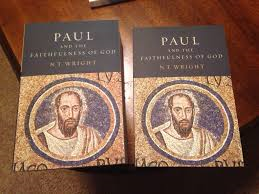
I recently sat down with N. T. Wright to talk about his book Paul and the Faithfulness of God (Fortress, 2013).  I’ve put a link to my interview.N. T. Wright

http://www.civitate.org/2014/07/the-city-podcast-n-t-wright/?utm_source=rss&utm_medium=rss&utm_campaign=the-city-podcast-n-t-wright

The Imitation of Christ


Jack Wisdom and I taught a Lenten series at Ecclesia Houston on the Imitation of Christ.  Jack is an elder at Ecclesia and one of the scholar-writers who helped us with the translation.  He is a lawyer during the day and a New Testament scholar all the time.  He is a good friend, and I admire the way he carefully reads through the Scripture.

One of my favorite biblical texts urging us to follow Jesus and have his mind is Philippians 2.5-11.  It is one of those passages I think about and quote often.  At the heart of it is an early Christian hymn that sets the story of Jesus within poetic verse.  A lot of modern translations obscure the fact it is a hymn.  The New American Standard Version (NASV), for example, formats every verse like a paragraph so you never really know you’re dealing with a hymn.  Now I like the NASV, but that is one of its shortcomings.  In The Voice we decided to take seriously not only the words but the forms as well.St. Paul

The Bible contains more than prose.  It contains poems, hymns, acrostics, and wordplays.  Now, to be honest there are aspects of the original Greek, Hebrew and Aramaic that you cannot replicate in another language; but there are features which you can at least attempt to bring over into the target language—in our case English.  For example, Lamentations is written in an acrostic poem.  So our scholar-writer Dr. Kristin Swenson, research professor at the University of Virginia, did an excellent job at approximating the look, sound, and meaning of the Hebrew acrostic.  An acrostic is a type of poem where each line or set of lines begins with a new letter in alphabetic order: A, B, C, etc.  It’s a challenge to do because English has more letters than Hebrew.  Still we sensed there was beauty and meaning in the form.  Take a look at how we did Lamentations 3.  If you don’t have a copy of The Voice, you can always look it up on www.biblegateway.com.

Back to Philippians 2.  Here is how we translated the Philippian hymn to Christ.

Though He was in the form of God,

He chose not to cling to equality with God;

But He poured Himself out to fill a vessel brand new;

a servant in form

and a man indeed.

The very likeness of humanity,

8 He humbled Himself,

obedient to death—

a merciless death on the cross!

So God raised Him up to the highest place

and gave Him the name above all.

1So when His name is called,

every knee will bow,[a]

in heaven, on earth, and below.

11 And every tongue will confess[b]

“Jesus, the Anointed One, is Lord,”

to the glory of God our Father!

The hymn captures the career of Jesus from his preexistent glory with God to his incarnation, suffering and then exaltation.  Paul urges the Philippians to have the same mind (2:5).  Larry Hurtado, retired New Testament professor at the University of Edinburgh, offered a phrase a few years ago that has helped me think about this.  Jesus, he said, is “the lordly example” of humility and service.  Most lords through history have demanded others serve them.  This Lord emptied himself, humbled himself and ultimately gave his life for others.  We can’t do those actions, but we can strive to have the same mind.  Now that we are beyond the Lenten season, my hope is that we might follow the lordly example of Jesus in service to God, his people, and his creation.

Many thanks to David Taylor and Paul Owen who hosted me recently at Montreat College in western North Carolina.  I had a wonderful time sharing with hundreds of students, faculty, and staff in class and in chapel.  Their students asked some great questions.  Some of which I’m still pondering and hope to answer later, here on this blog.  Montreat College is a great school in one of the most beautiful settings I’ve ever seen.  I can see why people want to go there to study, hike, and do life together.

What is the “Big Idea” behind N. T. Wright’s Big Book on Paul?

Recently I sat down with N. T. Wright, Research Professor for New Testament and Early Christianity at the University of St. Andrews.

Me:

Professor Wright, I tell my students that every good book, every important book has a “big idea.” What is the “big idea” behind your book, Paul and the Faithfulness of God (Fortress 2013)?Paul and Faithfulness of God

 Wright:

The big idea is to see how Paul does something which I think he is not usually given credit for, which is that he basically invents something which in hindsight we could call Christian theology.  Now that may seem rather odd, because didn’t the Jews have theology?  Well they did and they didn’t.  Didn’t the pagans have theology?  Well not really.  They talked about the gods but that wasn’t a big topic of analysis.  Paul has this vision that because of who Jesus is, because who the Holy Spirit is, everything that they had known about God as in the Jewish Scriptures has to be reworked from top to bottom, particularly for this reason: that Paul believes that what has happened through Jesus, his death and resurrection has radically defined the people of God so that the people of God are no longer defined as they were in Israel by circumcision and the Sabbath and the food laws and the things which marked out Jewish people from their non-Jewish neighbors.  So if you are going to have a community which is a single community which is very important for Paul, the unity of the church is very, very important for Paul–not for us and that’s a problem by the way but a topic for another conversation.   If this community is to be united and holy but without those markers to keep it place, how are you going to do that when Paul’s answer is that the whole community needs to be involved in this prayerful, worshipful, Scripture-soaked reflection on who God is, who God’s people are, and what God’s future is for God’s world.  So in a sense this book is about Pauline theology and I expound all the details of Pauline theology, but back of that is this sense that Pauline theology as a whole is something which he is doing with his congregations because he realizes that without that they are not going to be able to be the people they are called to be.

They way I put it is this.  You know this saying: “Give someone a fish and you feed him for a day.  Teach him to fish and you feed him for life.” Paul isn’t content just to give people dogmas: “Here is a true doctrine which you ought to believe.”  He does that and that will help for a while.  What he wants people to do is to grow up in their thinking, to mature as Christians in their thinking, so that then they will be able to sustain their life and the life of the church in days to come because he won’t always be just to tell them: “believe this, don’t do that, whatever.”  So teaching people to think Christianly which then emerges as Christian theology.   That is the heart of it.