Page 11 of 17

Why no hell fire and brimstone?

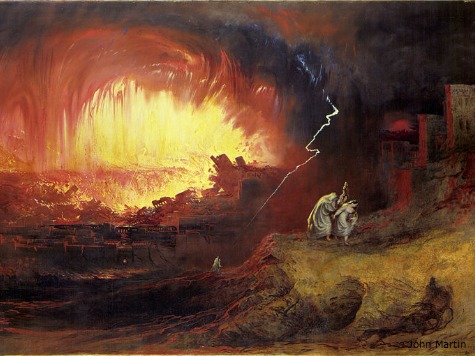
In writing Romans, before Paul gets to the good news of the gospel (Romans 3 and following), he lays out the bad news: the wrath of God is breaking in from heaven.  For Paul God’s wrath is a present reality not some distant, future threat. We are living in “the present, evil age” (Gal 1:4), where the proliferation of idolatries, perversions and corruption are the ambient human condition (Romans 1).  It’s just the way things are even as we know things are not the way they are supposed to be.  Evangelicals use “the Roman road” to highlight the threat of hell, but Paul doesn’t do that.  The bad news is not the threat of fire and brimstone in some afterlife; it is the fact that God’s wrath is already evident in the world in what is effectively God’s hands-off policy.  God has stepped back and given us up to idolatry, disillusionment, strife, sexual sins, fractured families, and wicked minds.  For the apostle, sin and depravity may be the cause of God’s fury, but they are also the effect.  The presence and spread of human vices throughout the earth make life miserable and wretched. Perhaps we can say it this way: we are not only punished for our sins, we are punished by our sins.

hell fire and brimstone

If salvation for Paul consists primarily of God’s invading presence, then divine wrath consists ultimately of God’s silence and absence in the midst of a counterfeit world.  God doesn’t step in and smash us with his powerful right arm; he steps back and says, in effect, “if that is what you want, that is what you will get.” That is heaven’s wrath.  Now we are not saying that Paul completely ignores any threat of future judgment (e.g., 2 Thess 1:5-12); what we are saying is that the threat of fire and brimstone is not the only way to frame the human plight.

Fortunately, Paul doesn’t stop with the bad news; he has good news too.

Morna Hooker on “the Faith of Jesus”

Earlier this year Michael Bird highlighted an article by Morna Hooker in the Scottish Journal of Theology: 

Morna D. Hooker, “Another Look at πίστις Χριστοῦ,” SJT 69 (2016): 46-62.

In that article she joins a chorus of scholars who agree that at key moments in his letters Paul relates that redemption is centered in the faith or faithfulness of Jesus.  This is a position argued decades ago by Richard Hays.  Now, I’m pleased to note, many scholars have begun to read Paul this way.  As Hooker notes, this new reading has deep implications for Paul’s theology.Morna Hooker

To read Bird’s blog post click here.


When I was working on The Voice translation of the Bible with Thomas Nelson, I made and won the argument that “faith/faithfulness of Jesus” is how these texts ought to be read on the fact that the King James Version (1611) got it right!  Here are two examples:

Romans 3:22-23:

22 Even the righteousness of God which is by faith of Jesus Christ unto all and upon all them that believe: for there is no difference:

23 For all have sinned, and come short of the glory of God;

And Galatians 2:20:

20 I am crucified with Christ: nevertheless I live; yet not I, but Christ liveth in me: and the life which I now live in the flesh I live by the faith of the Son of God, who loved me, and gave himself for me.

Most modern translations take this as an objective genitive and render it “faith in Jesus” or “faith in the Son of God.”  In The Voice we translated those key passages as subjective genitives: Jesus exercises faith/ trust/ faithfulness (to God).  Hooker is correct that Jesus is clearly an object of faith in Paul; but in these and other key places when Paul is describing the essence of the gospel he is clear that our redemption is due to God’s rightness and Jesus’ faithfulness.

Is there a “center” in Paul’s theology?

An earlier generation of scholars were fond of questing for the “center” of Paul’s theology.  Even in the midst of occasional, contingent situations, they believe there was an inner logic, a coherence to Paul’s thinking.  Today, scholars are less prone to talk about “center” though they do use adjectives like “central,” “integral,” and the like.  I’m wondering are we beyond trying to locate a theological center for Paul, a conceptual place from which he theologizes?  St. Paul

In an earlier book (Rediscovering Jesus, IVP [2007], with E. R. Richards and Rodney Reeves)I went in quest for the center of Paul’s theology and decided on the following criteria.

How can the center of Paul’s theology be determined? Put another way, what criteria will lead us to the center? The center will be that/those aspect/s of Paul’s theology that best satisfies the following criteria:

The center must be

1.. integral: it finds expression in all parts of all his letters.

2.. generative: it participates in—and to some degree generates—all his theologizing. It can help to explain everything else.[1]

3.. experiential: it results from encounters he has with the risen Jesus.

4.. traditional: it is consistent with the traditions he inherits and uses.

5.. scriptural: it serves as the interpretive key to new readings of Scripture.

6.. theological: given Paul’s commitment to monotheism, the theological center is ultimately a word about God, explaining and revealing him.

7.. presuppositional: at times it sits beneath the surface of Paul’s letters, supporting and limiting the argument.

The aspect or aspects of Paul’s theology that fit these criteria are likely candidates for the center of Paul’s theology.

[1]E. P. Sanders, Paul and Palestinian Judaism: A Comparison of Patterns of Religion (Philadephia: Fortress, 1977), p. 441, states it negatively: “a theme cannot be central which does not explain anything else.”

I’m wondering if the quest for a “center” or what is central/ integral is still relevant.  What do you think?

The (W)right Way to Read Paul

My coauthors (Rodney Reeves and Randy Richards) and I are working on the second edition of our book Rediscovering Paul: An Introduction to His World, Letters and Theology (InterVarsity, 2007).  It is a substantial rewrite, not just a cosmetic upgrade. Rediscovering Paul cover

Chapter 10 is our chapter on Paul’s theology and, as I’m rewriting, I’m (re)reading N. T. Wright’s two volume Paul and the Faithfulness of God (Fortress, 2013).  At the beginning of the second big volume he lays out his agenda.  His central argument is that Paul’s worldview and his theology must be understood together.  They are interdependent.  When you grasp Paul’s theology correctly and faithfully, you “do justice to the whole and the parts;” you understand the shifting historical contexts in which he lived, the forces and factors that influenced him, and you read his letters a bit more faithfully.

The (W)right way to read Paul holds together and in tension the various themes of his letters which scholars often pit against one another.  There is, he says, an “inner coherence” which emerges when you try to understand the sequence of his arguments. The letters are not a collection of detached sayings; they are robust arguments.  They are grounded in the larger themes and narratives of his Scripture and Jewish heritage.

Wright cites with approval Kasemann (Romans, 1980) when he noted that Paul’s letters do have a central concern, a coherent, inner logic which can be investigated and known.

So Wright builds his project on three platforms:

First, he begins with Paul’s Jewishness as a given, expressed in a framework of three major aspects of second temple Jewish thought: monotheism, election and eschatology.  For Wright, these elements are integrated not detached.  You cannot, for example, understand Paul’s soteriology in isolation from election, theology and eschatology.  These three elements cover the wide, gaping central concern of Paul who remained a thoroughly Jewish thinker.

Second, this framework had to be rethought, reimagined, and recast around Jesus and the Spirit.  Paul had a new understanding of what God had been up to in the Messiah and the gift of the Spirit.  He could no longer continue to think about these central categories in the same way.  The cataclysmic event of the cross and resurrection of the Messiah had changed everything.

Third, Paul’s christologically and pneumatologically redefined categories (monotheism, election, and eschatology) were deployed through the Gentile mission in three ways.

  1. They became the major aims of his letters. His letters were part of his missionary strategy, that is, to establish Jesus-infused and Spirit-directed communities across the Mediterranean.  His letters reflect this radically reworking.
  2. Paul’s own charismatic readings of Scripture were not based on proof-texting; they were grounded in reading large swaths of Scripture and attuning his mind to the great narratives of Israel which reached their appropriate climax in the Messiah. It is Paul’s full intention that his Jesus-infused and Spirit-directed communities inhabit these stories.
  3. Even as Paul’s own theology demands the formation of “churches,” he is also engaging the pagan world of his day (again in three ways).
  • the philosophers’ quest for the good life is upstaged by the good news of the gospel
  • the religious quest of late antiquity for salvation (broadly understood) with its obsession with gods and spiritual powers finds its final destination in the church
  • the imperial quest of empire is outmaneuvered by the acclamation of Jesus’ lordship, Israel’s true Messiah

Paul, according to Wright, draws from paganism everything which he thinks is true.  But pagan idolatry had ruined any chance for the wise of this age to achieve their human potential.  The human-happiness project of pagan philosophy never achieved what it promised.

But the gospel made people more human not less because, among other things, it placed in the center the only human whose life was worth imitating.

In the end Wright believes there is a coherence to Paul’s thought.  It is a coherence which holds together all the parts, uniting the disparate elements of his arguments even thought each letter is written over against a contingent situation.

An early generation of scholars was fond of talking about “the center” of Paul’s theology.  It was identified by some as justification by faith, by others reconciliation, and still by others participation in Christ.  Each of these were different ways of dealing with the broad theological category, soteriology.  Wright does not utilize the language of “center,” but his discussion of what is central, coherent appears to operate along a similar track.

 

A “Forged” Gospel and Substitutionary Atonement

I had the privilege on May 6, 2016 of moderating a panel discussion at the Lanier Theological Library.  Mark Lanier, owner and namesake of the library, was out in California and made a surprise appearance at the end.  I guess the winds were in his favor.

The topics were diverse: The Gospel of Jesus’ Wife and the notion of substitutionary atonement in Paul.  Those two topics were related only in that our special guest, Simon Gathercole, had written on them recently.  We rounded up some usual and unusual suspects for the afternoon’s discussion. Here are the key contributors:

David Capes (Moderator – Dean, Professor of New Testament, Houston Graduate School of Theology, Houston, TX)
Graham Cole (Dean, Professor of Biblical and Systematic Theology, Trinity Evangelical Divinity School, Deerfield, IL)
Craig Evans (Dean, School of Christian Thought, John Bisagno Distinguished Professor of Christian Origins, Houston Baptist University, Houston, TX)
Simon Gathercole (New Testament Scholar/Teacher, University of Cambridge, England)
David Moessner (Professor, A. A. Bradford Chair of Religion, Texas Christian University, Fort Worth, TX)

The video lasts for 90 minutes but contains a lot of great information on topics related to the New Testament.  I’m grateful to Charles Mickey and Brent Johnson for their help that day.  Mark Lanier took a big chance getting a non-lawyer to moderate, but I hope he wasn’t too disappointed.  I thought it was a good discussion.


Here is a link to the discussion:

http://www.laniertheologicallibrary.org/seminar-videos-2/